

The bill mandating ESG disclosure has failed to clear the first hurdle in the National Assembly’s Committee on Finance: the Legislation Subcommittee. The ruling and opposition parties are at odds even over the necessity of making disclosure mandatory, and specific provisions such as the scope of applicable companies and liability exemptions vary significantly across different bills, casting doubt on the government and ruling party’s goal of passing the law within the year. The 291 large listed companies that would be subject to the first wave of application are in a position where they must prepare without even knowing what they will be required to disclose.
According to a MoneyToday investigation on the 22nd, the Committee on Finance held a meeting of its First Legislation Subcommittee on the 17th to review the bill mandating ESG disclosure (a partial amendment to the Capital Markets Act), but decided to hold additional discussions at the subcommittee next week due to differences in opinion between the ruling and opposition parties. Some members of the Committee on Finance requested additional materials from the Financial Services Commission, including overseas cases where statutory mandatory ESG disclosure has been introduced, differences between domestic and international systems, and regulatory impact analyses. A political official stated, "Discussions are going in circles starting from the necessity of mandatory disclosure," adding, "We have not even begun substantive discussions on specific issues."
The bill mandating ESG disclosure follows the 'ESG Disclosure Roadmap' announced by the ruling party and government (party-government) on July 8, and is one of the national priorities of the Lee Jae-myung administration. The party and government aimed to pass an amendment to the Capital Markets Act within the year, revise implementing regulations within three months, and begin implementation from fiscal year 2027.
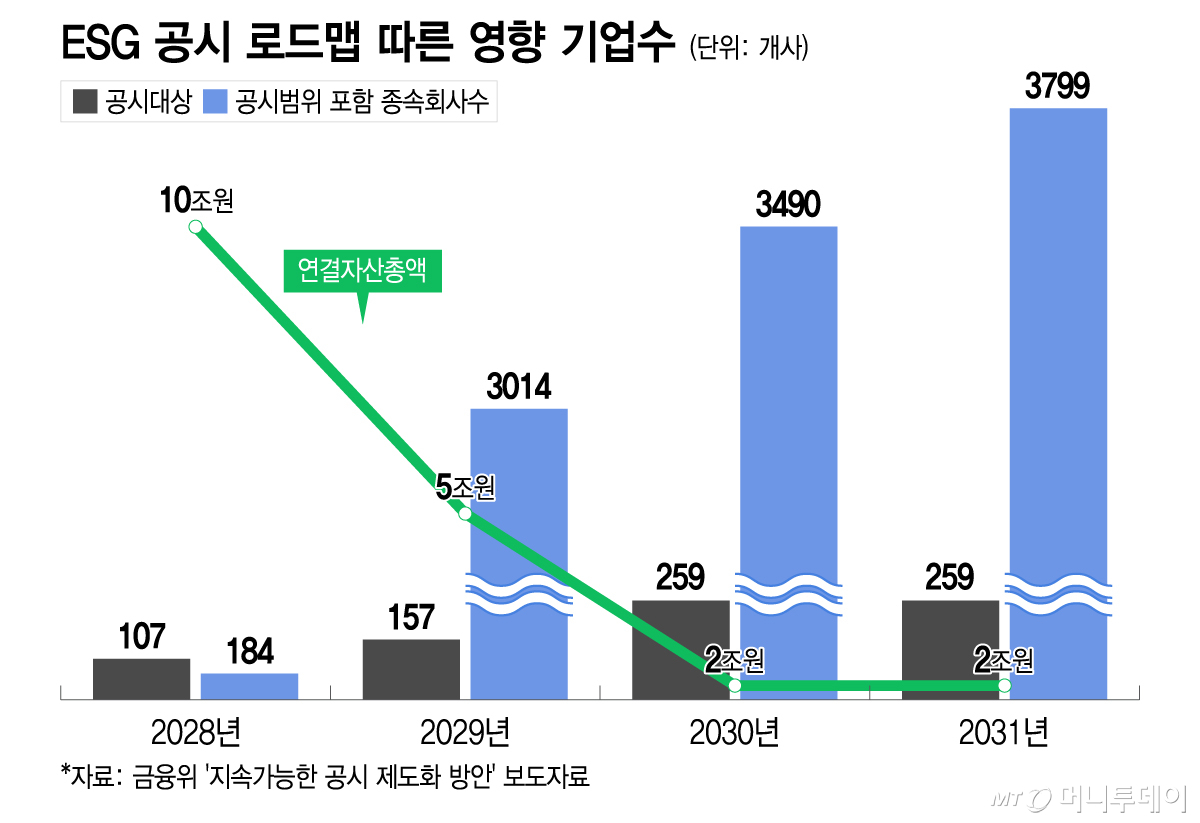
However, uncertainty in the market is growing as the bill has not even cleared the first hurdle of the standing committee’s legislation subcommittee. The situation is particularly marked by 'disclosure uncertainty' for the 291st companies that are required to disclose under the roadmap starting from fiscal year 2027, including 107 KOSPI-listed companies with total consolidated assets of 1 trillion won or more and 184 major subsidiaries. Most of the currently proposed amendments to the Capital Markets Act stipulate that ESG disclosure should be included in business reports rather than separate reports. According to the party-government roadmap, ESG disclosure must begin with the business report to be submitted in March 2028, but there is no finalized plan on what or how to disclose.
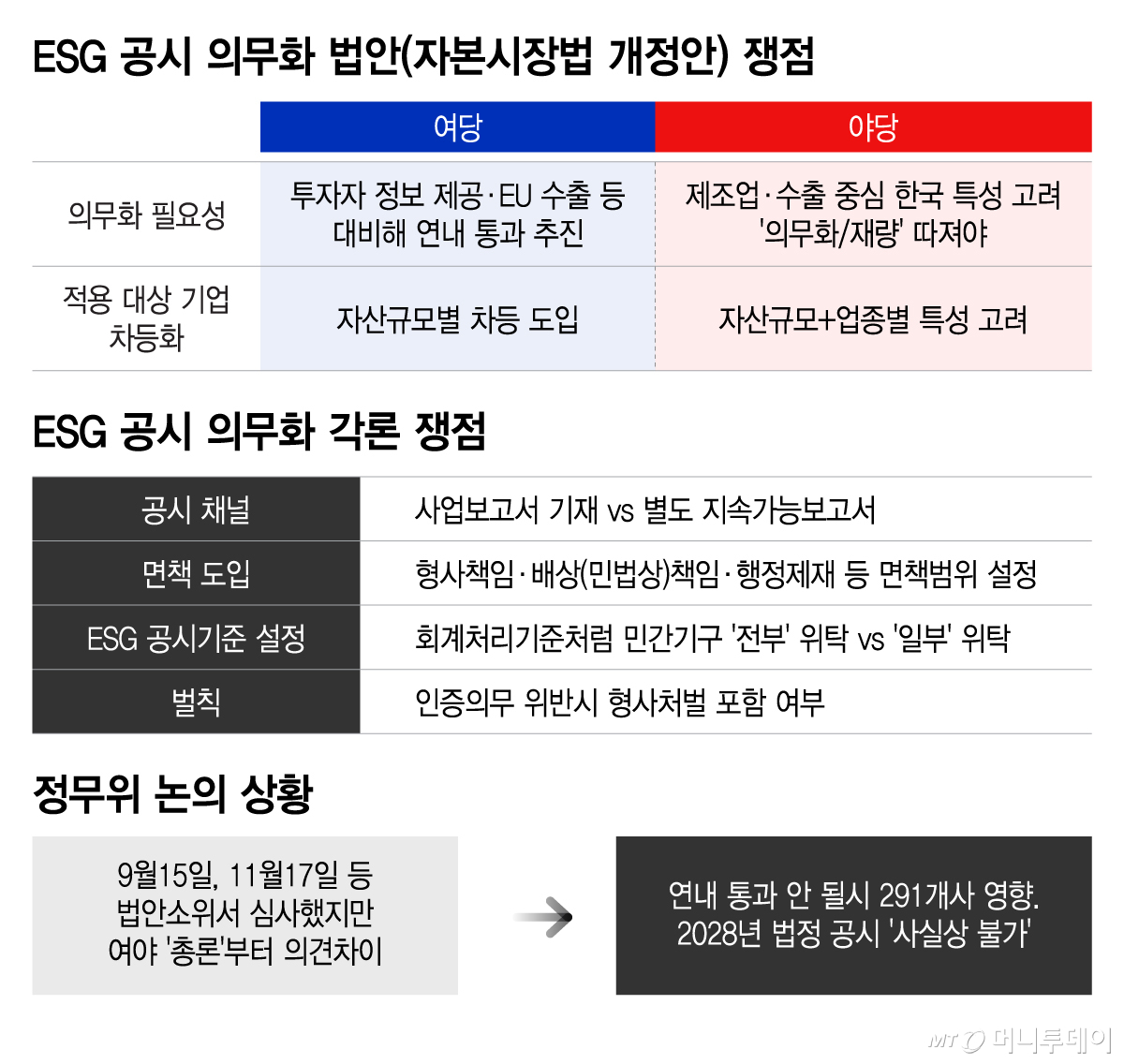
There is a clear temperature difference between the ruling and opposition parties starting from the 'necessity' of why ESG disclosure obligations should be institutionalized. According to the minutes of the Legislation Subcommittee meeting on September 15, members of the People Power Party hold the position that the necessity requires further verification, citing grounds such as fairness across industries and overseas cases. Rep. Cho Jung-hoon of the People Power Party argued, "In three to four years, this would apply obligations to almost all KOSPI-listed companies, so it is right to approach this with sufficient consideration for the corporate environment." Rep. Kim Jae-seop of the same party stated, "The issue of fairness across industries is central regarding ESG," adding, "It should be introduced only after concrete discussions on how to quantify specific indicators have taken place."
Members of the Democratic Party of Korea emphasize the necessity of mandating ESG disclosure. Rep. Park Sang-hyuk, the ruling party’s floor leader in the Committee on Finance, said, "There were also requests from the National Pension Service, the country’s largest pension fund," while Rep. Kim Hyeon-jung of the same party argued, "We are proposing to make it mandatory to resolve the problem that makes it difficult for investors to compare information, as voluntary disclosure varies in scope and standards."
While opinions differ between the ruling and opposition parties even on general principles, specific provisions are more complex. These include: whether to include ESG disclosure in business reports or mandate separate sustainability report disclosure; whether to limit corporate liability exemptions to criminal responsibility or expand them to civil compensation liability and administrative sanctions; and whether to allow the Financial Services Commission to fully delegate the establishment of ESG disclosure standards to private expert institutions. The contents vary across proposed bills, requiring further coordination between the ruling and opposition parties and the government.
In this situation, financial authorities have decided to explain the necessity to the National Assembly as thoroughly as possible to secure passage within the year. A financial authority official stated, "We are preparing all requested materials and providing additional explanations." As this is a party-government consultation proposal, it is known that the ruling party will also expedite discussions and reviews in the legislation subcommittee to achieve passage within the year.

 in STOCK

