

[For more diverse corporate information on startups, visit Unicorn Factory's Big Data Platform Data Lab.]
Alginic acid extracted from brown algae such as kelp and wakame is a key plant-based natural material used across industries—from pharmaceutical capsules to cosmetics, food additives, and industrial coatings. Although South Korea ranks among the world's top three producers of brown algae, paradoxically, domestic alginic acid extraction and manufacturing Gi Ban-eun (EVP)has relied entirely on imported raw materials.
A startup that directly addresses this raw material procurement structure has drawn industry attention. That company is Plantner, which transforms discarded or neglected unused seaweed into high-purity alginic acid and reimagines it as customized materials for various industries.
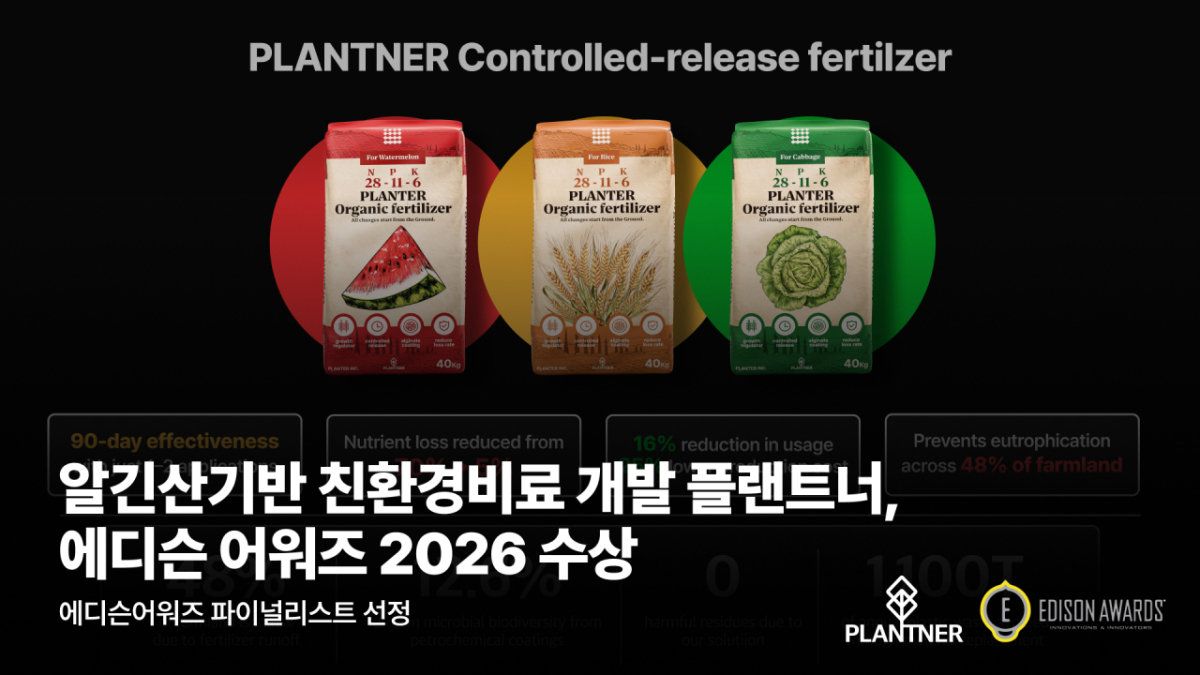
Plantner goes beyond simple extraction and purification by applying advanced technologies such as formulation and polymerization to enhance material properties according to the needs of demand sectors including biotech, medical devices, and beauty. Recognized for its technological prowess and business viability, Plantner has swept major domestic and international awards, including a Silver Award at the 2026 Edison Awards.
Plantner recently succeeded in securing pre-Series A investment. This round was led by Coolidge Corner Ventures, with participation from Impact Square, Hanha Financial Group-Qunesty, Yuhan Kimberly-MYSC, and AI Angel Club-CNTech.
Brown algae once deemed unmanageable except for incineration…Even local governments spend over 10 billion won on disposal costs alone

Lee Hyun-ju, Deputy Managing Director of Coolidge Corner Ventures, which led the investment, highly praised Plantner's business model that starts from discarded resources. "Although South Korea ranks among the world's top three in brown algae production, most is used only for food, and non-edible brown algae had no disposal method other than incineration," she said. "Rural local governments have been spending over 10 billion won annually on incineration costs, causing negative environmental impacts."
She continued, "Plantner uses waste as raw material, securing low-cost inputs while significantly reducing incineration costs and environmental burdens. If the company can implement an eco-friendly process that extracts alginic acid with almost no use of toxic formaldehyde, it could trigger massive changes in a market that has relied 100% on imports."
The turning point for Lee's confidence in the market potential was an interview with a university professor conducting joint research with Plantner. She noted that because alginic acid is entirely imported, domestic demand has become extremely polarized between low-cost and high-priced options.
In reality, the market is split: Chinese products priced around 9,900 won per 100 grams but with low ingredient reliability, versus Norwegian and Japanese products verified for quality but costing up to 24 million won per 100 grams. As a result, research labs are forced to use low-cost products, while companies requiring high quality must bear the burden of expensive imports. The absence of reasonably priced materials in the middle range has effectively blocked market demand.
Lee remarked, "Because reliable quality cannot be obtained at reasonable prices, many users who could utilize more alginic acid end up not using it at all. If domestic production becomes possible with superior quality and price competitiveness, its growth potential will be enormous."
"Business acumen beyond typical early-stage deep-tech companies"

Exceptional business acumen uncommon for early-stage deep-tech firms was another investment highlight. Lee stated, "Even at an early stage, the company focused on reducing initial growth risks by conducting R&D processes with companies in the form of PoC (Proof of Concept). What stood out was that Plantner did not simply wait for raw material purchases but had already secured a fertilizer coating business model capable of generating immediate revenue in the market."
In fact, Plantner has expanded its natural material technology into agriculture, launching an organic fertilizer project for soil improvement in Vietnam. Through a circular agriculture model utilizing unused resources and agricultural/food products from Busan, the company achieved results as a foreign enterprise Choi Cho-ro (수상)at 'TechFest Vietnam', hosted by the Ministry of Science and ICT of Vietnam.
Lee added, "We expect alginic acid exports to Vietnam and local fertilizer production processes in the second half of this year. Short-term KPIs (Key Performance Indicators) will include alginic acid extraction methods and efficiency by brown algae type, as well as export performance or local sales in Vietnam."
With the investment funds, Plantner plans to establish an alginic acid production facility in Yangsan, South Korea, and expand customized improvement research for target industries. Through this, the company aims to accelerate localization and commercialization while gradually advancing into global markets including the United States.
Shin Jeong-woo, CEO of Plantner, emphasized, "We are promoting domestic production of alginic acid based on high-quality Korean seaweed and aim to grow as a material-focused enterprise that drives eco-friendly innovation in the global bio and beauty markets."
[MoneyToday startup media platform 'Unicorn Factory']

 in FUTURE


