

[For more diverse corporate information on the startups featured in this article, please visit the Unicorn Factory big data platform 'Data Lab'.]
Low Earth orbit is rapidly becoming crowded. As launch costs decrease and private sector entry into space accelerates, centered on small satellites, the number of satellites reaching Earth's orbit is increasing swiftly. Consequently, the competitive arena of the space industry is also changing. The new competitive edge now lies not only in how well satellites are manufactured and launched, but in how valuable information can be obtained from satellites once in orbit, how freely they can maneuver, and how long they can be operated.
Accordingly, technologies that enhance the value of satellites in orbit are gaining attention. The related market is expanding rapidly, ranging from high-resolution cameras for precise ground observation to thrusters that move satellites into desired orbits, and on-orbit servicing (OOS) that revives satellites with depleted fuel or malfunctions.
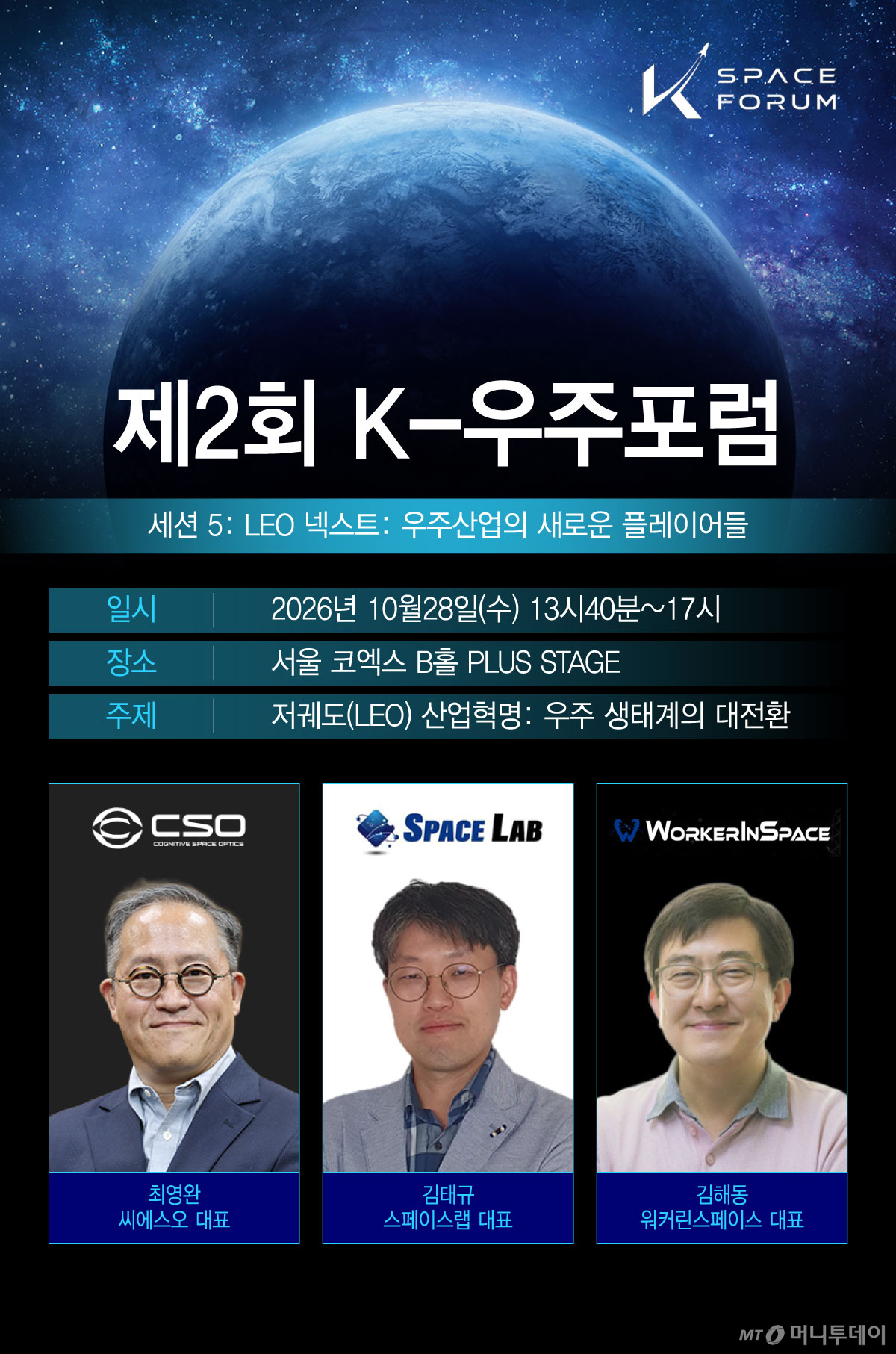
At 'Session 5' of the 2nd K-Space Forum, to be held at Seoul COEX on the 28th, three domestic startups that have taken up the challenge of these industrial changes will stand before space industry stakeholders and investors. The protagonists are CSO, which develops ultra-small high-resolution satellite cameras; Space Lab, which manufactures thrusters, the 'engines' of satellites; and Walkerin Space, which is preparing on-orbit services for repairing and refueling satellites in space.
CSO, the first to take the stage, develops ultra-small high-resolution optical cameras that serve as the 'eyes' of satellites. Its feature is achieving high resolution while reducing size and weight through a 4-mirror optical design based on proprietary patents. The company signed a supply contract for six satellite cameras worth approximately $6 million (approximately 9 billion won) with Ghalam, under the Kazakhstan Space Agency. This marks the second export achievement of satellite optical cameras by a domestic company, following Satrec. CSO also embarked on its first space demonstration of its own camera through the fifth Nuri rocket launch in the third quarter of this year.
Space Lab develops chemical thrusters, which correspond to the 'engines' of artificial satellites. Its core technology is an 'electrically controlled chemical thruster' that decomposes propellant using electricity instead of a catalyst, utilizing its self-developed low-toxicity propellant (fuel). The absence of a catalyst makes it advantageous for future 'on-orbit refueling,' where only the propellant is replenished to continue satellite operations. In next year's sixth Nuri rocket launch, a satellite equipped with the thruster will approach another satellite and capture footage through a proximity maneuver mission, aiming to secure the first 'space heritage.'
Walkerin Space aims to establish a 'satellite maintenance shop' in space. Through its versatile robotic satellite 'VEROS,' equipped with dual-arm robot arms, it is developing on-orbit servicing technology to perform fuel refueling, repair and part replacement, inspection, and orbital towing. Last year, the company became the first domestic private enterprise to build a '3D microgravity simulation ground test facility' that replicates a space-like microgravity environment on Earth, enabling mock tests of on-orbit missions such as satellite maintenance and fuel refueling. The company plans to complete its commercial demonstration satellite, 'VEROS 1,' in 2029 to conduct technology verification in the actual space environment.
The value chain of the space industry, which had focused on manufacturing and launching satellites, is now expanding into observation, orbital maneuvering, and maintenance. CSO, Space Lab, and Walkerin Space are challenging this newly evolved space mission by leveraging the satellite's 'eyes,' 'engine,' and 'maintenance shop,' respectively.

[MoneyToday Startup Media Platform Unicorn Factory]

 in FUTURE

