

[For more diverse corporate information on the startup featured in this article, please visit the Unicorn Factory big data platform 'Data Lab'.]
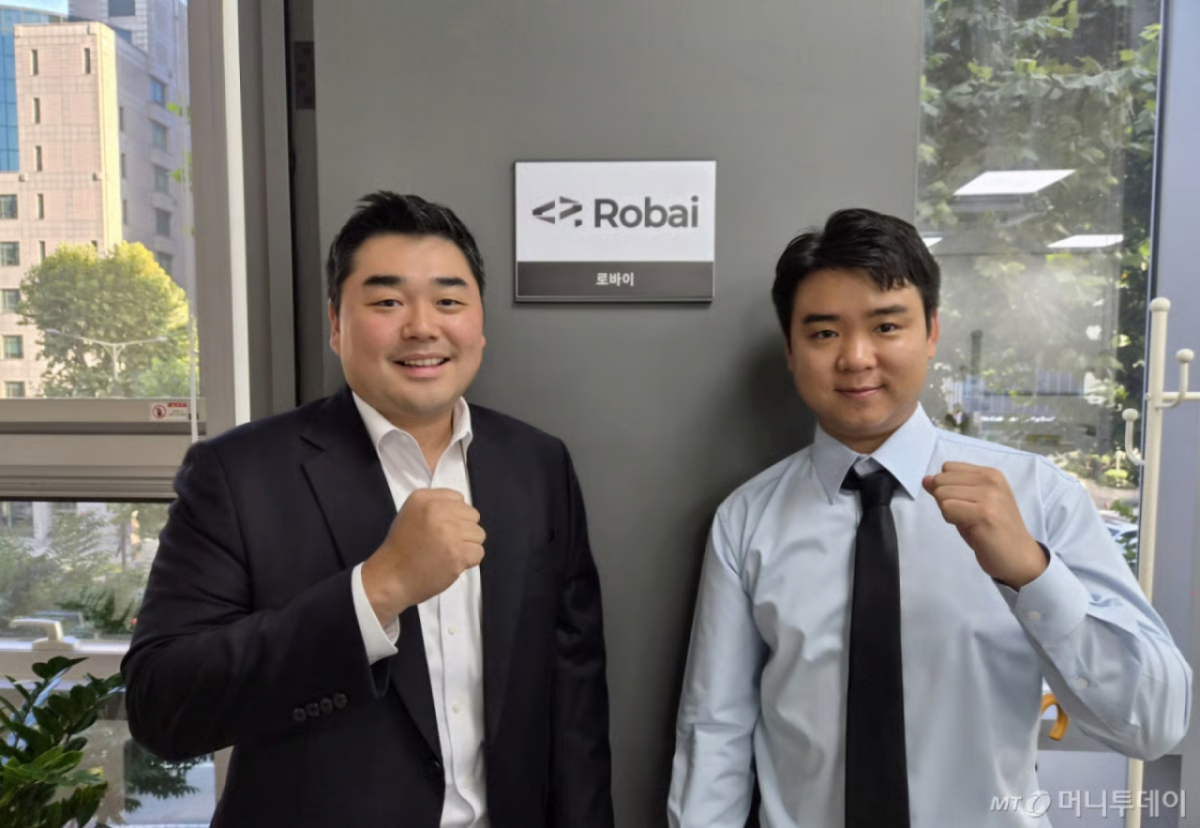
"The biggest bottleneck in moving hardware to the next version is that it requires new control learning. This process typically takes several months to over a year, but we aim to enable AI to learn this autonomously within one week."
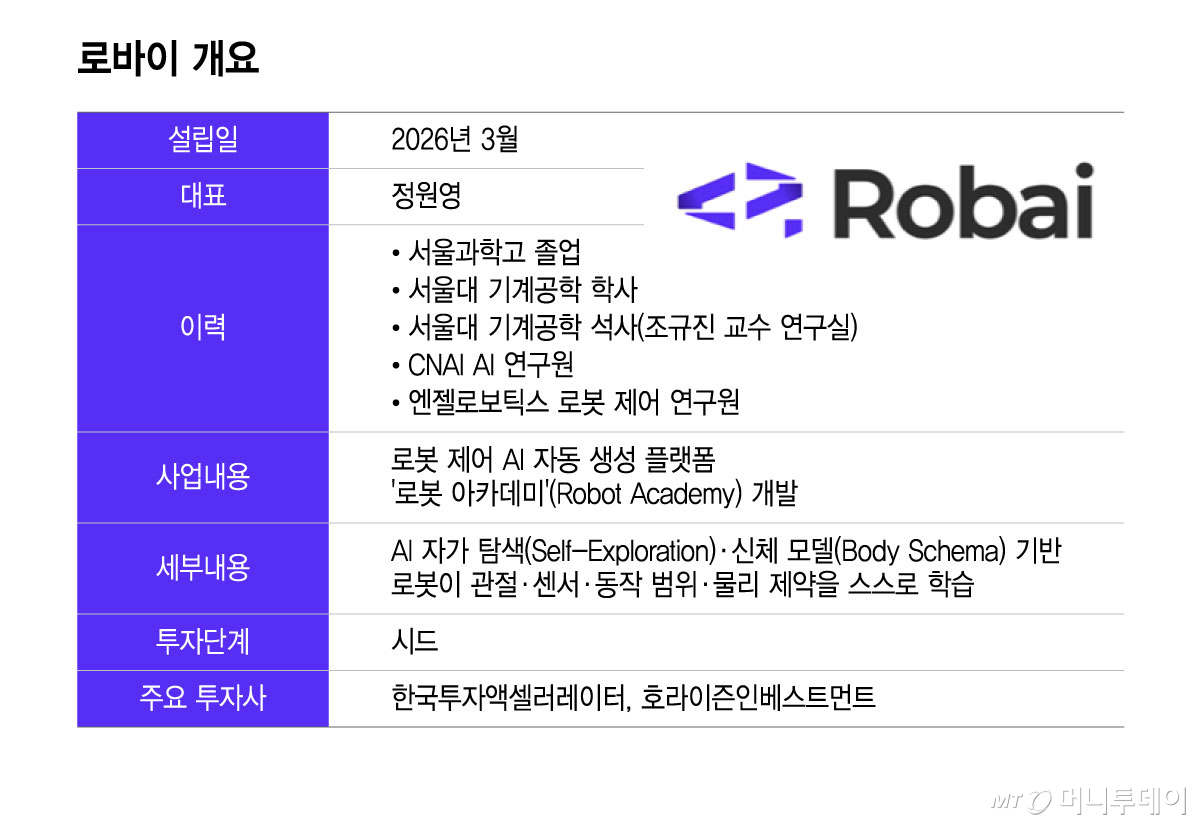
A startup has emerged claiming to solve an industry challenge with technology that allows robots to explore their own bodies and learn movement independently, much like humans. The company is Robai, established in March of this year. Robai recently secured seed investment from Korea Investment Accelerator and Horizon Investment.
MoneyToday's startup media platform, Unicorn Factory, met with Jung Won-young, CEO of Robai, and Shin Chan-ul, Team Leader at Horizon Investment who invested in the company, to discuss the background of the founding and the reasons for the investment.
Jeong (CEO) graduated from Seoul Science High School and completed his bachelor's and master's degrees in mechanical engineering at Seoul National University. He then worked as an AI researcher at CNAI from September 2022. Subsequently, he served as a firmware and robot control researcher at Angel Robotics from October 2024 to January 2026, gaining experience in both hardware and software. Jeong (CEO) explained the background of the founding by stating, "The era of one person per robot is coming soon, so I pondered what problems would be most important in that process and which ones I could solve well."
Automating basic robot control with AI
A core issue Jeong (CEO) noticed in the field is the enormous time and repetitive labor involved in robot control. Developing control software to move a new robot typically takes several months, and the development period becomes even longer as the robot's structure and degrees of freedom (the number of directions joints can move) become more complex. This is because angle values and torque values (the force generated by the motor) must be manually adjusted for each motor, and any slight change in the robot's exterior requires the work to be redone from scratch.
Robai is focusing on automating with AI the area of understanding a robot's hardware and controlling its actual motors and joints. The method involves AI grasping the hardware characteristics of the robot and automatically generating control software tailored to that specific robot. The goal is to reduce the repetitive process of building control software every time a new robot is developed.
Jeong (CEO) stated, "As AI and robotics technologies have evolved separately, low-level control remains an area handled manually by robotics engineers," adding, "Replacing this part with AI is the problem we are trying to solve." This means that instead of engineers mathematically calculating every movement of a robot arm as before, they aim to enable robots to understand their hardware characteristics and control themselves.
The "Robot Academy" (tentative name) currently under development by the team is, in simple terms, a training ground where robots learn how to use their own bodies independently. Just as a newborn baby moves its limbs around to find out how far they can bend, the robot directly turns its motors to determine for itself how far its joints can move and how much force is needed to achieve the desired movement. Learning takes place in a 3D scanning environment that models the robot's shape in three dimensions. Through this, Robai aims to enable AI to understand the robot's hardware characteristics and control its actual motors and joints.
Because robots learn independently, another effect Robai anticipates is that data accumulates as more robots are trained. Jeong (CEO) noted, "Since it is based on self-learning, the entity that trains many robots first can become a 'good academy,'" predicting, "Just like Android operating system (OS) for smartphones, if we standardize in advance the basic control that robot manufacturers have had to repeatedly develop and secure market leadership, the gap in learning speed and quality with latecomers will widen over time."
Robai's primary goal is to complete a minimum viable product (MVP) demo and finish proof of concept (PoC) with customers by mid-January 2027. The company plans to showcase this primarily using multi-joint robot arms (manipulators) commonly used in industrial settings, before expanding to various types of robots.
The main customer groups are system integration (SI) companies that set up robots for specific industrial processes and robot hardware manufacturers. Jeong (CEO) explained, "As SI companies increase the number of robots deployed, revenue rises, but since humans must control them individually, labor costs increase equally," adding, "With our technology, we can significantly reduce labor costs for control while increasing speed, thereby changing this profit structure itself."
Robot hardware manufacturers also have to build new control software every time they develop a new robot. Robai automates this process, greatly shortening the development cycle and enabling the development of more generations of robots within the same period.
Growing physical AI market…Betting on execution capability
Horizon Investment, the venture capital (VC) firm where Team Leader Shin, who invested in Robai, belongs, is a new firm with assets under management of approximately 120 billion won. Team Leader Shin revealed the investment background by stating, "The criteria for judging a good investment are market size, the difficulty of the problem, and the execution capability of the team solving that problem."
He stated, "I judged that the physical AI market is an industry that will have a much greater impact on the world," pointing out, "While the form factors of existing robots are not diverse, in 5 to 10 years, form factors will become much more varied, including companion robots, wearable robots, and industrial robots. The practical bottleneck in current robot development is that engineers must manually readjust torque values and angle values from scratch every time a form factor changes."
Team Leader Shin also gave high marks to the startup team's synergy and execution capability. The fact that Song Jeong-woo, Chief AI Officer (CAIO) in charge of AI, and Lee Seung-hyeok, Chief Infrastructure Officer (CIO) in charge of infrastructure and machine learning, have worked together since their time at CNAI also reinforced the investment decision. Team Leader Shin said, "We judged that if Jeong (CEO)'s robot experience is combined with CAIO Song's AI capabilities and CIO Lee's infrastructure and machine learning capabilities, it would be an organization capable of solving the difficult problems we face."
[MoneyToday startup media platform Unicorn Factory]

 in FUTURE

