

[For more diverse corporate information on the startup featured in this article, visit the Unicorn Factory big data platform ‘DataLab’.]
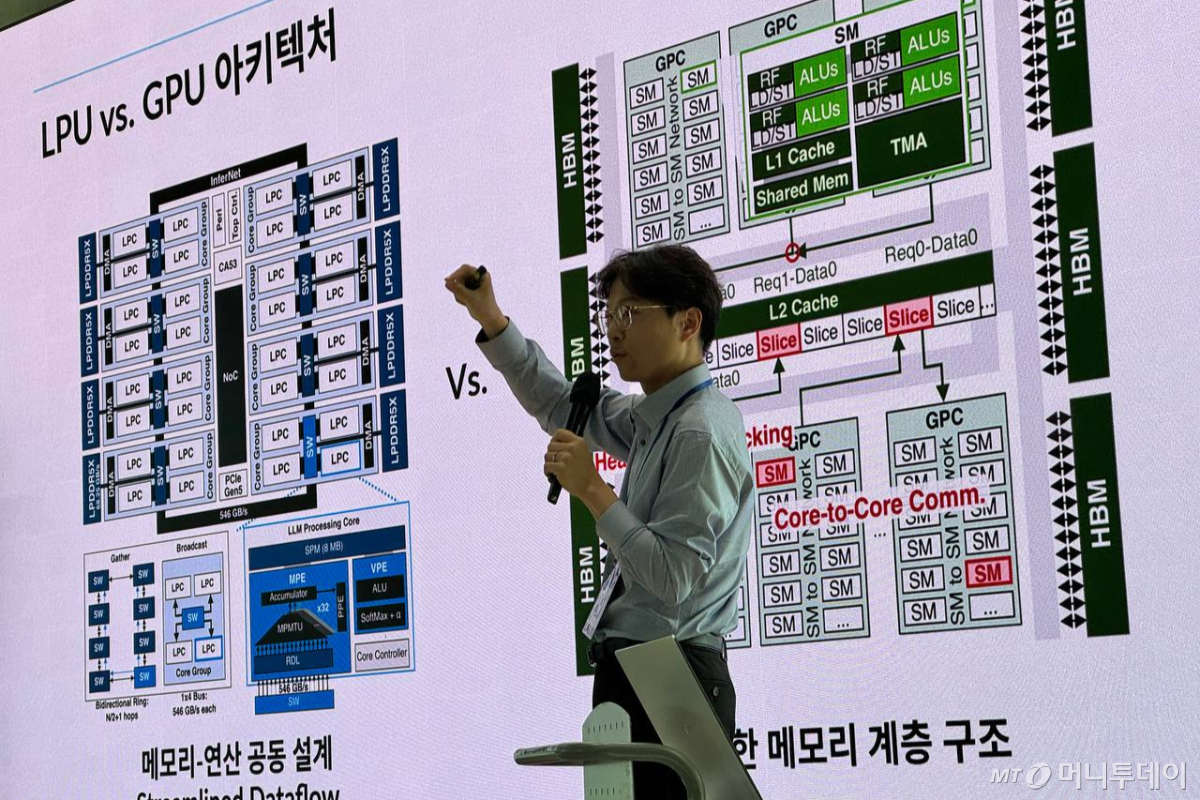
HyperExcel, a fabless semiconductor company specializing in inference for large language models (LLMs), has begun full-scale proof of concept (PoC) testing of its first-generation semiconductor ‘Bertha’ with Naver Cloud. HyperExcel plans to expand the PoC scale to rack units within the year and also conduct PoCs overseas, including in Japan.
Kim Ju-young, CEO of HyperExcel, held the ‘K-Cloud Tech Day’ on the 27th at the Seoul AI Hub in Gangnam-gu, Seoul, and disclosed the status of the ‘K-Cloud Technology Development Project’ conducted with the Institute for Information & Communications Technology Planning & Evaluation (IITP). As a national R&D project involving Rebellions, Fanea, MangoBoost, Rableup, SqueezeBits, Naver Cloud, KAIST, and others, HyperExcel serves as the lead research institution.
CEO Kim stated, “We received Bertha in March this year, performed bring-up (semiconductor operation work), and began server-level PoC testing.” Bertha is an AI semiconductor specialized for LLM inference. It is manufactured at Samsung Electronics’ 4-nanometer factory. Unlike GPUs (graphics processing units) or NPUs (neural network processors) that use HBM (high bandwidth memory), Bertha uses LPDDR (low power DRAM), which is primarily used in smartphones, yet delivers performance comparable to NVIDIA’s mid-to-high-end GPU, the RTX 6000.
Thanks to its LPDDR integration, Bertha’s power consumption is reduced to one-third of that of comparable devices. Because LPDDR itself is inexpensive, the product price is also only one-quarter that of the RTX 6000. The slow speed of LPDDR was overcome through architecture. The company explained that it developed an architecture that streams data in one direction, unlike GPUs that continuously exchange data with memory, thereby achieving fast computation speeds even with slower memory.
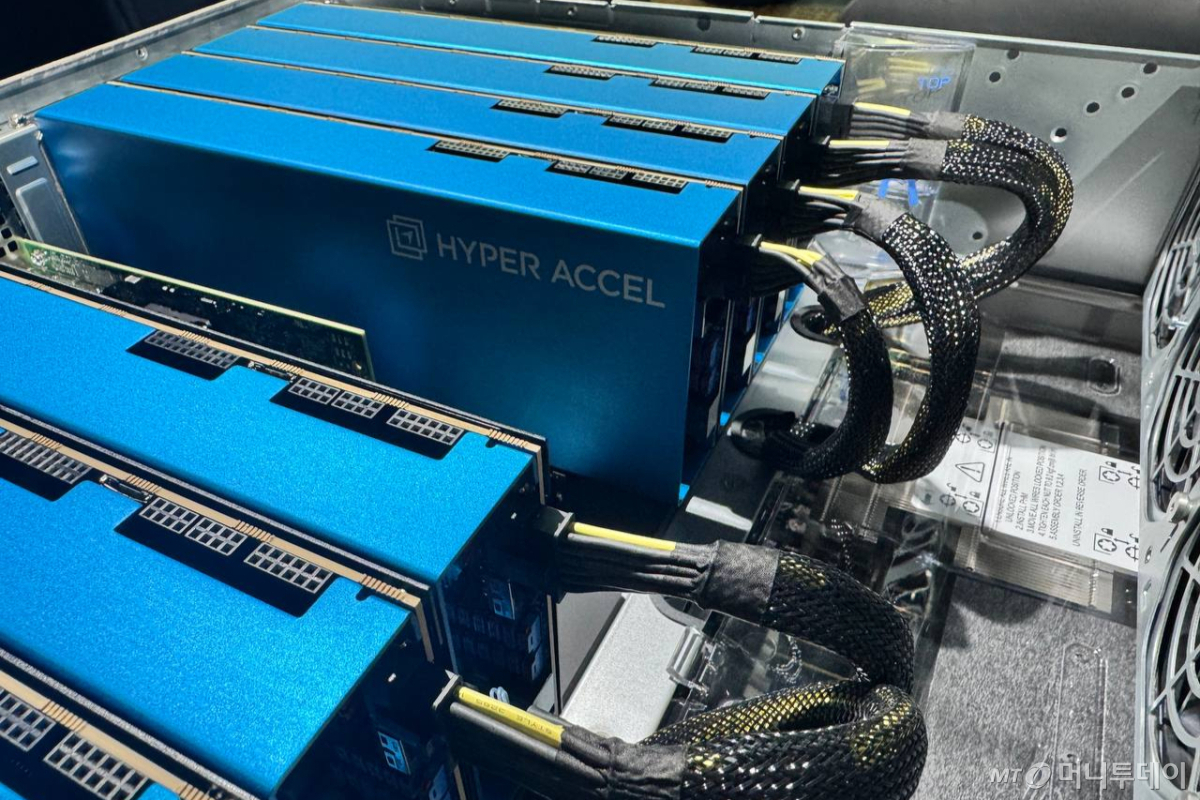
HyperExcel also disclosed measured performance results on the day. When running Alibaba’s ‘Qwen3-32B’ model with four Bertha chips, processing performance was approximately 40% higher than that of the NVIDIA RTX 6000. Performance per watt and performance per dollar were 3.7 times higher, respectively. CEO Kim noted, “The low unit price of the chip makes it possible to configure systems with more cards for the same budget.”
HyperExcel plans to continuously expand its PoC efforts going forward. Recent strategic investment decisions by Krafton and validation tests with a Japanese data center company are also anticipated.
Full-scale PoC testing is also set to begin through the K-Cloud Technology Development Project. Now entering its second year, this R&D project aims to implement ‘composable clusters’ starting next year, integrating technologies and components developed by participating companies into a single server and bundling inference and training AI semiconductors along with CXL (Compute Express Link) memory as separate resources.
CEO Kim said, “Our goal is to combine HyperExcel’s Bertha, Rebellions’ training NPU, Fanea’s CXL memory, MangoBoost’s DPU system, and Rableup’s infrastructure software into a single server for service delivery starting next year,” adding, “We will build K-Cloud infrastructure that effectively consolidates and services all domestic AI semiconductors.”
[MoneyToday Startup Media Platform Unicorn Factory]

 in FUTURE

