

High-margin EV investments, which had stalled amid an EV "chasm (demand slowdown)," are regaining attention due to demand recovery from Europe. With European electric vehicle sales rising by over 40%, domestic parts companies with higher exposure to related revenue saw their second-quarter operating profits also increase.
Electric vehicles place greater importance on thermal management systems compared to internal combustion institutional investor vehicles and feature more high-value components such as electronic braking systems and dedicated tires. Accordingly, domestic parts and tire manufacturers have increased investments in these areas.
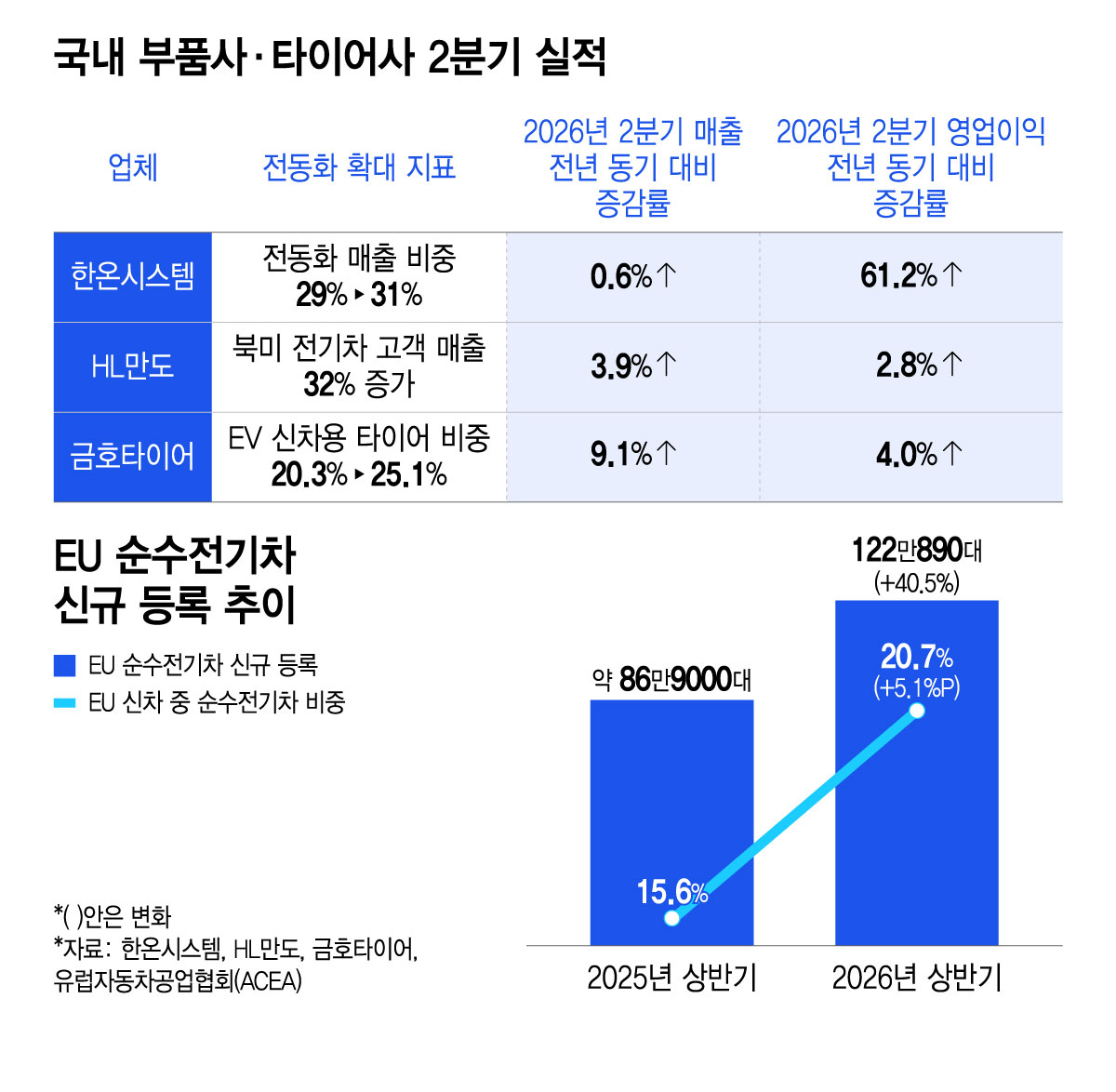
According to the European Automobile Manufacturers Association (ACEA) on the 5th, new registrations of pure electric vehicles in the European Union totaled 1.2289 million units in the first half of this year, a 40.5% increase compared to the same period last year. In June alone, pure EV registrations rose by 60.7%, signaling an increasingly clear recovery trend.
Hanon Systems, which had proactively invested in the EV thermal management sector, emerged as a beneficiary. Hanon Systems' second-quarter revenue reached 2.8752 trillion won, up just 0.6% year-on-year, but its operating profit surged 61.2% to 103.7 billion won.
During the same period, the share of electrification-related revenue rose from 29% to 31%, driven by increased orders for electric vehicles and HYBE-led vehicles from European customers. Unlike internal combustion institutional investor vehicles that can utilize engine waste heat, electric vehicles require efficient management of batteries, motors, power conversion devices, and cabin temperatures separately, resulting in greater complexity in thermal management systems and higher supply value per vehicle. Korea Investment & Securities estimated in 2019 that Hanon Systems' air conditioning system component revenue per vehicle was approximately $400 for internal combustion institutional investor vehicles and $2,000 for electric vehicles.
A Hanon Systems official stated, "We have invested in the more profitable EV thermal management business for a long time, but investment effects were delayed due to the chasm. Recently, as EV sales expanded centered on Europe, the share of high-value products increased, significantly improving profitability," he explained.
HL Mando also benefited from increased orders from EV customers and expansion into high-value electronic components. HL Mando's second-quarter revenue reached 2.4953 trillion won, up 3.9%, while operating profit rose 2.8% to 107 billion won. Sales to North American EV customers increased by 32%, and supply of high-value products such as integrated electronic braking systems (IDB2) and rack-driven electric power steering systems (R-EPS) also grew. Choi Tae-yong, a researcher at DS Investment & Securities, analyzed that "a cost burden of 21.5 billion won due to rising semiconductor and raw material prices was absorbed by improved product mix centered on high-value electronic components."
Hankook Tire, which increased its share of EV tires, continued its upward trend in operating profit. Hankook Tire's second-quarter revenue reached 1.3328 trillion won, up 9.1%, while operating profit rose 4% to 182.2 billion won. Notably, European sales hit a record high for any quarter at 420.9 billion won. Among Hankook Tire's global new vehicle tire revenue, the share of EV tires reached 25.1% in the second quarter, up 4.8 percentage points (p) year-on-year. The share of high-inch tires (18 inches and above) also rose from 43.4% to 47%.
Kumho Tire & Technology, approaching its earnings announcement, raised the share of EV tires in new vehicle tire revenue to 29.6%, up 6.6 percentage points year-on-year. The second-quarter consolidated operating profit consensus estimate (average analyst forecast) compiled by F&N Guide is also expected to increase by 44.9% compared to the same period last year. In fact, returns from EV tire investments are likely to fully materialize in the replacement market rather than the new vehicle market. Due to heavy batteries and high initial acceleration, electric vehicles require shorter tire replacement cycles than internal combustion institutional investor vehicles and demand dedicated technology capable of withstanding both low noise and high load simultaneously, resulting in higher product prices.

 in INDUSTRY
