

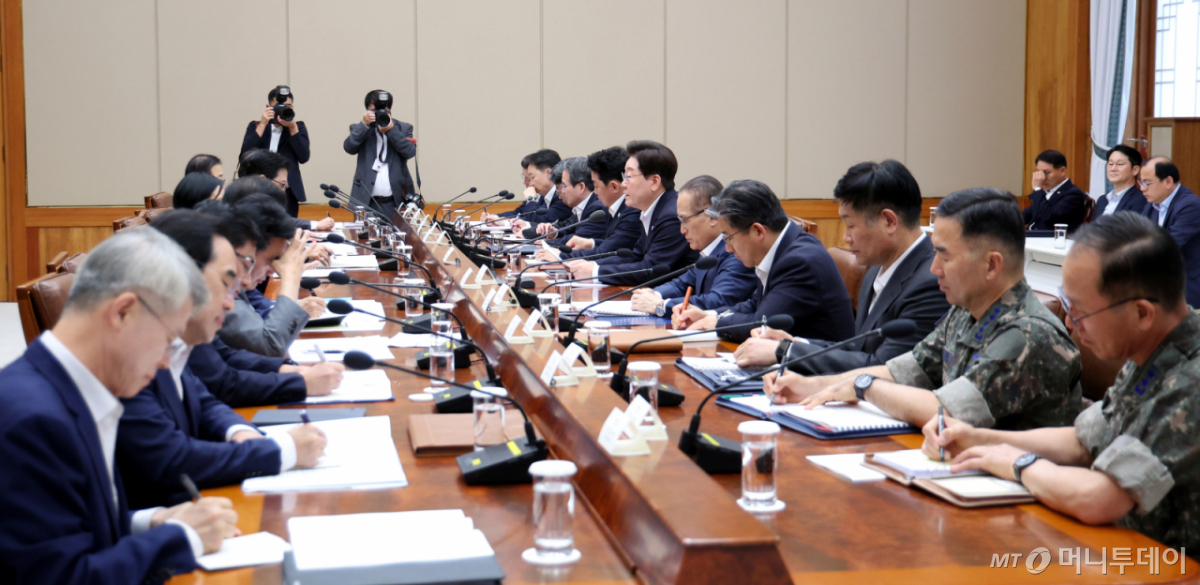
"It is even threatening the identity of the Republic of Korea."
This was not a sharp remark from the political sphere. Ahead of the 2012 general and presidential elections, as both ruling and opposition parties unleashed regulations on large corporations and welfare pledges, the five major economic groups at the time issued a joint statement criticizing populism and calling for it to stop.
South Korea's economic groups, centered around the Federation of Korean Industries (FKI, currently The Korea Economic Daily Association) and the Korea Chamber of Commerce and Industry (KCCI), have consistently voiced the business community's position at key moments. During the Moon Jae-in administration, despite the tense early days of the new government, the Federation of Korean Enterprises (FKE) and the Small and Medium Business Central Council took the lead in opposing the rapid minimum wage hike and the introduction of the 52nd-hour workweek. When the government released a strong carbon neutrality scenario in 2021, economic groups immediately objected.
Just last year, these groups went so far as to hold outdoor protests to block the ruling party's forced passage of the so-called yellow ribbon law (amendments to Articles 2 and 3 of the Trade Union and Labor Relations Adjustment Act). By putting the brakes on the ruling forces' unilateral actions, they signaled that businesses represent at least a different perspective.
However, since this year, statements by economic groups against the government have sharply retreated. In the business community, there is a prevailing view that the KCCI's 'inheritance tax press release' incident in early February became a watershed moment. This occurred after errors were found in the basis used to point out South Korea's excessive tax burden, prompting President Lee Jae-myung to strongly reprimand them. Even on the weekend, President Lee posted related articles on X (formerly Twitter), stating that "spreading fake news deserves condemnation," and directly held them accountable for serious responsibility.
Following this, KCCI executives all submitted their resignations, and the organization underwent a government audit, suffering through a measles-like ordeal. Among business leaders, there was a strong current of viewing this as 'taming.' Although KCCI is a statutory organization established under law, it was highly unusual for the President to personally intervene over inadequate press release preparation by some staff. Regarding this, The Korea Economic Daily Association (The Korea Economic Daily (Hankyung) Association), which has long been hushed due to its 'original sin' of involvement in the state affairs manipulation scandal during the FKI era, was seen as sending a strong warning message to the business community through KCCI. In fact, rebuttals or expressions of regret by economic groups regarding government policies have disappeared. This year, KCCI issued only four official comments and press releases, none of which opposed the government. Among the six official comments released by The Korea Economic Daily (Hankyung) Association this year, it is difficult to find any content critical of the government.
The same applies to the joint statement by the six major economic groups (KCCI, The Korea Economic Daily (Hankyung) Association, Korea Chamber of Commerce and Industry for Foreign Trade, SME Central Council, FKE, and Korean Mid-sized Company Federation). They issued ten statements this year; except for expressing concern last month over the Financial Services Commission's direction to institutionalize sustainability disclosure, all others were predominantly 'welcome.'
Dissatisfaction at the ground level is growing. While economic groups welcome the government's 'three mega-projects,' they do not demand the '52-hour workweek exemption' that businesses urgently claim is needed for these projects. Similarly, while welcoming the new domestic production tax credit, they fail to point out the issue of electric vehicles excluded from it. When the Semiconductor Special Act passed in the National Assembly in January, economic groups only expressed a 'welcome' stance, omitting discussions on the 52nd-hour workweek, which was considered substantive. This time, although the industry could not hide its bewilderment as electric vehicles were excluded from the tax credit target amidst China's rapid market dominance, all six major economic groups unanimously offered only 'welcome.'
An industry official pointed out, "As economic groups watch the government's mood, individual companies must fight each sensitive issue individually, ultimately creating a huge burden." He added, "The government must guarantee the autonomy of economic groups, and economic groups must urgently create a virtuous cycle that vividly conveys voices from the ground."

 in INDUSTRY
