

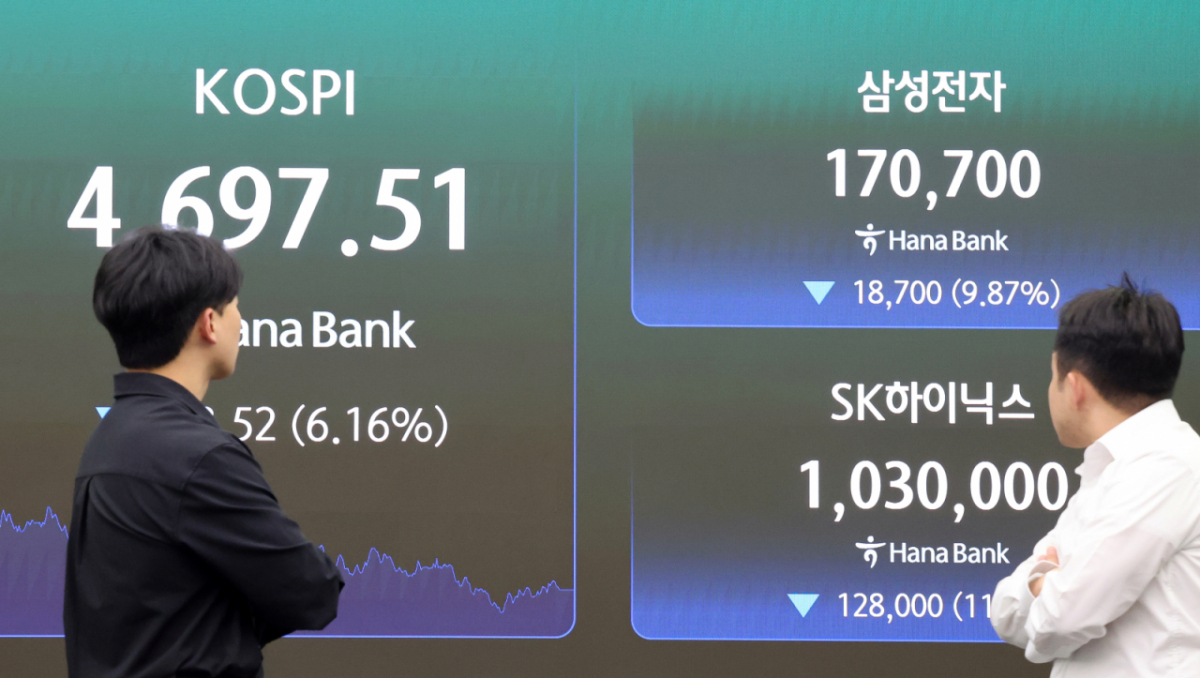
The financial authorities' move to ease the daily limit on share buybacks, introduced as a measure to counter a sharp stock market decline, had little impact on its first day of implementation. SK hynix, which accounts for much of the market impact and remaining buyback capacity, maintained its pace of purchases, while few other major companies followed suit.
According to disclosures by the Korea Exchange and the Financial Supervisory Service on Wednesday, SK hynix bought 350,000 shares on the open market on Monday, worth an estimated 395 billion won. The company maintained the same purchase volume as the previous day, even on the first day of the eased daily limit. The 350,000 shares represented just 23.5 percent of the previous daily limit of 1.492 million shares.
Among the 59th listed companies conducting direct on-market acquisitions, none purchased self-shares in volumes exceeding the existing daily limit. Hanwha Ocean, which began purchases on the 24th (283,000 shares; cumulative 12.1 billion won), also absorbed its volume within the pre-relaxation limit, while Samsung E&A, Meritz Financial Group, and Krafton maintained their existing purchase speeds.
Shinhan Financial Group, with a remaining possible purchase amount of 337 billion won, continued to wait and see without any purchases since the 13th. As of the 24th, the remaining amount for the 185th listed companies (combined direct and trust) conducting share buybacks was 1,464.66 trillion won, of which SK hynix (1,261.76 trillion won) accounted for 86.1%.
Movements to newly jump into share buybacks, leveraging the sharp drop in stock prices and the relaxation of purchase limits, are also scarce. There were only 13 share buyback disclosures on the 23rd and 24th. Apart from Cheil Worldwide (60 billion won) disclosed on the 24th and Hanwha Ocean (24 billion won), which initiated purchases for employee compensation, there were no other large-cap stocks.
This contrasts with March 2020, during the spread of COVID-19. On the first day (March 16) when financial authorities relaxed purchase limits at that time, 26 new disclosures were issued, and over the following three months, the number of listed companies engaging in self-share purchases jumped to 423, a 1.9-fold increase from the previous three months (227).
From the perspective of individual companies, it is pointed out that using share buybacks to shake supply and demand during a period of sharp stock price decline is itself a burden. If stock prices fall despite buying back self-shares due to market conditions, shareholder complaints may actually increase. There are also significant concerns about the potential supply-demand cliff that could follow after completing share buybacks.
As the index decline widens, voices calling for the actual deployment of another measure, the Securities Market Stabilization Fund (Seung-an Fund), are expected to gain momentum in the market. Brokerage analyses focusing on the scale of investment and purchase targets, rather than just whether it will be deployed, are also emerging one after another.
Some suggest that instead of mechanically buying market representative indices like KOSPI 200 as in the past, the Seung-an Fund could purchase stocks included in the Korea Value-Up Program index.
Park Se-yeon, a researcher at Hanwha Investment & Securities, said, "There are precedents such as the Bank of Japan's purchase of JPX-Nikkei400 tracking exchange-traded funds (ETFs) in 2014 and Korea Exchange's formation of Value-Up Program funds in 2024."
Park added, "While balance with deep-liquidity market representative indices and fairness in stock selection are issues, if policy funds buy dividend-paying and share-cancelling companies, it gives companies one more reason to increase shareholder returns."

 in STOCK
