

Samsung, Hanwha, POSCO and other 'future value investment' rights offerings (paid-in capital increases) as a driving force for stock price gains
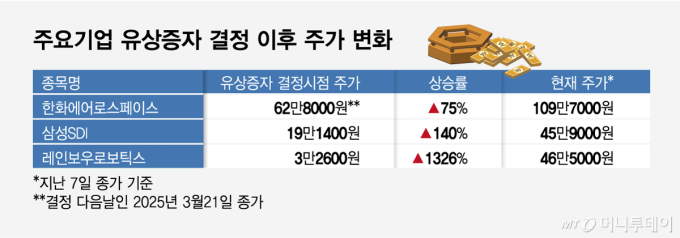
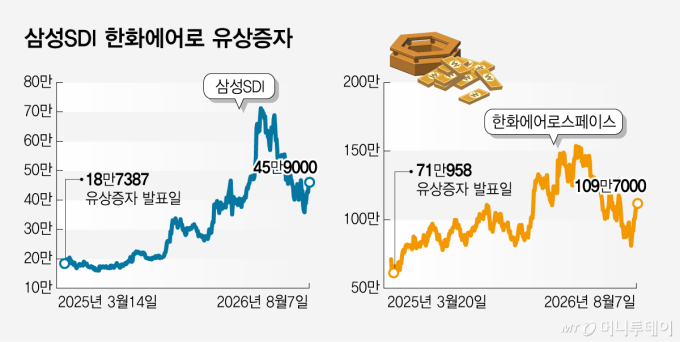
Hanwha Aerospace announced a rights offering (paid-in capital increase) worth approximately 3.6 trillion won after the market closed on March 20 last year. This is the largest amount in the history of the domestic stock market. The backlash was accordingly significant. Shareholders continuously questioned why a company that earned 1.7247 trillion won in 2024 would conduct a large-scale rights offering (paid-in capital increase). The following day, Hanwha Aerospace's stock price plummeted by about 13% to record 628,000 won. Now, approximately one year and five months later, Hanwha Aerospace's stock price stands at the 1st million won level. As of the 7th, the closing price was 1.097 million won. This represents a stock price increase of about 75% compared to immediately after the rights offering (paid-in capital increase) announcement.
While the background of the strong stock performance lies in a global boom in the defense industry, the decision on the rights offering (paid-in capital increase) is also evaluated as having played a certain role. Hanwha Aerospace was able to proceed with the capital increase by refining its plan: reducing the size of the shareholder allocation rights offering (paid-in capital increase) to 2.3 trillion won while simultaneously resolving to conduct a 1.3 trillion won third-party allocation rights offering (paid-in capital increase) involving participants such as Hanwha Energy. The funds raised were to be utilized for △investments in overseas maritime and land defense bases, △investments in next-generation core products such as the Cheonmu multiple rocket launcher, Redback armored vehicles, and air defense systems, which is said to have led to an enhancement of corporate value.
Such cases are not limited to Hanwha Aerospace. Samsung SDI decided on a 2 trillion won rights offering (paid-in capital increase) last year on March 14 for investments in production facilities in the U.S. and Europe and 'dream batteries' such as all-solid-state batteries. This decision was driven by the judgment that bold future investment was necessary even amidst a downturn in the battery industry. The stock price, which was 191,400 won on the day of the rights offering (paid-in capital increase) announcement, rose to 459,000 won as of the 7th. Analysis suggesting that Samsung SDI's bold future business investments will yield even greater results if demand in the battery sector fully recovers gains strength.
In addition, early last year, collaborative robotics company RAINBOW Robotics announced a rights offering (paid-in capital increase) targeting Samsung Electronics, and following the public disclosure, the stock price rose as Samsung Electronics' equity investment and strategic collaboration acted as positive news. POSCO Future M also saw its 2021 1 trillion won rights offering (paid-in capital increase) interpreted as an expression of the POSCO Group's will to strengthen its global battery supply chain, serving as a driving force that boosted stock prices. The company formalized another rights offering (paid-in capital increase) last May and decided to strengthen investments in domestic and overseas cathode materials, among other areas; its stock price, which was in the 120,000 won range, is now showing levels in the 150,000 won range.
This is why there are voices saying that investors have no reason to oppose a rights offering (paid-in capital increase) aimed at investing in future growth businesses to respond to growing markets, rather than having intentions such as repaying existing debts. During periods when fundraising is tightly constrained, a rights offering (paid-in capital increase) can be viewed not merely as a means to put out an urgent fire, but as an opportunity to persuade the market of the company's future vision. A business circle official explained, "A rights offering (paid-in capital increase) for facility investment to secure a clear market share or to attract global strategic investors becomes the most definitive signal proving a company's growth potential to the market. If a transparent fund execution plan and a clear growth vision are in place, a rights offering (paid-in capital increase) will become the optimal card to catch both rabbits of resolving funding shortages and enhancing corporate valuation."
"There is a role for the capital market… shareholder protection must be clear, but growth funds should not be blocked"
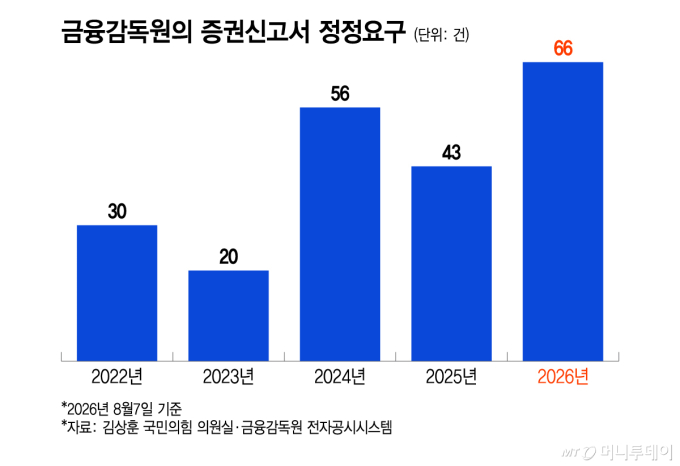
Companies thirsty for funds are worried that their fundraising channels might be blocked by the Financial Authorities' stricter scrutiny of rights offerings (paid-in capital increases). While the market views this as a backlash against past rights offerings (paid-in capital increases) that caused controversies over massive dilution and changes in fund usage, damaging shareholder value, there are concerns that if the perception that 'rights offering (paid-in capital increase)=shareholder value destruction' becomes entrenched, even normal fundraising for growth funds could contract.
◆ "Bad rights offerings must be strictly handled; good ones should be fast"
Companies argue that they should not reject rights offerings (paid-in capital increases) outright due to the possibility of dilution of shareholders' stakes or short-term stock price declines. They emphasize that if the raised funds are invested in facility investments, research and development, supply chain construction, new businesses, mergers and acquisitions (M&A), etc., thereby enhancing corporate valuation, it will ultimately benefit existing shareholders in the long run.
In many cases, what exactly is problematic regarding the Financial Supervisory Service's correction requests for securities registration statements related to rights offerings (paid-in capital increases) and the grounds for such judgments are not sufficiently disclosed to the outside. While the Financial Supervisory Service conveys reasons for improvement to the relevant companies during the correction request process, it does not separately disclose in detail to investors which phrases, risk factors, or fund usage plans were problematic. The market points out that it is difficult for companies pursuing capital increases or investors to predict the authorities' judgment criteria in advance.
If the burden on companies regarding rights offering (paid-in capital increase) scrutiny increases, normal fundraising for growth investment purposes could also be delayed or contracted. In fact, as correction requests continued, some companies saw their capital increase schedules delayed or their plans scaled back or withdrawn. The market also raises concerns that if such delays prolong, investment timing may be missed. Companies are requesting that while they fully disclose fund usage purposes, investment plans, and risk factors, the scrutiny criteria should be made clearer so that the market and investors can judge the business's success potential and the necessity of the capital increase itself.
A business circle official stated, "Rather than pitting shareholder protection against corporate fundraising, we must enhance the transparency and predictability of scrutiny criteria and correction request reasons to strictly filter out flawed rights offerings (paid-in capital increases) while allowing those for growth investment to proceed swiftly. Bad rights offerings must be scrutinized strictly, but good ones should be allowed to move quickly."
Amidst the trend of amending the Commercial Act to introduce directors' duty of loyalty to shareholders and strengthening protection for minority shareholders, the financial authorities maintain that companies must sufficiently explain fundraising purposes, usage, and risk factors to investors.
A Financial Supervisory Service official said, "We are looking into whether sufficient information has been provided for investors to make investment decisions, such as why a rights offering (paid-in capital increase) is necessary now, where the raised funds will be used, and what the investment risks are. It is not that the authorities intend to decide which companies should or should not conduct a rights offering (paid-in capital increase)." Regarding the non-disclosure of correction reasons to investors, the official added, "Since the corrected registration statement is the result of discussions between the supervising institutional investor and the supervised institutional investor, the correction reasons are not matters for public disclosure."
◆ U.S. and Japan: Broadly open paths for corporate fundraising while protecting shareholders
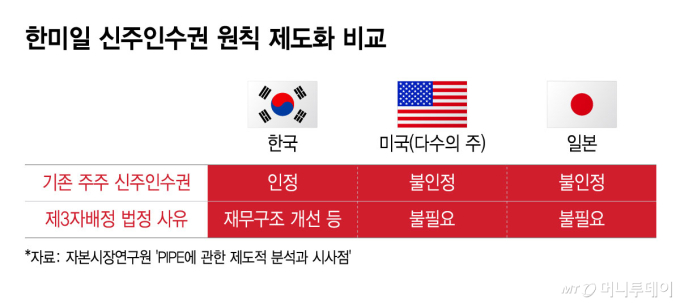
Not only general companies but also capital market participants emphasize that institutional maintenance is needed to ensure smoother corporate fundraising, going beyond the controversy over the Financial Authorities' strengthened scrutiny of rights offerings (paid-in capital increases). The suggestion is that a system design similar to those in the U.S. and Japan, which broadly opens channels for corporate growth fund raising while clearly blocking damage to existing shareholder value based on clear criteria, is needed for the domestic capital market.
The U.S. utilizes various fundraising methods such as ATM (At-the-Market Offering) and PIPE (Private Investment in Public Equity), allowing companies to flexibly choose the timing, scale, and investors of fundraising according to market conditions and funding needs.
ATM allows a company to sell shares at the current market price through securities firms while monitoring market conditions within a pre-set issuance limit, making it advantageous for dispersing market impact compared to issuing large volumes at once and raising funds as needed at necessary times. PIPE involves a company negotiating with specific investors such as institutional investors on issuance price, scale, and conditions to privately issue stocks or equity-linked securities. It enables faster and more flexible fundraising compared to public offerings.
While Korea has a third-party allocation rights offering (paid-in capital increase) similar to PIPE, its utilization requirements are more limited than in the U.S. because the Commercial Act requires a basis in the company's articles of incorporation and necessity for achieving the company's business purposes. A fundraising method that issues shares frequently according to market conditions, like the U.S.-style ATM, is also not a common means for domestic companies.
Japan strengthens shareholder protection procedures for large-scale third-party allocations based on relatively clear criteria such as issuance price, dilution rate, and changes in controlling shareholders. The Tokyo Stock Exchange requires that if dilution exceeds 25% through a third-party allocation or if the controlling shareholder changes, opinions on the necessity and appropriateness of the issuance be obtained from independent third parties or shareholder intent be confirmed through general meetings of shareholders. Japan's Commercial Act also regulates 'favorable issuance,' requiring special resolutions at general meetings of shareholders and explanations by directors if new shares are issued to specific investors at particularly favorable prices. In other words, rather than uniformly restricting corporate fundraising itself, this approach applies clear procedures when the possibility of damaging shareholder value exceeds a certain level.
A financial investment industry official stated, "We also need to broaden companies' fundraising options like in the U.S., and establish clear quantitative criteria and shareholder protection procedures at points where the possibility of damaging shareholder value increases, as in Japan. Rather than having the authorities broadly judge the necessity and appropriateness of individual capital increases, they should create rules that the market can predict and allow companies and shareholders to make judgments within those rules."

 in INDUSTRY


