

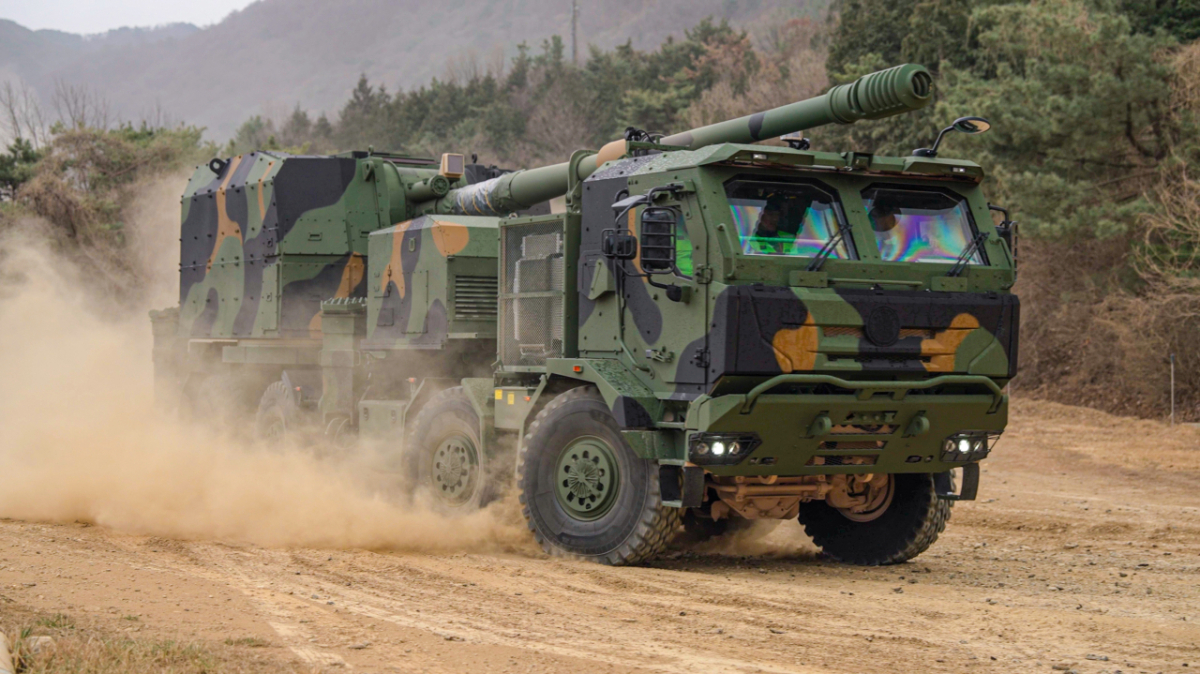
Hanwha Aerospace has taken its first step into the U.S. defense market with the K9 wheeled self-propelled howitzer (K9MH). The initial phase involves supplying six prototype units, but if the U.S. Army completes a four-year evaluation period, the project could expand to include up to 500 units and reach a contract value of around 10 trillion won. This deal is seen as Hanwha's "first major win" in the world's largest defense market, the United States.
According to industry sources on the 18th, Hanwha Defense USA, the U.S. subsidiary of Hanwha Aerospace, was selected as the developer and supplier for the Mobile Tactical Cannon (MTC) prototype project. The initial contract covers the supply of six K9 wheeled self-propelled howitzer prototypes worth 141.7 billion won, with an option to add 12 more units in the future. If a total of 18 units are delivered, the contract value could rise to approximately 371.5 billion won (262.903274 million U.S. dollars).
Hanwha's immediate goal is to finalize a definitive contract four years from now. The U.S. Army will operate the K9MH during this period, evaluating its performance, reliability, compatibility with domestic ammunition, and local production capabilities. Following these tests, decisions on operational deployment and the scale of production at the Yangsan facility will be made. Hanwha's K9MH was selected as the prototype supplier after outperforming formidable global defense companies such as Germany's LINE Mettal and the UK's BAE Systems, raising expectations for securing the definitive contract.
The U.S. market holds symbolic significance for Hanwha, as it has remained a barrier that the K9 could not penetrate until now. While Hanwha has previously expanded its K9 supply markets to Europe, Asia-Pacific, and the Middle East, this marks the first time the company has entered the U.S. Army's next-generation weapon system program. Seventy-six years after South Korea received artillery support from the United States during the 1950 Korean War, it is now providing support for U.S. artillery modernization and defense industry reconstruction.
This contract also represents a breakthrough nine years after Hanwha began targeting the U.S. market, starting with the largest land-based defense exhibition in North America (AUSA) in 2017. At that time, Hanwha directly transported full-scale K9 units weighing dozens of tons and non-composite armored vehicles to the U.S. exhibition site. Since then, the company established a subsidiary in Washington D.C., recruited former commanders of U.S. Forces Korea, former U.S. government officials, and personnel from global defense firms to build its local business foundation.
The group's commitment to nurturing the defense industry across two generations, led by Kim Seung-yeon (Chairman) and Executive Vice Chairman Kim Dong-kwan, has further supported this effort. Kim (Chairman) has consistently promoted defense as an industry directly linked to national security and a global export sector. A notable example occurred during the early 2000s when developing the Cheonmu system; despite concerns over sunk costs, he encouraged development by stating, "It's okay if we fail," and emphasizing that "the technology developed for self-reliant defense will remain with us." Additionally, long-standing networks built with former U.S. Presidents Bill Clinton and George W. Bush, as well as Edwin Pulner, founder of the Heritage Foundation, have bolstered efforts to expand business in the United States.
Executive Vice Chairman Kim translated this vision into concrete business strategies. Most notably, he led the 2014 acquisition of Samsung Techwin and Doosan DST, followed by a merger with Hanwha's defense division, laying the foundation for today's Hanwha Aerospace. He also quickly identified shifting demands from the U.S. Army for self-propelled howitzers, driving the development of the wheeled K9 and local investments in the United States, which ultimately led to this contract. Proactive investments, including the successive recruitment of talent from global defense companies, have proven effective in targeting the U.S. market.
A Hanwha executive emphasized, "The two-generation commitment to nurturing the defense industry, combined with our global network and meticulous strategic leadership, has created a foundation for simultaneously achieving self-propelled howitzer exports to the U.S. and naval vessel projects."

 in INDUSTRY
