

Domestic display companies are stepping up efforts to solidify their "super-distance" lead with next-generation technologies. From new technologies that transcend the limits of OLED manufacturing processes to panels that improve foldable weaknesses, they are adopting a strategy to counter China's pursuit through technological gaps.
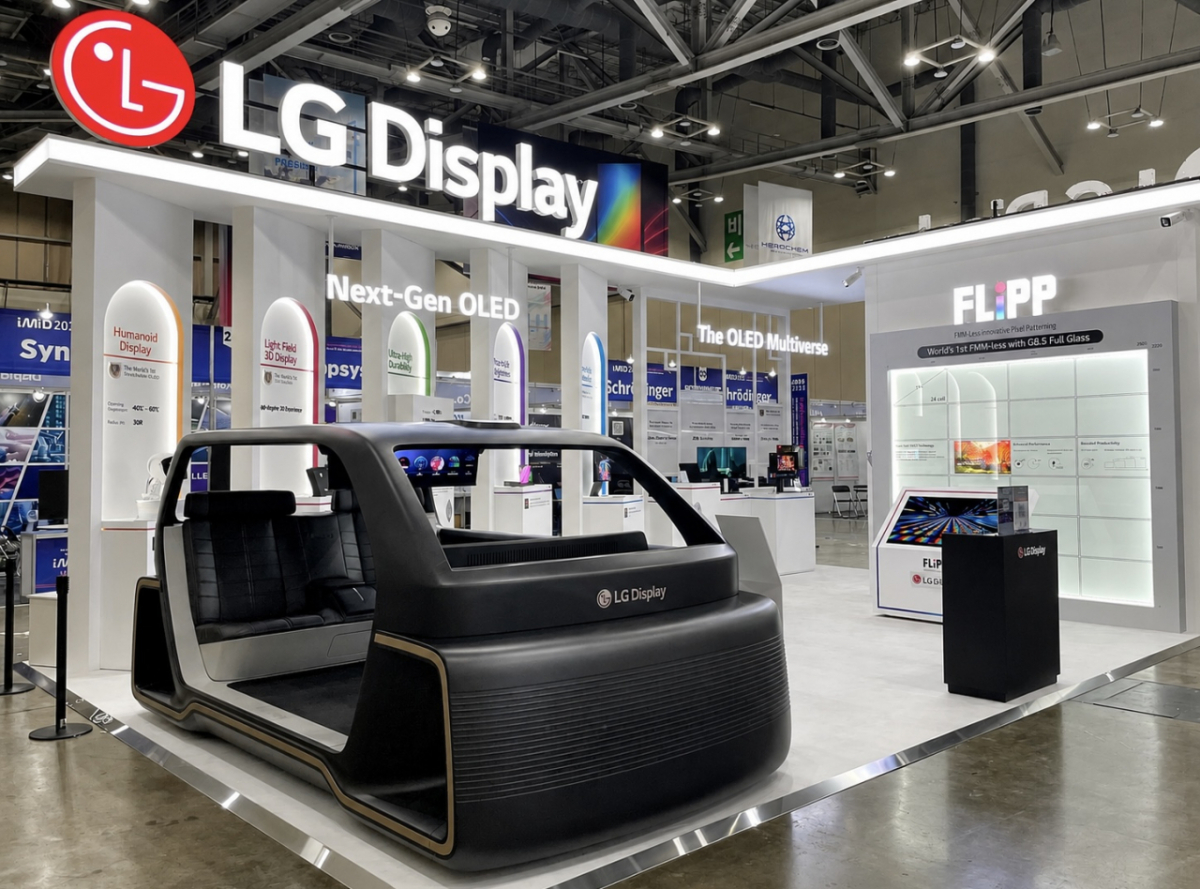
According to the electronics industry on the 19th, LG Display and Samsung Display participated in the 26th International Information Display Conference (IMID 2026) held at Busan BEXCO, showcasing next-generation OLED technologies and more. IMID is Korea's largest display academic conference.
First, LG Display unveiled its self-developed next-generation OLED patterning technology, "FLiPP," for the first time in the world. Generally, in OLED manufacturing, a thin metal plate called FMM (Fine Metal Mask) with tiny holes punched on top of the substrate is closely attached, and red, green, and blue organic materials are sequentially deposited into the holes to form pixels. However, since high-cost FMMs must be manufactured separately depending on display size and resolution, there are limitations such as significant cost burdens and potential defects due to errors in hole positioning.
LG Display independently developed "Flip," which forms OLED pixels without using FMM by applying photolithography processes used in semiconductor production. The method involves sequentially coating and fixing red, green, and blue pixels across the entire substrate, then precisely removing unnecessary parts using UV (ultraviolet) light. By eliminating FMM, the company reduced the possibility of defects while also reducing the space previously occupied by FMM between pixels, increasing the aperture ratio (the area actually covered by light-emitting pixels) by approximately 55% compared to before. This has resulted in effects such as a 1.6-fold improvement in brightness, a 2.4-fold increase in lifespan, and a 13% reduction in power consumption.
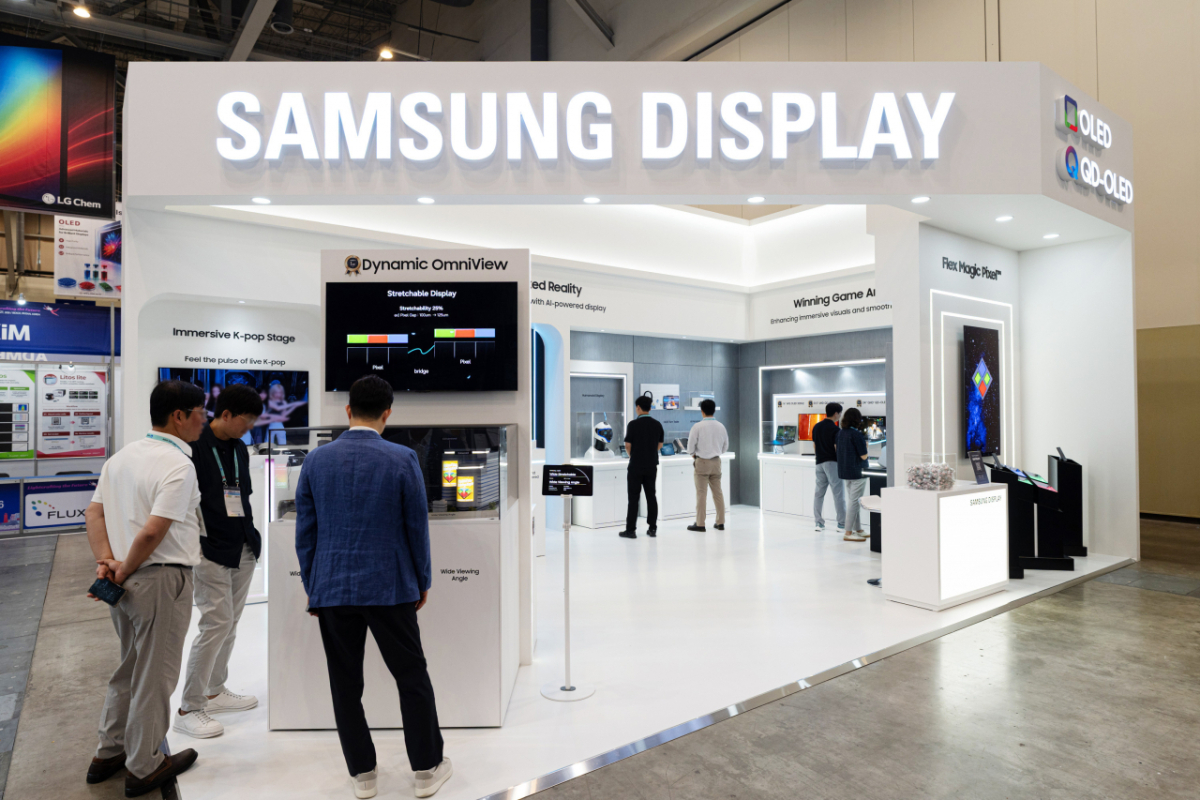
Samsung Display unveiled next-generation OLED technologies that transcend limitations in screen size, shape, and viewing angle. It introduced "Wide View," which improves the viewing angle of foldable displays, and for the first time revealed the world's largest (20-inch) stretchable display called "Wide Stretchable."
Currently commercialized foldable displays have a structural limitation where brightness on both sides of the central folding area is reduced to about 40% compared to the front view. "Wide View" completely redesigned the materials and structure of new organic light-emitting layers, minimizing brightness degradation even when viewing the curved part of the screen from the front, thereby achieving bright and uniform display quality.
"Wide Stretchable" applied tiling technology that connects two existing stretchable displays as if they were a single screen, increasing the screen size by more than twice compared to previous products. The two panels operate naturally as one display.
On this day, Lee Cheong, Chairman of Samsung Display, met with reporters and stated, "Construction has begun on the Asan Site 2 (A7 LINE)," naming flexible and foldable panels as priority production products. He added, "We will prepare to ensure production capacity is not lacking while monitoring market conditions."

 in INDUSTRY

