

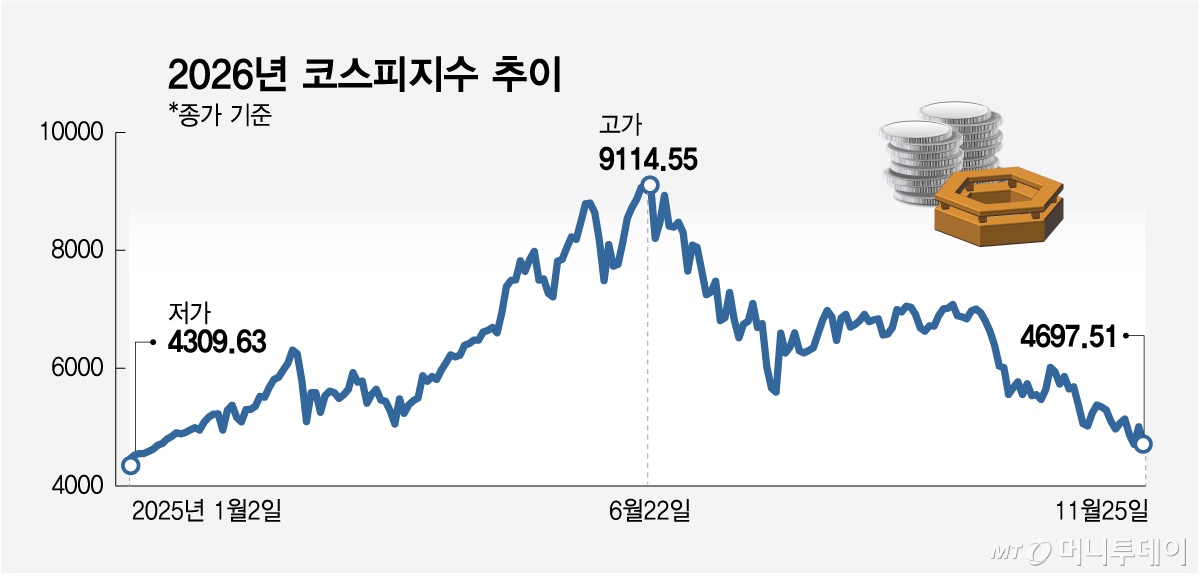
The KOSPI has reversed most of its year-to-date gains, returning to levels seen at the start of the year. Just one day after AI (artificial intelligence) investment sentiment briefly recovered on news of NVIDIA CEO Jensen Huang's return, the index plunged more than 6%, dropping to the 4,600 range for the first time in 212 trading days. Concerns over the memory industry outlook intensified following a downgrade of Micron's investment rating, compounded by uncertainty surrounding additional U.S. tariffs.
On Nov. 25, the KOSPI closed at 4,697.51, down 308.52 points (6.16%) from the previous trading day. This marked the first time since January 13 (4,692.64) that the KOSPI closing price fell within the 4,600 range. The closing price on this day was 48.46% lower than the peak closing price of 9,114.55 recorded on June 22. During intraday trading, the index slipped to 4,672.55, representing a 50.22% decline from the year's intraday high of 9,385.59 set on June 19.
BNP Paribas downgraded its investment rating for Micron, a leading U.S. memory semiconductor company, on the 24th (local time), citing that delays in data center investments could accelerate the timing of price declines for DRAM and NAND average selling prices. Micron's stock price, often regarded as a barometer for the memory semiconductor industry, fell 10.97% on the same day (local time).
Expectations that memory prices could turn downward earlier than anticipated led Samsung Electronics and SK hynix, ranked first and second in market capitalization, to drive the index decline. Samsung Electronics closed at 170,700 won, down 18,700 won (9.87%) from the previous trading day, while SK hynix closed at 1,030,000 won, a drop of 128,000 won (11.05%). Samsung Electronics' stock price fell to 170,000 won intraday, and its market capitalization based on the closing price dropped below 1,000 trillion won for the first time since February 4. SK hynix also approached the 1st million won mark for the first time since April 13.
News that the U.S. Trade Representative (USTR) could impose additional tariffs also weighed on the stock market. The Wall Street Journal (WSJ) reported on the 24th that the United States may release the results of its Section 301 trade law investigation into overproduction by 16 trading partners, including South Korea, along with a proposal for additional tariffs, within this week. Currently, some Korean products are subject to a combined tariff rate of 12.5%, comprising base tariffs and Section 301 tariffs related to forced labor.
Lee Kyung-min, head of the FICC Research Department at Daishin Securities, said that "amid discussions that existing trade agreement-based 15% tariff rates may be applied to South Korea, Japan, and the European Union (EU), tariff uncertainty itself is acting as a downward pressure on the stock market amid unstable investment sentiment."
According to the Korea Exchange, KOSPI regular session trading volume on this day was 1,453.67 trillion won, a 7.8% decrease from the previous trading day. This figure fell short of half of the year's daily average trading volume (310 trillion won) and was also lower than the November daily average trading volume (177.876 trillion won) calculated up to this date.
Even on the 24th, when the KOSPI surged 6.32%, trading volume decreased by 1.8% from the previous day. Although the index rose sharply, it remained unclear whether follow-up buying would continue; consequently, when foreign investors turned to net selling the next day, the KOSPI gave back all of its previous day's gains.
Jung Hee-chan, a researcher at Samsung Futures, pointed out that "KOSPI trading volume has again approached the year-to-date low recorded on the 17th, just before NVIDIA's earnings release," adding that "it is necessary to keep in mind that the rise occurred without accompanying trading volume."
Estimates regarding potential further declines are also emerging.
Lee Jae-man, a researcher at Hana Securities, noted that "while Samsung Electronics and SK hynix account for 49% of the market capitalization, causing their stock price drops to amplify index volatility," he estimated that "if we assume the KOSPI's trailing PBR (price-to-book ratio) falls to levels seen in August last year, before semiconductor stocks gained prominence, the lower bound of the index would be around 4,300."

 in STOCK
