

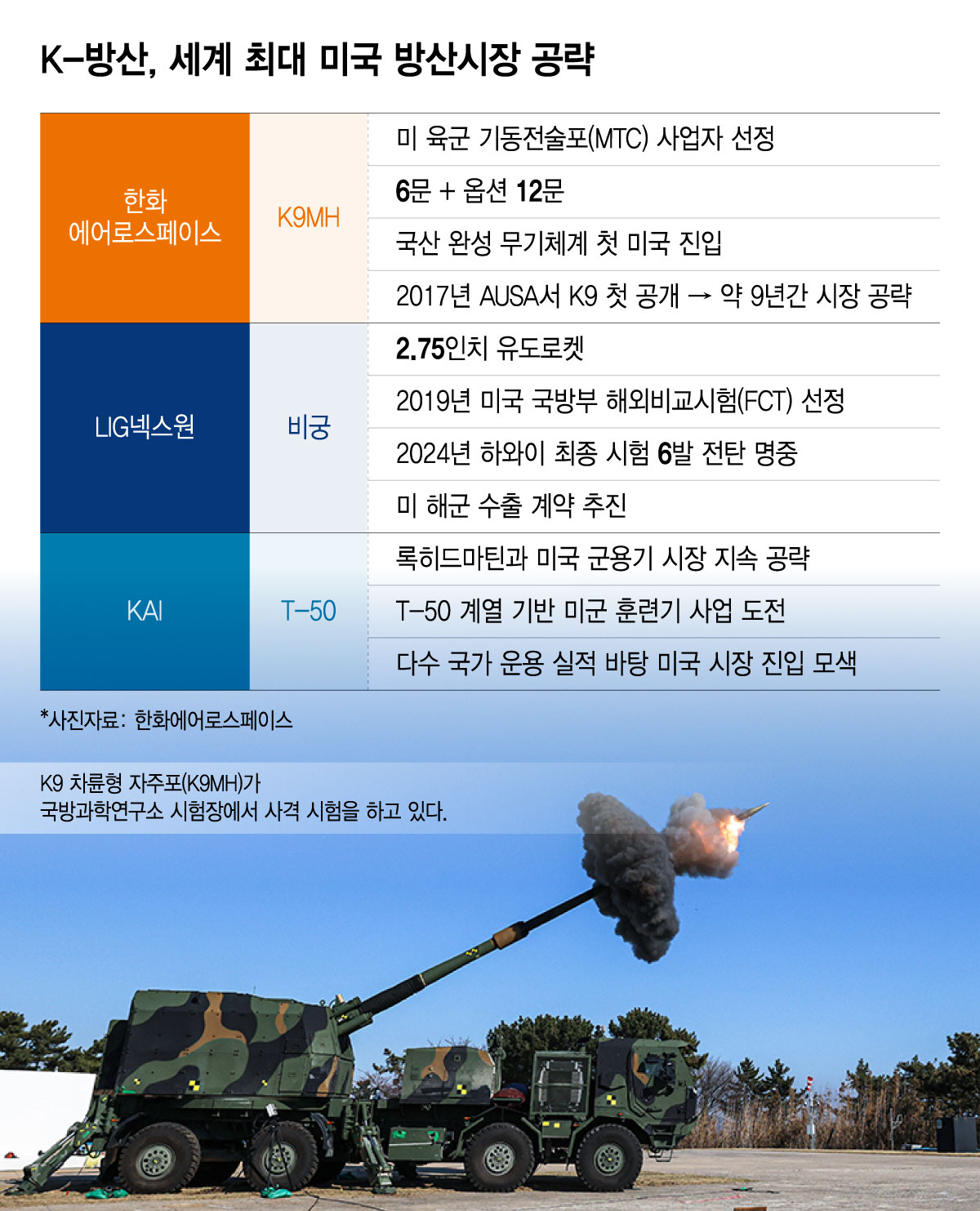
With Hanwha Aerospace leading the way as the first domestic weapon system to successfully enter the United States—the world's largest defense market—using its wheeled K9 self-propelled howitzer (K9MH), other K-defense companies such as LIG Defense & Aerospace (LIG D&A) and Korea Aerospace Industries (KAI) are accelerating efforts to build on this success.
According to the defense industry on the 22nd, Hanwha Defense USA, the U.S. subsidiary of Hanwha Aerospace, was recently selected as a developer and supplier of prototypes for the U.S. Army's Mobile Tactical Cannon (MTC) program. This allows for the initial delivery of six K9MH prototypes, with an additional 12 units to be supplied in the future. It marks the first time a domestic company has entered the U.S. market with a fully developed weapon system, despite the United States having the world's largest defense budget and hosting global defense giants like Lockheed Martin and RTX.
Hanwha spent nearly nine years and immense effort to open the door to the U.S. market. While K9 exports began in 2001 with Turkey and later expanded to Poland, India, Finland, Norway, Estonia, Australia, Egypt, and Romania—totaling nine countries—the U.S. threshold remained high. After first showcasing a full-scale K9 at the annual exhibition of the Association of the United States Army (AUSA) in October 2017, Hanwha has nearly every year transported equipment from Korea to the U.S. to persuade the U.S. Army.
Hanwha has also consistently demonstrated compatibility with U.S. ammunition. In 2022, at the U.S. Yuma Proving Ground, it confirmed compatibility with various American shells such as the M795 using the K9. At that time, it became the first foreign equipment to fire the U.S.-made XM1113 rocket-assisted projectile, achieving a range of 53 kilometers. In April 2024, it successfully fired the U.S.-made Excalibur precision-guided shell from approximately 50 kilometers away.
An opportunity arose as the U.S. Army shifted its focus toward rapidly acquiring proven self-propelled howitzers rather than developing new weapon systems. In August 2024, the Army issued a Request for Information (RFI) to the defense industry seeking a self-propelled howitzer system that could minimize development time. Following this, global defense companies including Hanwha, Germany's LINE Metal, Britain's BAE Systems, General Dynamics, and Israel's Elbit Systems entered the competition.
In response to the U.S. Army's requirements, Hanwha began developing the K9MH at the end of 2024 and produced its first prototype in the first quarter of this year. Leveraging nearly 40 years of accumulated technology and export experience since starting K9 development in 1989, Hanwha delivered a full-scale model just over a year after commencing development. Based on this achievement, Hanwha outperformed all other formidable global defense companies and was selected by the U.S. Army.
LIG D&A is also preparing to enter the U.S. market with its 2.75-inch guided rocket, "Bigeung." Selected in 2019 as a target for the Ministry of National Defense's Foreign Comparative Testing (FCT), Bigeung has undergone testing evaluations according to U.S. military requirements. In the final FCT held in July 2024 off the coast of Hawaii, all six launched rockets hit their targets. LIG D&A is now pursuing a sales contract with the U.S. Navy, marking the conclusion of the FCT process.
KAI has long been knocking on the door of the U.S. military aircraft market. Partnering with Lockheed Martin, KAI challenged for the U.S. military trainer program by promoting its T-50 series aircraft. Although it has not yet secured a contract for complete military aircraft in the United States, KAI is exploring opportunities to enter the U.S. market based on its track record of operating multiple T-50 and FA-50 series aircraft across numerous countries.
The shipbuilding industry took an early step into the U.S. market. Through the Korea-U.S. Shipbuilding Cooperation Project "MASGA" (Make American Shipbuilding Great Again), Korean shipbuilders such as Hanwha Ocean and HD Hyundai Heavy Industries are expanding business opportunities in the U.S. shipbuilding and naval vessel markets. The defense industry also views the entry of K9MH into the U.S. Army as an extension of Korea-U.S. industrial and security cooperation, now reaching ground weapon systems.
A source from the defense industry stated, "Traditionally, the United States has preferred to develop and procure weapons through its domestic defense companies rather than importing fully developed weapon systems from abroad, making it difficult for foreign companies to enter." He emphasized that "the entry of K9MH into the U.S. Army is significant not only as a contract win for an individual project but also as evidence that Korean defense companies can directly compete in the U.S. market."

 in INDUSTRY
