

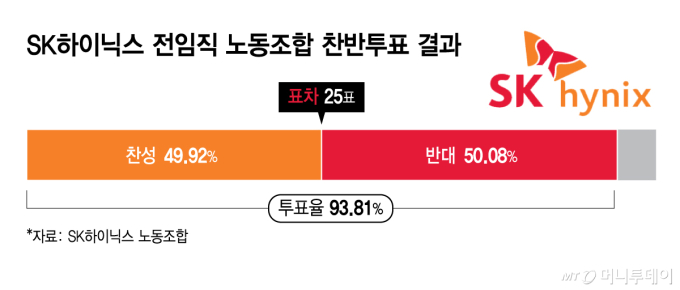
This year's wage and collective bargaining agreement (CBA) between SK Hynix management and labor failed to pass the threshold of a member vote, returning to the negotiation table. Although management introduced supplementary measures such as cash options for PS (profit-sharing bonus) payments in self-held stocks and loss protection against stock price declines, the tentative agreement was rejected. With the stock price falling significantly from its peak, demands for cash payment of performance bonuses amounting to hundreds of millions of won have continued, drawing criticism that employee compensation is being prioritized over shareholder interests.
Previously, management presented multiple safeguards to alleviate members' concerns about stock-based compensation. For the 2026 PS to be paid early next year, members can choose to receive 40% of the allocated shares in cash. Combined with the existing 40% cash portion, up to 80% can be received in cash, effectively delaying the application of the new payment method by one year. The number of shares will also be determined based on the lowest closing price among the preliminary earnings disclosure date, PS cash payment date, and stock delivery date. Provisions were also included to compensate for losses if the stock price falls after distribution.
However, it is reported that there was strong opposition among members to changing the payment method itself. Last year, management and labor agreed to abolish the PS cap and maintain a system where 10% of operating profit serves as the funding source for 10 years, with full cash payments. The resistance to switching back to stock-based payments after just one year appears to have influenced the vote. Dissatisfaction also arose over detailed conditions regarding welfare and benefits. Although it was decided to pay welfare points through the internal labor welfare fund to reduce income tax burdens, restrictions such as the inability to purchase gift certificates became issues, and tax implications related to stock loss compensation funds emerged as contentious points.
Alongside internal controversies surrounding the tentative agreement, voices criticizing potential infringement on shareholder interests are growing. In fact, SK Hynix's stock price plummeted nearly 50% from its peak of 2.919 million won on June 22, yet performance bonuses calculated based on this year's results are expected to increase significantly. Applying the 10th% PS funding ratio to SK Hynix's projected annual operating profit of 250 trillion won for this year yields a total fund size of 25 trillion won. The average PS per person is estimated at approximately 0.7 billion won (pre-tax). Even with the stock price effectively halved, there is an atmosphere where public criticism of demands for full cash payment of performance bonuses in the hundreds of millions of won is inevitable.
Shareholders directly bear the risk of corporate valuation decline, yet the tentative agreement includes provisions to mitigate losses from falling stock prices resulting from employees receiving self-held stock performance bonuses. The PS funding source is fixed at 10% of operating profit, meaning that as profits increase, the compensation scale distributed to employees also grows proportionally. Nevertheless, if cash payment ratios or additional compensation expand during re-negotiations, the gap in risk exposure between shareholders and employees could widen further. Critics argue this creates a "reversed order" compensation structure where shareholders bear stock price decline risks while employees are protected not only for performance but also against fluctuations in stock prices.
If labor-management conflicts prolong, public scrutiny may turn cold not only toward shareholders but society as a whole. SK Hynix plays a core role in the global semiconductor supply chain, centered on HBM (high-bandwidth memory) for AI. Given the significant share of semiconductors in the national economy, prolonged disputes over payment methods for performance bonuses amounting to hundreds of millions of won could increase the public pressure burden that the union must bear.
However, with the difference in today's union member referendum results being only 25 votes, prospects for re-negotiation are positive. Industry observers believe that rather than completely revising the existing tentative agreement framework, if management offers additional compensation such as settlement bonuses or adjusts certain conditions, the outcome of the next vote could change. Regardless of the office and technical staff union's voting results, the former employees' union and management must proceed with re-negotiations.
An industry source stated, "Since support and opposition are nearly split 50-50, there is room for a different outcome if management presents additional compensation proposals during re-negotiation." The source added, "Given that both sides face significant burdens from prolonged conflict, adjusting additional conditions could lead to the tentative agreement passing in the next vote."

 in INDUSTRY
