

Korean and Chinese hydrogen experts unanimously emphasized that government policy support from each country is crucial for the development of the hydrogen industry. It is analyzed that China was able to become the world's largest hydrogen producer thanks to active policy support. Domestic industry leaders urged the Korean government, whose will to foster the hydrogen industry has weakened, to bring about change.
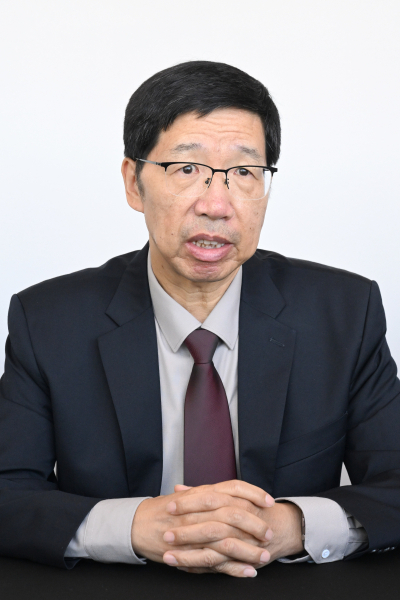
Yang Fu-wen, professor at the School of Vehicle and Mobility at Tsinghua University in China (photo), said on the 17th during an interview with domestic media held before the "Korea-China Hydrogen Dialogue" hosted by the Korea Hydrogen Association at a hotel in Seoul's Jung-gu district: "Policy is an essential support pillar for the development of the hydrogen industry."
Yang Pu-wi-en (Prof.) explained that China ranks first in the world in hydrogen production capacity, with government support serving as the foundation for these achievements. He stated, "Under President Xi Jinping's proposed goals of 'carbon peak' and 'carbon neutrality,' China has announced medium- to long-term strategies related to hydrogen." He added, "Guided by these directives, various hydrogen-related policies continue to be announced by both central and local governments."
Yang Pu-wi-en (Prof.) emphasized, "(In China) over 100 hydrogen-related policies are announced annually. According to our own statistics, since 2021 alone, there have been more than 30 central government-level policies favorable to the development of the hydrogen industry." He noted that these include diverse areas such as green power consumption, grid construction, policies to reduce costs, and hydrogen utilization in industrial complexes. He further added, "The recent buzz around creating 'carbon-zero industrial parks' is also included in these policies." Hong Eun-hee, head of Hyundai Motor Group's Energy & Hydrogen Business Division, also took the stage at the event that day to deliver a presentation titled "Achievements and Challenges in theation of FCEV (Fuel Cell Electric Vehicles) Passenger Cars and Buses," calling for increased interest and support from the Korean government toward the hydrogen industry.
He stated, "Hydrogen is an industry requiring long-term technological development and large-scale infrastructure investment." He continued, "Until now, the Korean government has established pioneering systems such as enacting the world's first Hydrogen Act and introducing a hydrogen power bidding market, while the industrial sector has achieved results on this foundation." However, he also requested, "From the perspective of industry, we ask that you consider two things together to ensure this momentum continues into the next stage." He added, "First, a predictable policy environment is needed so that companies can continue investing from a medium- to long-term perspective." He further emphasized, "Only when there is trust that the direction and support system of policies will be maintained can the industrial sector more actively engage in long-term research, development, and investment."
He also said, "Another issue we must consider is the perspective on hydrogen." He explained, "Hydrogen is not just a mobility fuel; it is a resource that can contribute to energy security and grid stability. Its role must be considered from the viewpoint of energy diversification."
He continued, "We hope that the upcoming second Hydrogen Economy Implementation Basic Plan will include challenges identified at business sites so far, and through the convening of the Hydrogen Economy Committee, the government and industry can reaffirm shared goals." He concluded, "If the government and industry work together to build such a consensus, Korea's hydrogen industry can leap beyond its current achievements to the next level."

 in INDUSTRY
