

"We have exported high-speed trains and subway cars to over 40 countries so far, and we will continue to expand further."
Lee Yong-bae Hyeon Dae-ro-tem (CEO)Lee Sa (President) met with reporters at 'InnoTrans 2026' held in Berlin, Germany on the 22nd (local time), stating, "Regarding Uzbekistan, a government-to-government 'MOU for strengthening strategic cooperation' was recently signed, so I expect good news regarding high-speed train supply around early next year." Uzbekistan is the first country to receive Hyundai Rotem's Korean-style high-speed train, and additional orders are being pursued following 2024.
InnoTrans, held biennially, is the world's largest railway exhibition, attracting an average of 170,000 visitors from countries around the globe. This year, Hyundai Rotem set up its booth on the largest scale in history to target the global market.
"Lee (President) has always focused all concepts and R&D directions on the global market," he emphasized, adding, "Visitors came from various countries including Morocco, Egypt, and Slovakia at this year's booth."
In fact, Hyundai Rotem has rapidly increased the export share of its railway business in total revenue. It has secured large-scale projects one after another in Australia, the United States, Canada, and other countries with subway cars, including high-speed trains. In particular, it aims to win a contract for the New York Metropolitan subway car replacement project, valued at up to 10 trillion won.
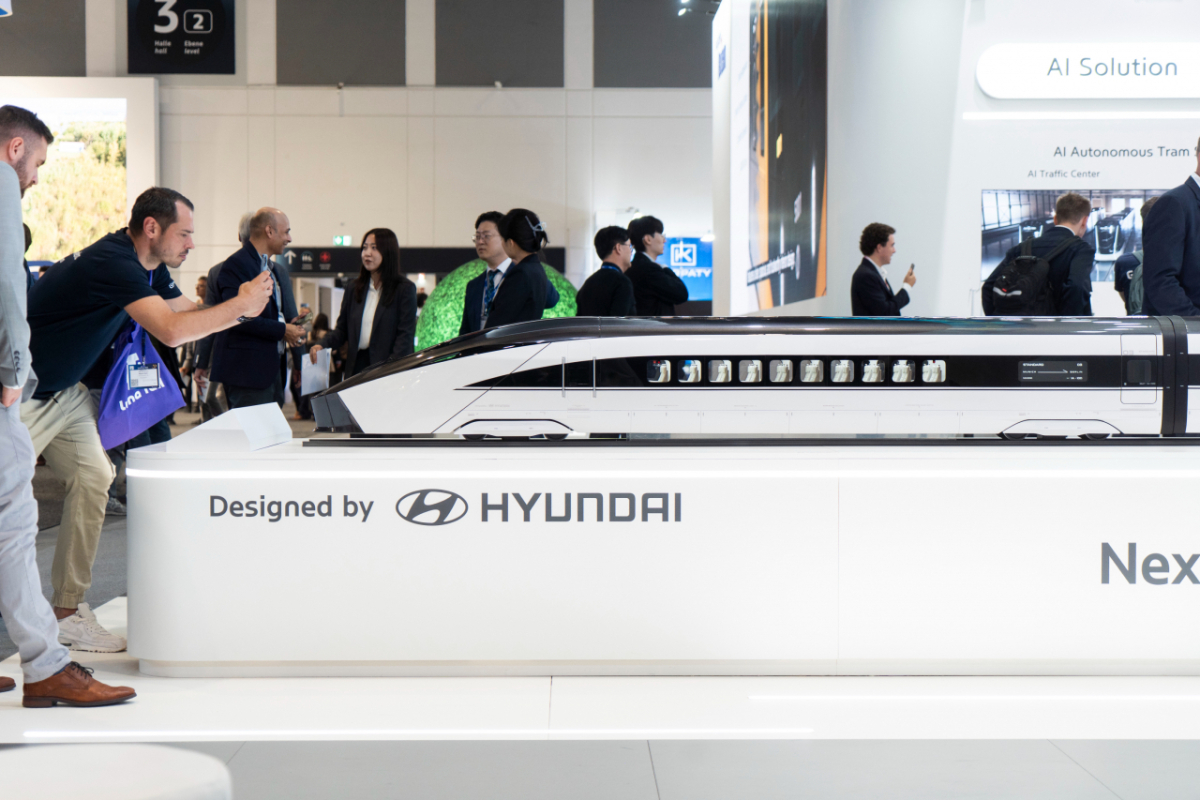
The next-generation high-speed train unveiled for the first time at this exhibition is also a result aimed at targeting overseas markets.
Cho Il-yeon, head of Hyundai Rotem's Railway Systems Division, stated, "In high-speed trains, speed, performance, and power are no longer enough; UX (user experience) and UI (user interface) have become important," adding, "We created a friendly high-speed train for everyone." Most notably, this high-speed train features the full-scale integration of Hyundai Motor Group's 'design DNA' as designers from Namyang Research Institute's Modern Design Center participated in its development.
Hyundai Rotem focused on securing top speed performance of 370 km/h while reducing noise and improving ride comfort for the next-generation high-speed train.
As a result, it succeeded in lowering the air resistance coefficient by approximately 36% compared to Korea's latest commercial high-speed train, KTX-Cheongnyong. Inside, the space between seats and luggage racks was widened, and seat comfort was enhanced. A 'VIP cabin' featuring premium interior materials and differentiated fabrics was also prepared. Head Cho stated, "Recently, many foreign passengers have been riding high-speed trains, which can represent South Korea's image," adding, "There was also an internal request within the group to create a 'world-class' vehicle at the Genesis level for high-speed trains."
Hyundai Rotem plans to challenge the KTX-1 replacement project scheduled by Korail (Korea Railroad Corporation) with its next-generation high-speed train. The total project scale is expected to reach 5 trillion won, starting with 28 cars next year and totaling 49 cars (784 vehicles). This strategy aims to prove performance domestically and use it as a foundation for expanding overseas orders.
To secure the future railway market, Hyundai Rotem is accelerating development of physical AI (artificial intelligence) and autonomous driving technologies.
At this InnoTrans, a blueprint for a fully autonomous 'future hydrogen tram' was unveiled. The 'ADAS' (Advanced Driver Assistance System) for railway vehicles, completed through in-house development this year, is the first step toward commercializing fully autonomous trams. Beyond obstacle detection, AI distinguishes and recognizes people and structures. Hyundai Rotem has set a goal to complete technology development for fully autonomous trams by 2031.
Additionally, it is pursuing differentiation by enhancing eco-friendliness with hydrogen as an energy source. Lee Won-sang, CTO (Chief Technology Officer) of Hyundai Rotem, explained, "Global companies such as France's Alstom and Germany's Siemens are also entering the field of physical AI," adding, "Railways will ultimately go toward autonomous driving."
Hyundai Rotem expects to gain a competitive edge over rivals by leveraging Hyundai Motor Group's accumulated technologies in physical AI and hydrogen fields to secure the market ahead of competitors.

 in INDUSTRY
