

While revenues in the global complete vehicle industry have remained flat, profits have declined significantly, making the deterioration in profitability evident. Analysts point out that even if sales recover, it will be difficult to translate this directly into improved profitability due to overlapping factors such as investment burdens during the transition to electrification, increased supply from Chinese manufacturers, and changes in the trade environment including tariffs.
According to a report titled "Changes in Profitability of the Complete Vehicle Industry and Its Implications" by the Korea Automotive Research Institute on the 29th, the combined operating profit of 20 major global complete vehicle companies last year was $59 billion (approximately 80.22 trillion won), a decrease of 62.9% from the previous year. During the same period, combined revenue increased by 2.4% to $2.5392 trillion, but the operating profit margin fell from 6.4% to 2.3%. This level is less than one-third of the peak in 2023 (7.9%).
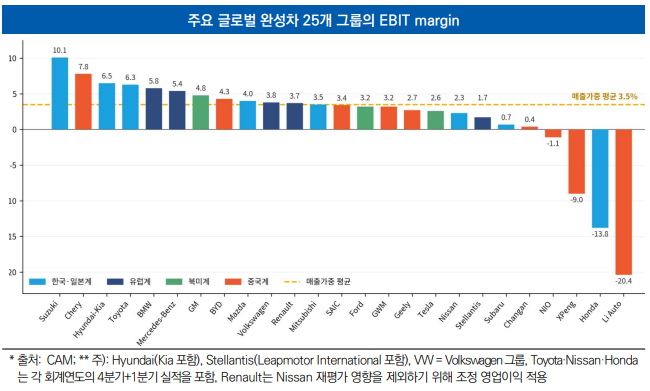
This trend continues this year as well. According to the Center for Automotive Management (CAM) in Germany, revenue for 25 complete vehicle companies in the first half of this year decreased by 1% compared to the same period last year, and earnings before interest and taxes (EBIT) declined by 16.3%. The average EBIT margin also dropped from 4.4% to 3.5%.
The background factors cited include △the burden of operating multiple powertrains during the electrification transition △increased development and operation costs for software (SW) and artificial intelligence (AI) △expanded supply from China, and △changes in the trade environment. While maintaining internal combustion engine and hybrid vehicle businesses, companies must simultaneously invest in electric vehicle platforms and batteries; however, converting production lines to match demand changes requires $200 million to $400 million and 9 to 15 months. The revenue of five Chinese companies (BYD, Geely, SAIC Motor, Changan, and FAW) increased by 71% from $178 billion in 2019 to $305.1 billion last year, but their operating profit margins remained in the 2-4% range. The institute assessed that these companies are increasing supply while maintaining low profitability. In the first half of this year, European sales by Chinese manufacturers increased by approximately 65%, and their market share rose from 7% to 11%.
Results varied by company. Suzuki, based on sales in emerging markets such as India, maintained an EBIT margin of 10.1% in the first half of this year, while Hyundai Motor Group and Toyota, which are strong in multiple powertrains including hybrid vehicles, also recorded stable profitability. In CAM's tally, the EBIT margins for Hyundai Motor and Kia were 6.5%, ranking third after Suzuki and Chery. On the other hand, Mazda and Nissan, which have a high proportion of sales in the United States, saw their profitability worsen due to tariffs, while Stellantis, Ford, and Honda, which revised their electrification strategies, experienced a sharp drop in profits as they reflected impairment and restructuring costs. Tesla's operating profit margin fell from 7.2% last year to 4.6% as its research and development (R&D) costs increased by approximately 41%.
It is pointed out that merely recovering sales volumes and utilization rates will not be enough to achieve high profitability similar to the post-COVID-19 period. In response, there are calls to establish a flexible production system capable of manufacturing multiple powertrains in a single factory and to reduce duplicate investments in software and AI through joint development and standardization. Kim Han-sol, head of the Industry Research Division at the Korea Automotive Research Institute, emphasized, "The key will not be restoring profitability to past levels itself, but rather the execution capability to sustain future investments based on the profitability of existing businesses and connect them to actual sales and profits."

 in INDUSTRY
