

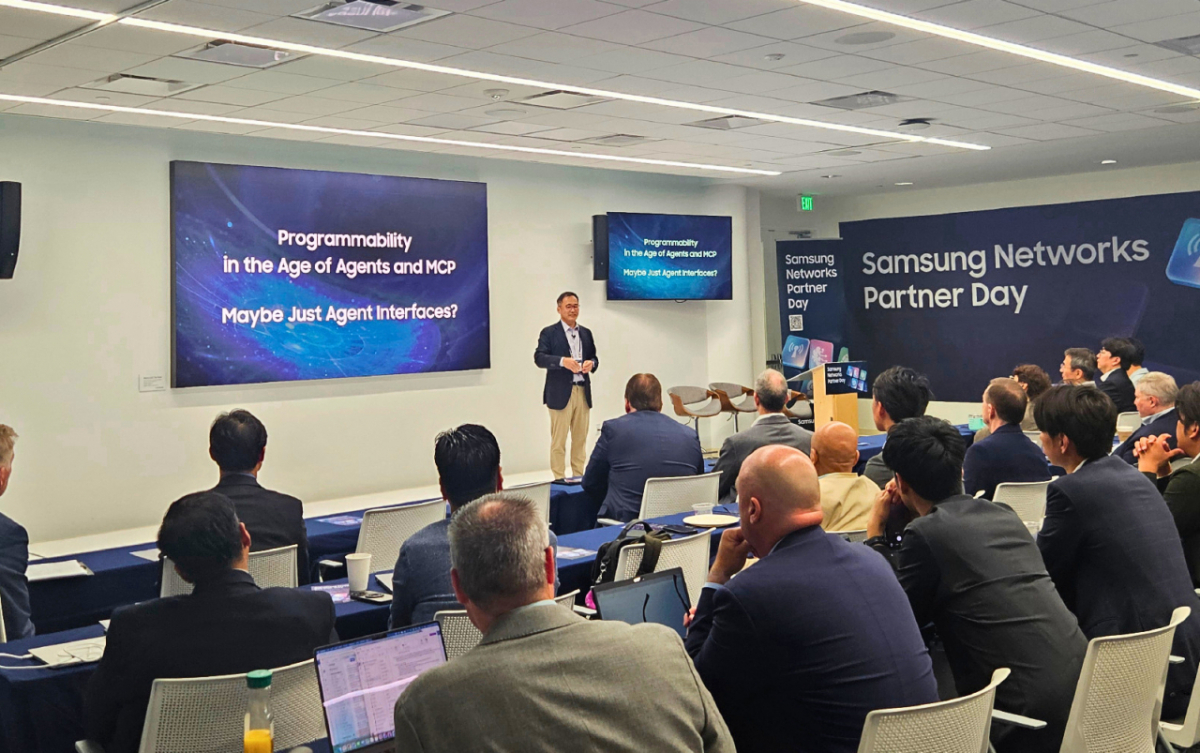
Samsung Electronics announced on the 15th that it will hold discussions with global telecommunications industry partners over two days starting from the 14th (local time) in Mountain View, Silicon Valley, U.S., regarding cooperation strategies for next-generation network technologies.
At the 'Partner Day' held on the first day of the event, there was an intensive discussion on software-based network strategies and ecosystem cooperation plans to respond to changes in the telecommunications industry brought about by AI (artificial intelligence).
In its keynote speech, Samsung Electronics explained that as AI expands beyond applications and services to the entire infrastructure, it is driving structural changes in telecommunications networks that have continued for over 100 years. The company stated that next-generation networks integrating AI and virtualization will be a key driver in realizing new communication methods that overcome the limitations of existing telecommunications technologies.
In the subsequent panel session, telecom operators shared requirements and blueprints for AI-based future networks. Manufacturers discussed the direction of development for the telecommunications ecosystem based on experiences accumulated during the commercialization of AI and virtualized networks. They also explored ways to discover new network-based services beyond simple connectivity services and expand them into business opportunities.
On the 15th, the 'Silicon Valley Future Communications Summit 2026' will be held. The summit consists of three sessions: △AI-embedded 6G (6th-generation mobile communication) networks, △expansion of 6G coverage based on satellite communications, and △ultra-connectivity linking the real and virtual worlds.
The AI-embedded 6G network session will discuss ways to improve telecommunications network performance and operational efficiency using AI, as well as technical challenges for realizing intelligent infrastructure. The 6G coverage expansion session based on satellite communications will address the current status and outlook of low Earth orbit satellite constellations, along with technical barriers and solutions for space communications.
It will also share satellite communication standard specifications and roadmaps under discussion at 3GPP, the international mobile telecommunications standardization body. The ultra-connectivity session will explore ways to create new user services by utilizing technologies that recognize physical spaces and connect them with digital services, such as integrated sensing and communications (ISAC) and physical AI.
Samsung Electronics will also showcase core 6G technologies jointly developed and verified with global partners. It plans to demonstrate the latest technological achievements, including △AI-based Radio Access Network (AI RAN), △high-density Multiple-Input Multiple-Output communication system (X-MIMO), △distributed Multiple-Input Multiple-Output communication system (D-MIMO), and integrated sensing and communications.
In particular, it will reveal communication performance by applying AI to all layers of the Radio Access Network (RAN) and data transmission performance in the 7GHz band, a candidate frequency for 6G. It also plans to present actual verification results regarding perceived communication quality for users in cell boundary areas and sensing performance utilizing base station infrastructure.
Samsung Electronics is accelerating the development of 6G and AI communication technologies by collaborating with global mobile carriers, research institutions, and working groups. This year, it began cooperation with LG Uplus for ISAC technology development and conducted field verification with Verizon at a major global sports event held in Dallas, U.S. It is striving to realize 6G technology by strengthening research cooperation with major domestic and international telecom operators such as SoftBank, NTT Docomo, KDDI Research, KT, and SK Telecom.
Jung Jin-guk, Senior Vice President and Head of the Next-Generation Communications Research Center at Samsung Research, Samsung Electronics, said, "Samsung Electronics is leading the development of core network technologies that will concretize the realization of 6G through close cooperation with telecommunications industry partners." He added, "We will continue to concentrate our pre-research capabilities for the advancement of next-generation communication technologies for both carriers and users."

 in INDUSTRY
