

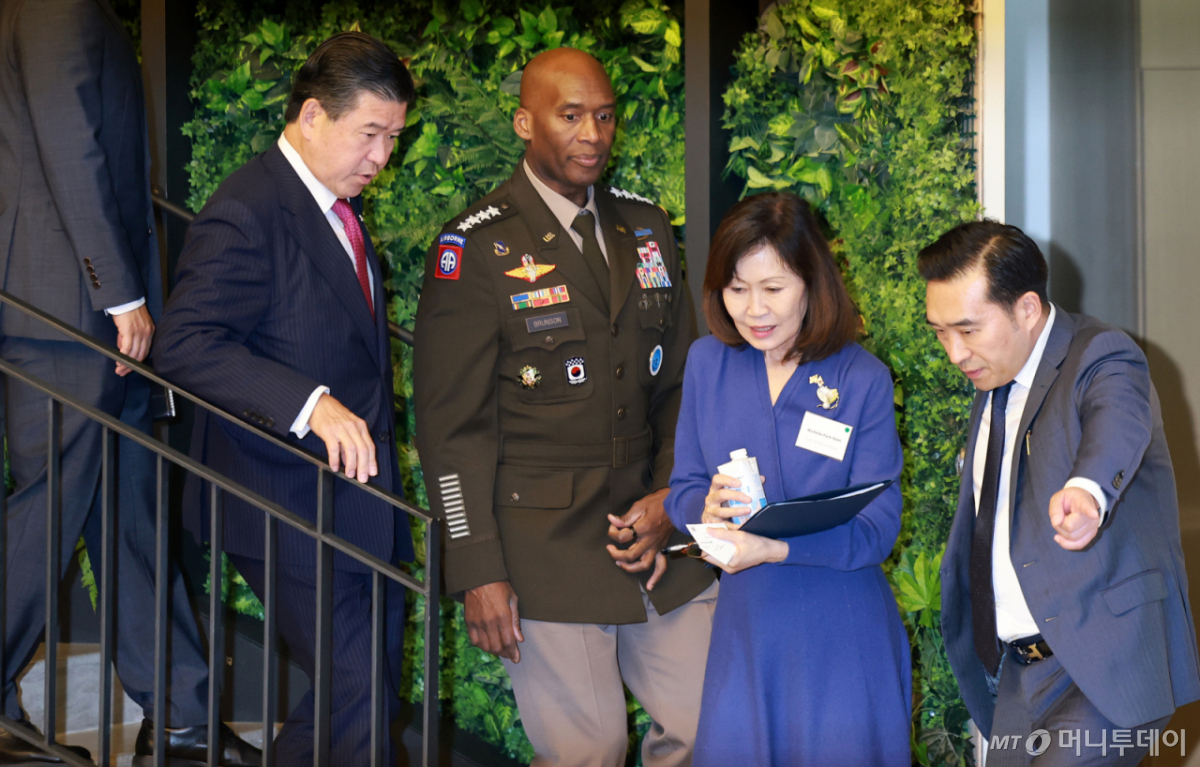
Behind U.S. Ambassador to South Korea Michelle Park Sook's call for an expanded economic role for South Korea lies the perception that "security is the foundation of prosperity." The argument is that since the South Korean economy has grown on the security provided by the U.S.-South Korea alliance, it is now time to support the alliance through investment in the United States and fair treatment of American companies. General Xavier Brunson, Commander of the ROK-US Combined Forces Command and USFK, outlined a plan to leverage South Korea's defense and shipbuilding capabilities for the maintenance of U.S. military forces, concretizing the link between economy and security.
Ambassador Sook stated at a lunch briefing hosted by AmCham at Mondrian Seoul Itaewon in Yongsan-gu, Seoul on the 21st, "The truth guiding the U.S.-South Korea relationship is that prosperity and security cannot be separated." She explained that because combined U.S.-South Korean forces have deterred hostile actions on the Korean Peninsula, the Miracle on the Han River was possible, and that USFK continues to maintain a state of alert, supporting the growth of South Korean companies.
It is interpreted that the U.S. emphasis on South Korea's investment in the United States as an alliance-level issue stems from this same perception. Ambassador Sook said, "Our trade and investment are not limited to the economy," adding, "Stable energy, competitive shipyards, and reliable supply chains strengthen the readiness of both nations' militaries." She also evaluated South Korea's decision to increase its defense spending to 3.5% of gross domestic product (GDP) as an investment that builds deterrence and the defense industry simultaneously. The reason for emphasizing energy cooperation is artificial intelligence (AI). This is because developing new AI technologies requires massive amounts of "sustainable energy."
She also raised the issue of improving the treatment of U.S. companies in South Korea. She clearly stated, as she has previously indicated, that American companies must be able to compete in South Korea without discrimination. Citing the refinery that Korea Zinc is building in Tennessee, United States, Ambassador Sook said, "We hope Korean companies expand further into the U.S. and grow, and we also hope American companies receive fair treatment here." Regarding digital regulations, she noted that while things have improved since the joint fact sheet (joint explanatory document), they still need to be improved.
Pointing to China as a security threat in the region, she called for cooperation among South Korea, the U.S., and Japan. Ambassador Sook stated, "At times, China is the biggest threat in the Indo-Pacific region," noting, "24% of all trade passes through that sea area, and large amounts of crude oil and natural gas are transported there, yet China tries to dominate it while coercing other countries such as Taiwan and the Philippines." After pointing out that China has been in dispute with Japan over the Senkaku Islands and faces similar issues with South Korea, she argued that cooperation is needed not only bilaterally between the U.S. and South Korea but also with Japan.
Commander Brunson proposed expanding maintenance cooperation by leveraging South Korea's shipbuilding and manufacturing capabilities. He said, "U.S. Navy vessels received maintenance in dry docks on the Korean Peninsula and were able to return to service faster than if they had been maintained on the mainland," adding, "I think we should do this across all domains." This means expanding the scope of cooperation beyond maritime maintenance, repair, and overhaul (MRO) to include additive manufacturing. It is interpreted that operational sustainability can only be achieved if equipment can be repaired within the Indo-Pacific region without being sent back to the U.S. mainland.
He also mentioned viewing South Korean companies as a pillar of the alliance. Addressing business and industry leaders, Commander Brunson said, "You are an integral part of the combined defense system," urging them not to settle for a transactional supplier-buyer relationship. He further emphasized that a deeper and more permanent integration must be achieved between U.S. innovation and South Korea's creativity and large-scale manufacturing capabilities, stating that the alliance's strategic depth will increase only if production, maintenance, and technological capabilities extend from both nations' mainlands to the front lines.

 in INDUSTRY
