

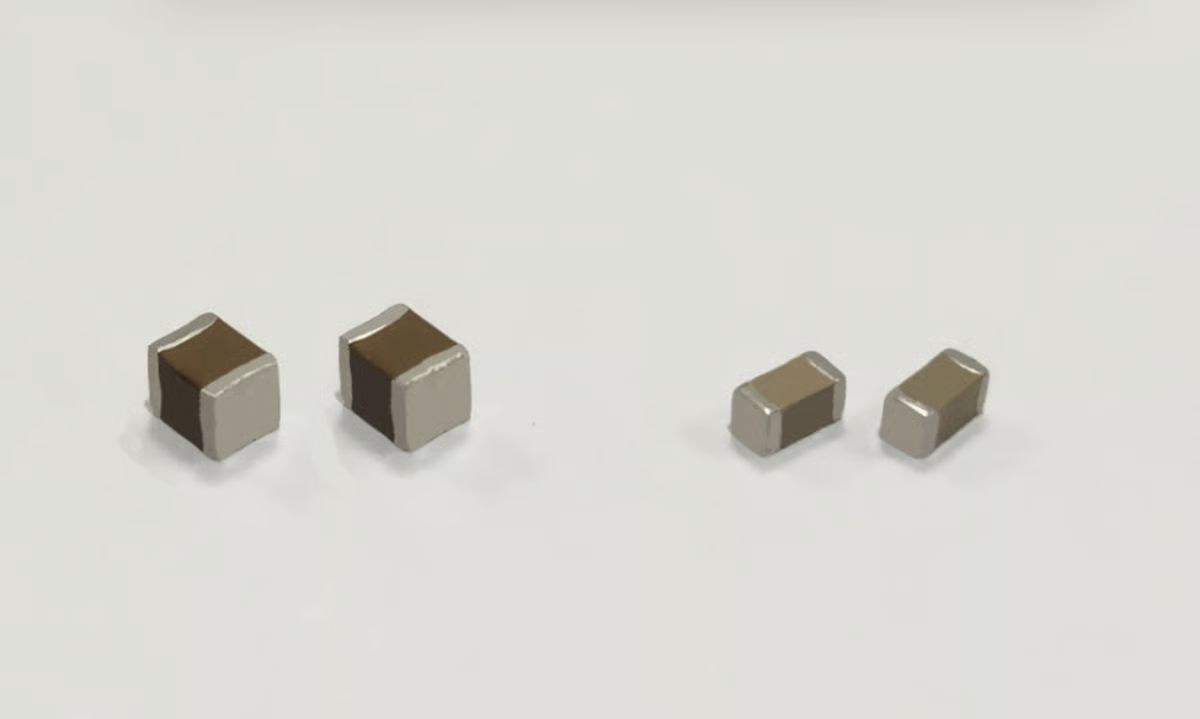
Samsung Electro-Mechanics has developed a new design technology to mitigate quality degradation issues that arise during the high-capacity scaling process of multilayer ceramic capacitors (MLCCs). The technology reduces the risk of internal electrode deformation and protective layer cracking or moisture ingress, thereby enhancing product reliability. This move is interpreted as an effort to strengthen the technological competitiveness of high-value-added MLCCs.
According to patent information search service KIPRIS on the 23rd, a recently disclosed 'Stacked Electro Component' patent by Samsung Electric details technology aimed at reducing the risk of internal electrode deformation and protective layer cracking in MLCCs. The design extends the internal electrodes to the side surfaces of the stacked body and wraps the stacked body with a single dielectric sheet to enhance structural reliability.
An MLCC is a component that stores electricity by alternately stacking internal electrodes and dielectric layers. To increase capacity, the layers must be made thinner and the number of stacks increased. However, if the average thickness of the electrodes or dielectric layers falls below 0.35 micrometers (µm), mechanical strength and moisture resistance may decline.
In particular, in existing structures, the step formed by creating the dielectric layer wider than the electrode could cause the electrode to bend, and stress concentrated at the bonding surface of a separately attached protective sheet raised concerns about cracking and moisture ingress.
In this patent, Samsung Electro-Mechanics extended the ends of the electrodes to the side surfaces of the stacked body to reduce the step. It also designed the structure so that a single dielectric sheet wraps four sides of the stacked body to disperse stress. The thin areas of the protective layer are kept at 90% or less of the maximum thickness, with some forms adjusted within the 80-90% range. Samsung Electric explained that this was considered because making it excessively thin could reduce product symmetry and lower quality uniformity.
Material properties were also differentiated. Relatively large crystal grains were applied to the internal dielectric layer to ensure dielectric constant, while small crystal grains were applied to the external protective layer to enhance mechanical strength. Samsung Electric confirmed the effect of reduced moisture ingress due to changes in the protective layer structure in actual testing. However, it was reported that the currently confirmed improvement effects are focused on moisture resistance, and additional effects such as reducing internal cracks are at a stage requiring future review.
This type of design is linked to the company's expanding high-value-added MLCC business. MLCCs for AI (artificial intelligence) servers must operate for long periods in high-temperature and high-voltage environments, making insulation performance and moisture resistance reliability important in addition to capacity. This month, Samsung Electric signed an MLCC supply contract worth 285.6 billion won with a major global company for AI servers.
However, it was understood that specific Yangsan plans or application timing for this technology have not yet been determined. Applying the manufacturing method presented in the patent to actual production would require process changes and additional costs for existing LINEs, so a review of commercialization economics, such as quality improvement effects relative to investment burden, is necessary.
An industry official said, "This patent is significant in that it attempts to overcome moisture resistance and structural defects, which have been cited as technical constraints, at the structural design stage," adding, "Yield verification and economic evaluation will be key variables until future commercialization."

 in INDUSTRY
