

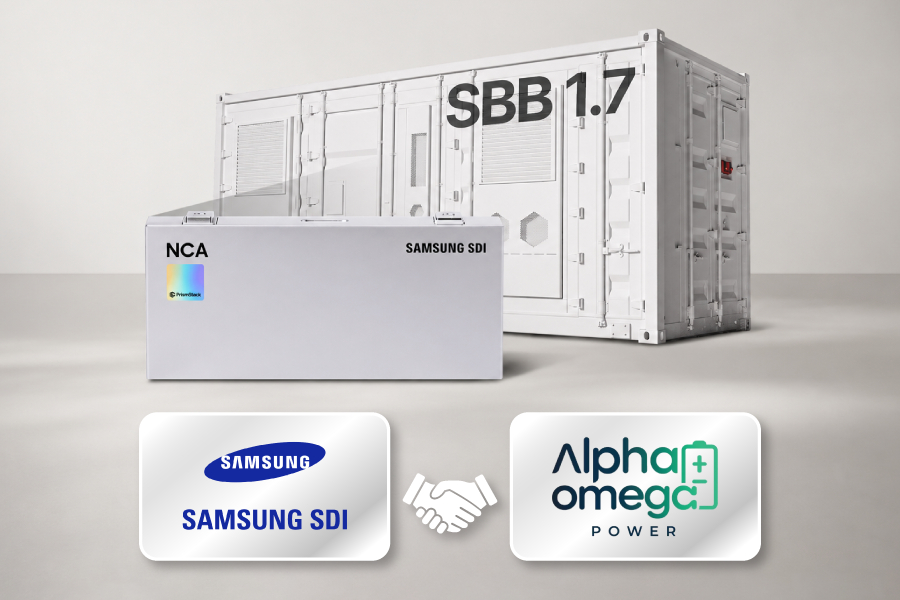
Samsung SDI is accelerating its push into the U.S. Energy Storage System (ESS) market by leveraging ternary NCA (Nickel-Cobalt-Aluminum) and LFP (Lithium Iron Phosphate) batteries. Based on local production and the safety of prismatic batteries, the company has consecutively signed large-scale order contracts, broadening its foothold in the North American market.
According to battery industry sources on Monday, Samsung SDI America (SDIA) signed an ESS solution supply contract for a scale of 1 GWh with Alpha Omega Power (AOP), a U.S. energy specialist company. Including the first batch contracted at the end of last year, the total supply scale is 1.5 GWh. While the contract amount has not been disclosed, it is estimated to reach several hundred billion won when considering market averages. AOP plans to deploy the supplied ESS solutions in a large-scale power project set to break ground in Texas state next year.
It is assessed that Samsung SDI's strategy, highlighting the safety and technological capability of prismatic batteries, was effective. The product being supplied this time is 'SBB (Samsung Battery Box) 1.7,' which applies high-capacity high-nickel NCA material. It shares the same 20-foot specification as the existing SBB 1.5 but has an energy density that is 17% higher.
It also incorporates Samsung SDI's ESS design know-how, including the application of AI-based pre-diagnosis and life prediction algorithms for abnormalities. The product has also obtained certifications such as NFPA 855, the fire safety installation standard of the National Fire Protection Association, and UL 9540, an ESS-related safety certification.
Samsung SDI is tackling the ESS market in the U.S. by utilizing both NCA and LFP batteries. At the end of last year, it signed an LFP battery supply contract for ESS worth over 2 trillion won with a U.S. energy-related infrastructure development and operation company. In March this year, it concluded a battery supply contract worth approximately 1.5 trillion won with a major U.S. energy specialist company. The contract at that time included provisions for the sequential supply of NCA and LFP batteries.
Since the two batteries have different characteristics, Samsung SDI's strategy is to respond to diverse demands based on the strengths of each product. NCA batteries have high energy density, making them advantageous for storing large amounts of energy in limited spaces. In particular, the competitiveness of NCA batteries can be highlighted in fields requiring high output and high energy density, such as Battery Backup Units (BBU), which are gaining attention due to increased power demand from AI data centers. On the other hand, LFP batteries have strengths in terms of relative cost competitiveness, lifespan, and thermal stability.
In line with the expansion of the ESS market, SamsungSDI is also expanding its local production system. SamsungSDI has been producing NCA-based ESS batteries since the fourth quarter of last year by converting part of the electric vehicle battery production line at the Indiana state factory of Star Plus Energy (SPE), a joint venture with global automaker Stellantis. It plans to begin producing LFP batteries for ESS at the same factory starting from the fourth quarter of this year.
Fabrice Hudry, Vice President and Head of the ESS Team at Samsung SDI's Americas subsidiary (SDIA), stated, "AOP is one of the fastest-growing independent power producers in the United States," adding, "We will continue to expand our business foundation and further strengthen our position in the North American ESS market through differentiated technological capabilities and local production."

 in INDUSTRY
