

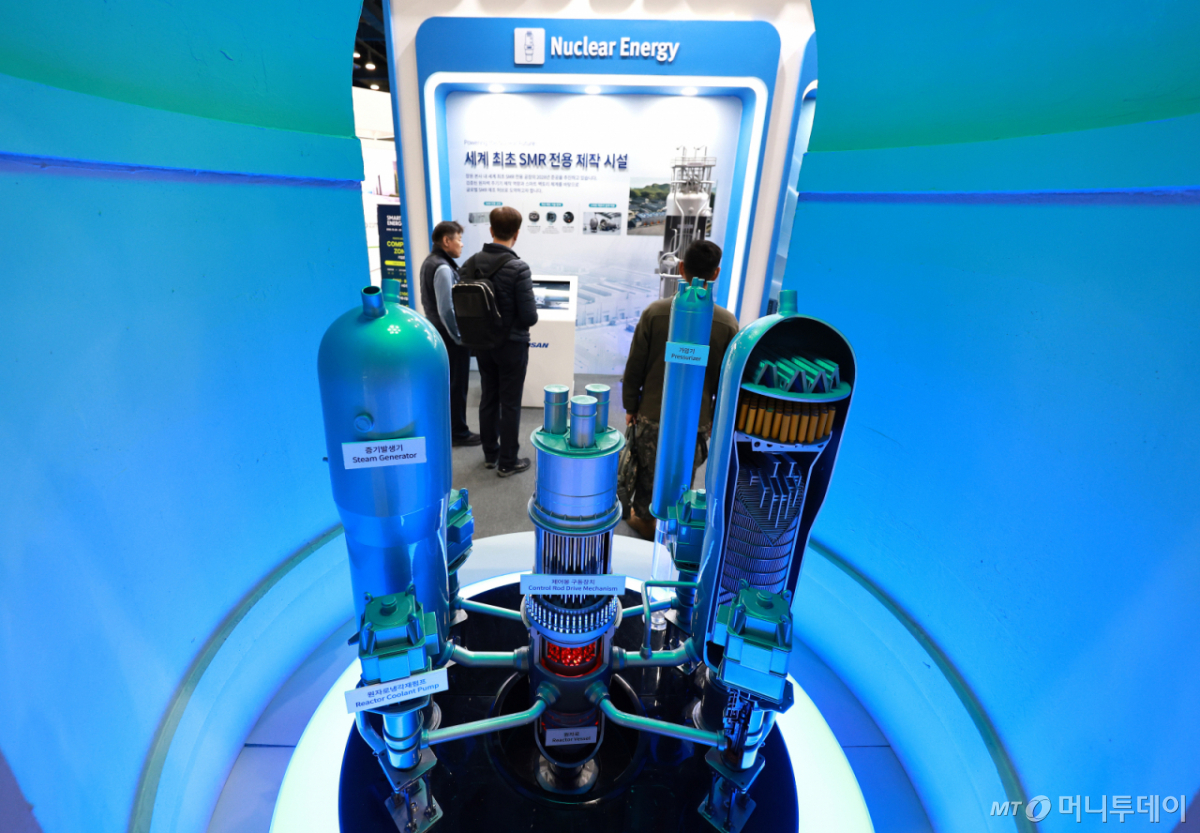
As semiconductor production plants and AI (artificial intelligence) data centers proliferate, power consumption is surging, and voices are growing louder that the role of nuclear power plants must be strengthened. Given that it takes more than 10 years to build a new nuclear plant, experts point out that the government can no longer afford to delay its decision.
According to industry sources on Monday, the Ministry of Climate, Energy and Environment officially launched a public deliberation committee for nuclear power in connection with the basic plan for electricity supply and demand last month.
It plans to conduct a national baseline survey to select a citizen participation panel by the 14th. The aim is to derive recommendations regarding the role of nuclear power in the 12th Basic Plan for Electricity Supply and Demand, which outlines medium- and long-term power plans through 2040. It is understood that the committee will focus on determining the range of the share of electricity generation from nuclear power, rather than debating for or against it.
The energy industry maintains that expanding the share of nuclear power is essential. This is because new power demand alone for the government's three mega-projects to build an AI ecosystem, including semiconductor plant construction, is expected to reach approximately 38 GW (gigawatts).
The widespread adoption of electric vehicles and the electrification of factories are also cited as factors driving increased power consumption. It is assessed that it is impossible to meet this massive demand with renewable energy alone, which has the weakness of "intermittency." This is why a roadmap encompassing not only large-scale nuclear plants but also SMRs (Small Modular Reactors) is needed.
In particular, nuclear power has the advantage of emitting almost no carbon during the generation process. This is the background behind major countries worldwide moving to expand nuclear power in line with building AI ecosystems.
In the United States alone, a project is being pushed to build eight nuclear plants by investing up to 120 billion dollars (approximately 160 trillion won) in partnership with our government. TerraPower, a U.S. SMR company founded by Bill Gates, has set commercialization around 2030 as its target.
The public deliberation committee is expected to submit recommendations as early as next month. An energy industry official noted, "It takes at least nine years and up to 13 years for a new nuclear plant, including site selection," adding, "If we do not secure a sufficient lower limit on the share now, it could lead to power shortages in 10 years."
According to the "2026 Q2 Energy Public Awareness Survey" released by the Korea Energy Information and Culture Foundation last August, 79.2% of respondents agreed with the necessity of building new nuclear plants.
The government side has also consistently sent favorable messages regarding nuclear power. Lee Ho-hyun, second vice minister of the Ministry of Climate, Energy and Environment, attended 'Smart Energy Plus 2026,' hosted by MoneyToday and COEX on Oct. 28, and said, "We will significantly expand economical and clean energy to support the AI era We will accelerate a bold and swift energy transition that dramatically promotes renewable energy and actively utilizes nuclear power."
Jang In-sook, head of the SMR Safety Division at the Nuclear Safety and Security Commission, also stated at 'SEP 2026,' "We have changed our goal to start developing SMR review criteria from 2027 so that regulations do not hinder commercialization," adding, "SMRs are ultimately a race against time, and regulations must be prepared to match that pace."

 in INDUSTRY
