

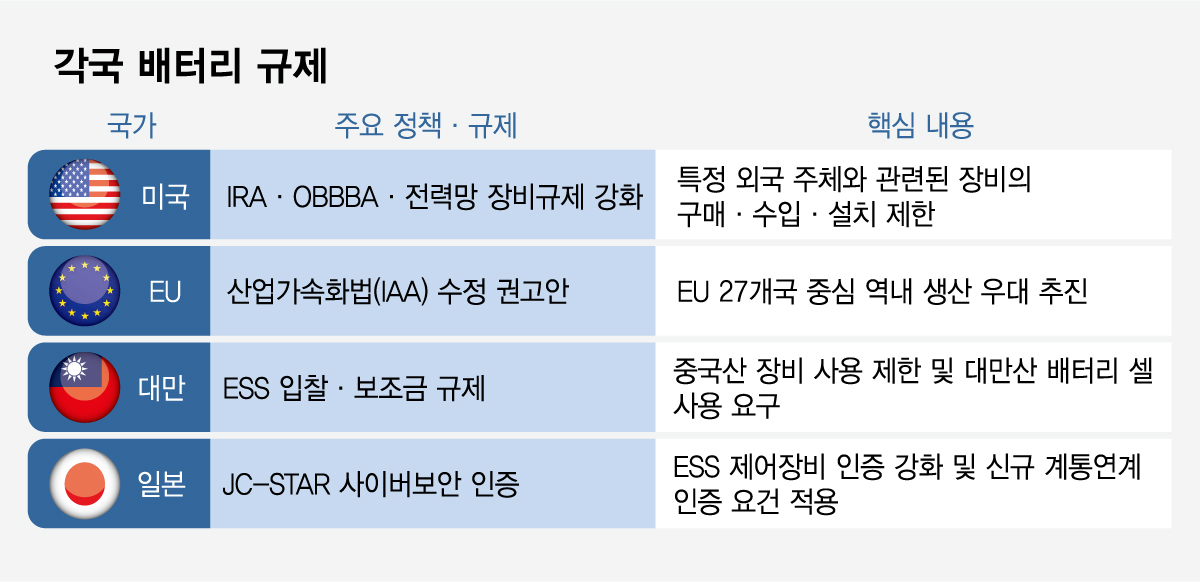
Domestic battery companies, which had been struggling against low-priced Chinese-made batteries, are facing a turning point as regulations tighten around the world. The United States and Taiwan are strengthening restrictions on Chinese products, while the European Union (EU) is favoring production within its region. Japan is also scrutinizing market entry requirements strictly through cybersecurity certification.
According to battery industry sources on the 4th, following the Inflation Reduction Act (IRA) and the One Big Beautiful Bill Act (OBBBA), the United States issued an executive order this year strengthening supply chain security standards for major grid equipment such as battery energy storage systems (BESS) and inverters. The core of the order is to restrict the purchase, import, and installation of equipment associated with specific foreign entities that may pose a risk to national security. As a result, the competitiveness of domestic battery companies, which are classified as Non-Prohibited Foreign Entities (Non-PFE), is expected to be highlighted.
The EU is also pursuing policies that favor products produced within its region. In its revised recommendation for the Industrial Accelerator Act (IAA) in September this year, it proposed limiting the scope of local production recognition from including third countries such as Free Trade Agreement (FTA) partners to focusing on the 27th EU member states. The proposal also includes a criterion requiring at least 50% intra-regional added value and restricting the relocation of manufacturing facilities that received public support outside the EU for five years.
Although the IAA has not yet been finalized, the domestic battery industry believes that intra-regional production capabilities for both cells and materials will become increasingly important. Max Jeon, head of SK On's Energy Storage System (ESS) business division, stated, "Europe is the country where the biggest changes have occurred since the beginning of this year." He explained, "If the basic purpose of the United States is to exclude Chinese products, Europe operates on the concept of providing preferential treatment for production within its own borders, thereby strengthening localization requirements. Supplying and operating products suitable for the local market has become more important."
Currently, the top three domestic battery companies have secured production bases in Europe. LG Energy Solution is operating a battery plant in Wroclaw, Poland, with an annual capacity of 80 to 90 GWh (gigawatt-hours). The production capacity of Samsung SDI's God factory in Hungary is estimated at approximately 40 GWh annually. SK On has a total production capacity of 48 GWh across its Komarom 1 and 2 factories in Hungary (10 GWh and 8 GWh, respectively) and its Ivancica factory (30 GWh).
In addition, Taiwan is restricting the use of Chinese-made ESS due to cybersecurity and supply chain stability concerns. In solar-linked ESS tenders, the use of Chinese-made integrated ESS and Chinese-made control equipment with communication functions is restricted. The industrial ESS installation subsidy regulations established this year require the use of Taiwanese battery cells and prohibit the use of Chinese brands and Chinese-made products in communication and control equipment such as Battery Management Systems (BMS) and Power Conversion Systems (PCS).
Japan is also utilizing cybersecurity certification as a form of invisible regulation. The Japanese government applies the 'JC-STAR' cybersecurity certification system to ESS subsidy support, among other areas. Starting next April, certification will be mandatory for control equipment with communication functions in high-voltage and extra-high-voltage ESS applying for new grid connections. While Chinese products are not directly excluded, market entry may be restricted depending on whether certification is obtained, potentially acting as a non-tariff barrier.
Samsung SDI is one of the battery companies moving to expand its business in the Japanese market. It obtained relevant security certifications in Japan last year. Based on this, it plans to expand ESS battery sales in Japan to 2 GWh by 2030. An industry official said, "It is difficult to win in a head-on price competition with China." He added, "Domestic companies are creating opportunities through local production requirements and security certifications."

 in INDUSTRY
