

The growth of China's home appliance industry, which expanded its scale by leveraging price competitiveness, has hit a brake. Domestic demand has plunged, leading to revenue declines for major appliance makers, while overseas markets have been plagued by quality controversies. Analysts suggest that Korean home appliance companies, which have built trust in their products through rigorous management, may see an opportunity to strengthen their position in the global market.
According to Chinese market research firm AVC (Ouyunwang) on the 10th, China's domestic home appliance retail sales (excluding smartphones and PCs) in the third quarter of 2026 reached 179.1 billion yuan, a 10% decrease compared to the same period last year. This was influenced by demand being pulled forward due to the Chinese government's "trade-in" policy (support for replacing aging products) last year. Additionally, sales of high-priced products declined as consumer sentiment weakened.
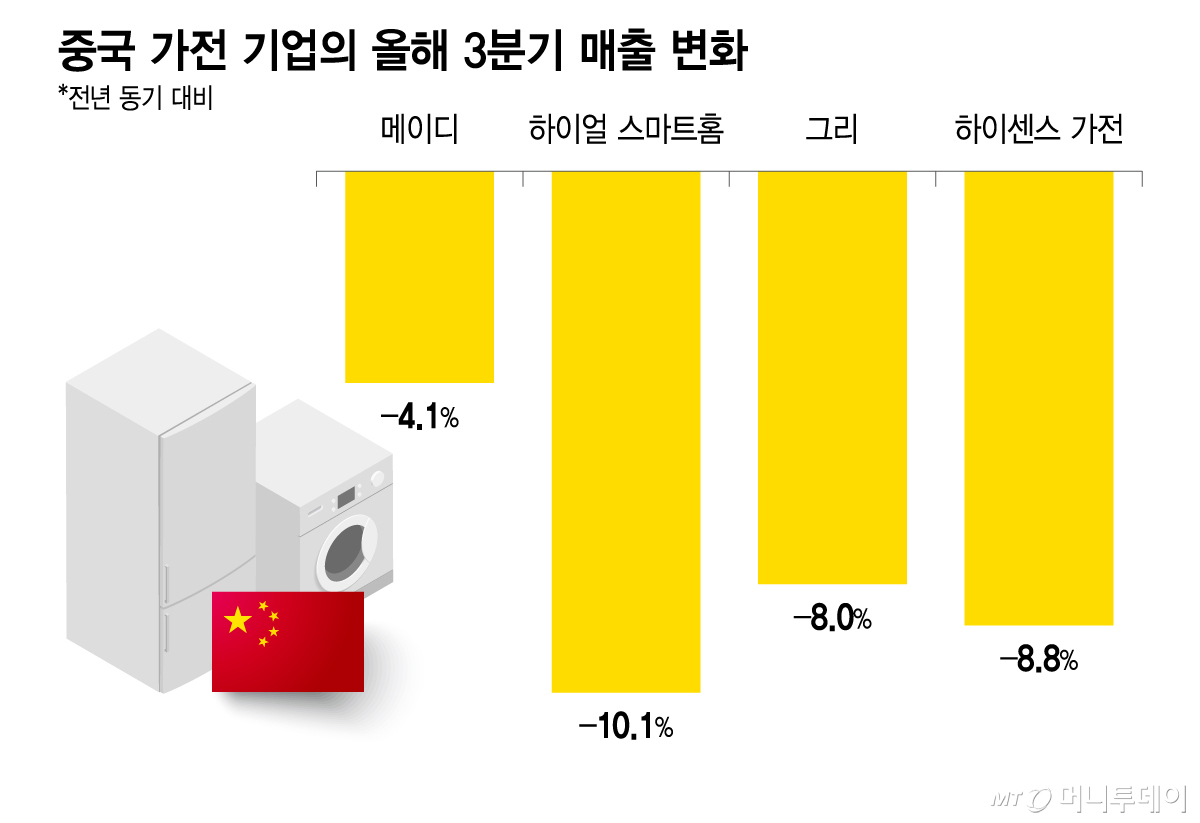
The performance of major companies also took a step back. Haier Smart Home's third-quarter revenue and net profit decreased by 10.1% and 12.3%, respectively, compared to the same period last year. During the same period, Hisense Home Appliances saw its revenue drop by 8.8%, while its net profit plummeted by 74%. Midea and Gree also experienced revenue declines of 4.1% and 8.8%, respectively. Beyond China's domestic market, home appliance consumption decreased in major markets such as the United States and Europe, and rising raw material and transportation costs further exacerbated operational burdens.
Overseas, issues surrounding product safety and advertising credibility have emerged one after another. The U.S. Consumer Product Safety Commission (CPSC) recalled approximately 120,000 refrigerators manufactured by China's Galanz in July last month. Of the 34th fire reports related to these refrigerators, one resulted in a fatality. Previously, a German court ordered the suspension of advertising for some TCL TVs, ruling that their QLED advertisements could mislead consumers.
Quality issues are also growing within China. According to China's State Administration for Market Regulation (SAMR), the volume of consumer goods recalled in China last year was approximately 8.23 million units, an 81.3% increase from the previous year. Furthermore, 86.2% of consumer defect reports were concentrated on electronic and electrical products.
As quality and reliability issues became prominent, China's home appliance industry has also initiated self-reflection. Nearly 100 home appliance and furniture brands, including Midea, Haier, Xiaomi, and TCL, participated in the "Eradication of False Performance Evaluations" campaign launched by the China Household Electrical Appliances Association in June last month. The initiative aims to reduce practices that mislead consumer judgment by testing under conditions detached from actual usage environments or manipulating data. Industry observers describe this as a de facto "self-criticism" by China's home appliance industry.
Meanwhile, Korean home appliance companies are strengthening their fundamentals. Although they have faced difficulties due to aggressive marketing by Chinese firms, they are maintaining competitiveness by reducing costs, expanding the business-to-business (B2B) market, and enhancing quality management.
LG Electronics' revenue and operating profit in the third quarter of this year increased by 8.9% and 13.5%, respectively, compared to the same period last year. Despite a global consumption slump, its Home Appliance & Air Solution (HS) business division surpassed 7 trillion won in revenue for the second consecutive quarter, marking a 7% growth over the previous year. Samsung Electronics' home appliance business also maintained revenue levels comparable to those of the previous year.
The companies are also continuing to receive favorable reviews regarding quality. LG Electronics ranked first in Consumer Reports' annual survey on kitchen appliance brand reliability in the United States. Its washing machines also recorded a first-place ranking across all categories. Samsung Electronics achieved first place in six categories, including refrigerators, dryers, and dishwashers, in the consumer satisfaction evaluation for home appliances conducted by J.D. Power.
An industry official stated, "Although uncertainties in the global business environment, such as tariffs, subsidies, and wars, have accelerated over the past few years, it is precisely during times like these that companies must strengthen the fundamental of quality to ensure their longevity."

 in INDUSTRY
