

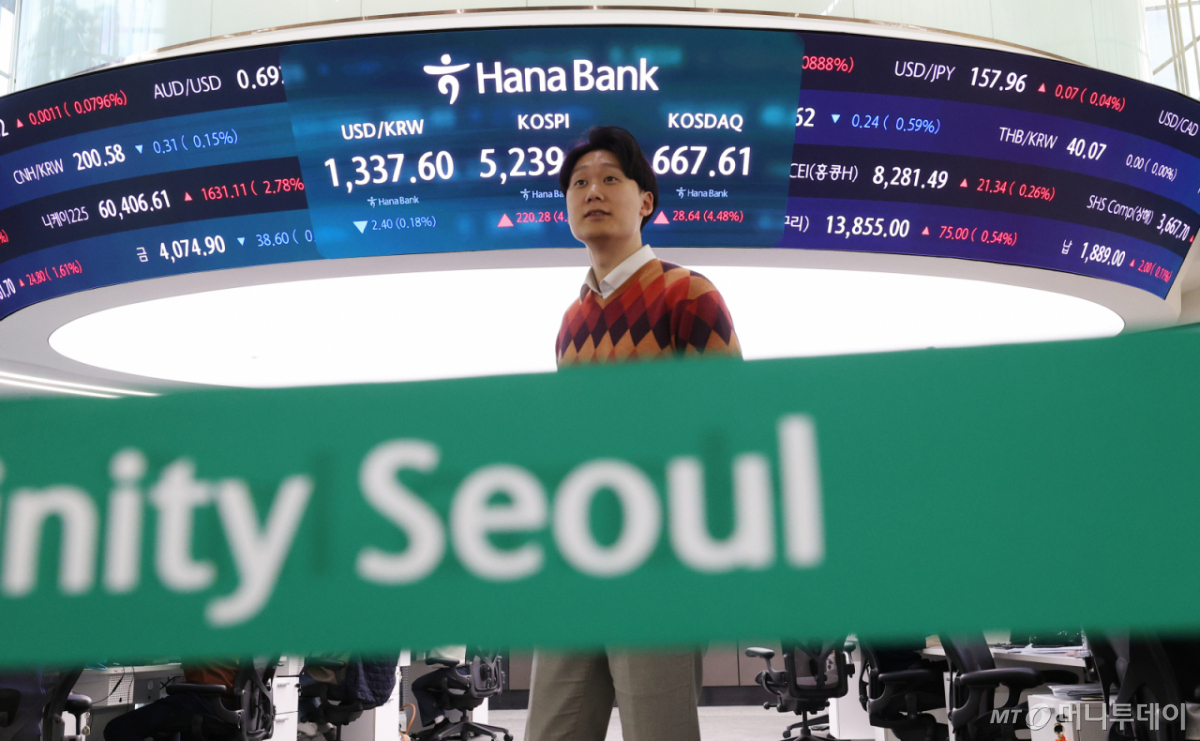
As Korea’s two major stock markets closed higher, attention is turning to whether the rebound driven by easing concerns over AI infrastructure will continue. While securities firms view the rise on Tuesday as a result of falling oil prices, opinions are divided regarding future prospects.
Some analysts have taken a cautious stance, arguing that judgments should be made after reviewing the U.S. CPI (Consumer Price Index) released late on this day and CoreWeave’s earnings to be announced in the morning of the 11th.
The KOSPI index closed at 5,239.13 on this day, up 220.28 points (4.39%) from the previous trading session, recovering the 5,200 line. The KOSPI opened at 5,247.22, up 228.37 points (4.55%), and maintained its strength. Shortly after the opening, the 28th buy-side sidecar (futures market circuit breaker) of this year was triggered.
The KOSDAQ index ended trading at 667.61, up 28.64 points (4.48%) from the previous session. It opened at 661.73, up 22.76 points (3.56%), and maintained its upward momentum. The 20th buy-side sidecar of this year was also triggered in the KOSDAQ market. This marks the ninth time this year that buy-side sidecars (futures market circuit breakers) have been triggered simultaneously in both major stock markets.
In terms of supply and demand for KOSPI, foreign buying emerged after a long absence. Foreign investors made net purchases worth 632.6 billion won in the KOSPI market on this day. This is their first net purchase in eight trading days since the 29th of last month.
The financial investment industry views today’s rise as a result of the sharp drop in oil prices. Many analysts also note that the market sentiment reversed after U.S. President Donald Trump stated on the 8th (local time), “It depends on whether Iran signs a very strong agreement, but the likelihood of such a need arising is very low,” suggesting a low probability of military attack.
However, expert opinions are divided regarding the future stock market. Some experts analyzed that the KOSPI’s decline has approached levels seen during the 2008 Financial Services Commission era, highlighting its undervalued appeal.
Kwon Beom-seok, a researcher at Samsung Securities, said, “The KOSPI’s decline on the 9th was 44.9% from its 52-week high. If the correction trend continues, it is expected to converge toward the maximum decline of 54.5% during the 2008 Financial Services Commission era.” He added, “From a medium- to long-term perspective, I judge that the investment appeal of the Korean stock market is expanding further.”
On the other hand, cautious views are also being raised, suggesting that the situation should be monitored given the persistent uncertainty.
Yang Hyeon-gyeong, a researcher at iM Securities, said, “It is difficult to definitively determine the sustainability of the rebound until we confirm interest rate burdens and funding conditions through the U.S. CPI tonight and CoreWeave’s earnings tomorrow morning.”
Lee Eun-taek, a researcher at KB Securities, stated, “The Middle East issue is not easy to predict as easily resolved, and it has already repeated several times where things seemed to improve only to worsen again.” He added, “The CPI release is scheduled for tonight, and signals that inflation has eased remain unclear, so analyzing inflation factors is more important at this stage.”

 in STOCK
