

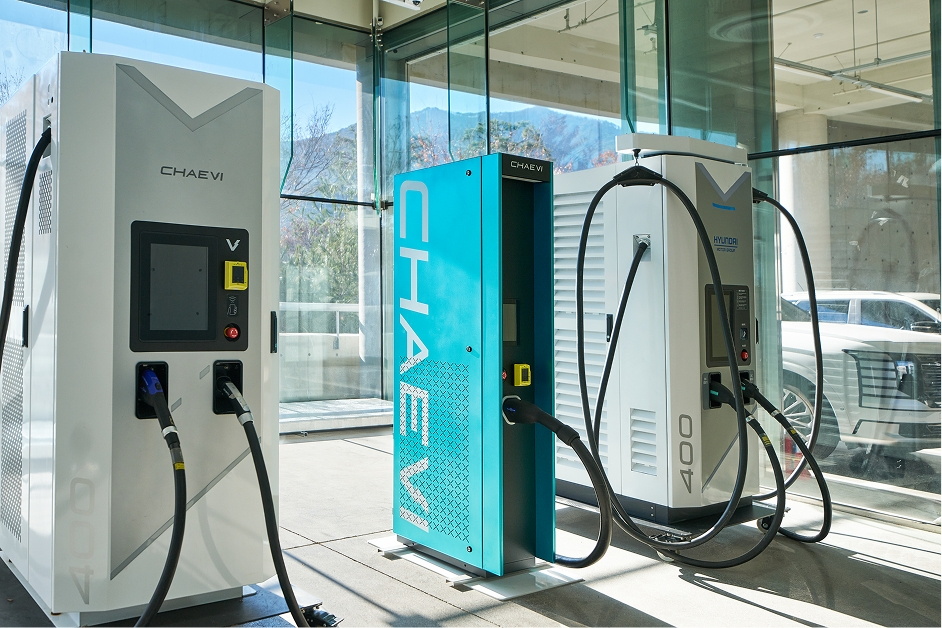
Chaevi, an operator of fast-charging infrastructure for electric vehicles, said Thursday it has installed a 1.2-megawatt (MW) megawatt charging system (MCS) at the Ansan branch of the Korea Electrotechnology Research Institute and begun integrated testing.
MCS is a high-output charging technology designed to supply power to large commercial vehicles, such as electric trucks and buses, whose batteries have seven to 10 times the capacity of those in regular electric passenger cars. The technology is considered key to expanding the adoption of commercial EVs by reducing charging times for large-capacity batteries.
Since 2024, Chaevi has served as the lead organization in a government-funded project to develop and test AI-based, high-efficiency MCS and ultra-fast charging systems. It is conducting the project with 11 participating institutions.
The latest tests bring together two components developed separately: a power bank that supplies electricity and an MCS dispenser that delivers power to vehicles. The integrated system will be tested for performance, safety and reliability.
Chaevi plans to conduct 2,000 hours of testing through early next year, focusing on continuous high-output charging performance and power quality. Based on the results, the company aims to improve the system and advance charging technology for large electric trucks and buses.
"We will expand the charging technology and infrastructure operating capabilities we have built around passenger EVs into the large mobility sector," Chaevi CEO Choi Young-hoon said.
Meanwhile, Chaevi's MCS dispenser won an innovation award in the vehicle technology and advanced mobility category at CES 2026, as well as a consumer choice award in the charging infrastructure manufacturer category at the EV Awards 2026.

 in INDUSTRY
