

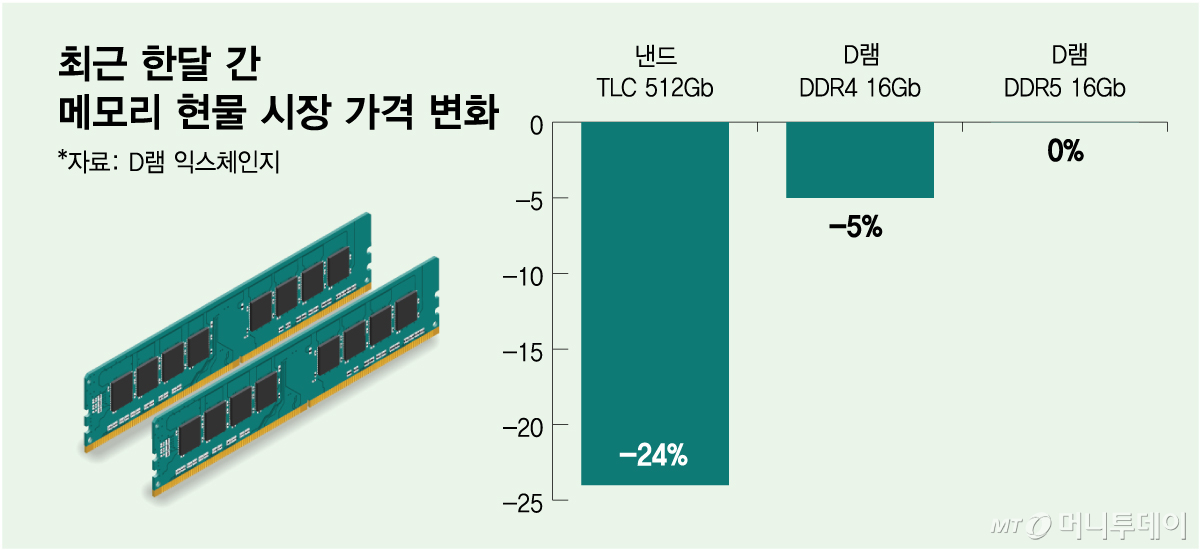
As shortages of memory semiconductors (hereinafter "memory") continue, centered on AI data centers, memory prices for PCs and smartphones are falling. NAND flash (hereinafter "NAND") spot prices have dropped more than 20% in a month. While memory for AI is virtually sold out, a polarization phenomenon is emerging where IT consumer-oriented memory struggles with sluggish demand.
According to market research firm DRAMeXchange on the 19th, the spot price of TLC 512Gb (gigabit) NAND wafers recently fell by 24% from a month earlier to $14.20. During the same period, prices for TLC 1Tb (terabit) products also dropped by 14%.
TLC (Triple Level Cell) is a NAND technology that stores 3 bits of data in a single memory cell. It offers higher storage efficiency and superior price competitiveness compared to SLC and MLC, which store 1 or 2 bits per cell, and is widely used in SSDs (Solid State Drives) for smartphones and PCs.
Memory spot prices are those in the distribution market where small-scale transactions occur among mid-sized finished product manufacturers and memory module companies. Although the total transaction volume is small, these prices quickly reflect supply and demand conditions and market sentiment. NAND spot prices peaked in August last month before turning downward, with the pace of decline accelerating recently.
The drop in NAND spot prices is analyzed as being primarily driven by sluggish demand in the PC and smartphone markets. The cost burden resulting from surging memory prices has led to market contraction. According to Counterpoint Research, global smartphone shipments in the third quarter of this year decreased by 19% compared to the same period last year. PC shipments also fell by 21% during the same period.
Finished product manufacturers are responding to slowing demand by reducing SSD storage capacity or delaying memory purchases, exerting downward pressure on prices. Additionally, weakened NAND orders from Chinese CSPs (Cloud Service Providers) have had an impact. On the supply side, distributors holding inventory are offering products at low prices to secure cash. The combination of reduced demand and inventory disposal has led to lower prices.
The decline in NAND prices that began in the spot market could also affect contract price negotiations between memory manufacturers and customers going forward. Bank of America (BofA) analyzed, "Contract prices for TLC 512Gb NAND wafers have approached historic highs," adding, "If end-users delay urgent orders, contract price negotiations may be postponed, potentially weakening the bargaining power of memory manufacturers."
Legacy production lines, which account for 20% to 30% of global NAND wafer production capacity, are also a factor intensifying downward price pressure. BofA explained that these production lines are unsuitable for enterprise SSDs for AI data centers, where demand has recently surged, and must continue producing NAND for general IT applications such as PCs and smartphones. This means that even if NAND demand for AI increases, it will be difficult to alleviate the supply burden on consumer-oriented NAND.
TrendForce stated, "A reduction in enterprise SSD demand from Chinese CSPs next year is expected to offset order increases in North America," adding, "As oversupply deepens, we predict that overall NAND contract prices in Q1 next year will fall by 0% to 5% compared to the previous quarter."
Spot prices for legacy DRAM are also falling. The spot price of DDR4 (Double Data Rate 4) 16Gb products was $79 on the previous day, down 5% from a month earlier. Prices, which had risen to $93 in early September last month, have continued to decline since then. This is interpreted as being influenced by sluggish PC demand and weakened purchasing sentiment due to high prices. Currently, an inversion phenomenon is also appearing in the spot market where legacy DDR4 prices are higher than those of newer DDR5.
Memory demand for AI infrastructure remains robust. DRAM from Samsung Electronics and SK hynix is virtually sold out through next year's production volume. Global big tech companies are moving to sign long-term supply agreements (LTAs) to secure stable volumes. Memory manufacturers are focusing their production on memory for AI rather than for PCs and smartphones. Spot prices for newer DDR5 have also maintained a stable trend after surpassing $60 last month.
Expanding AI demand is expected to continue driving up HBM (High Bandwidth Memory) and DRAM prices in the future. TrendForce forecast that HBM4 prices next year will rise by more than double compared to this year. As memory manufacturers increase HBM production within limited production capacity, the production capacity available for general-purpose DRAM inevitably decreases.
Sanjay Mehrotra, CEO of Micron, said at the "TomorrowX Summit" held on the 18th (local time), "Supply conditions will be even tighter in next year and 2028 than in 2026," adding, "We are currently discussing volumes for 2028 with customers."

 in INDUSTRY
