

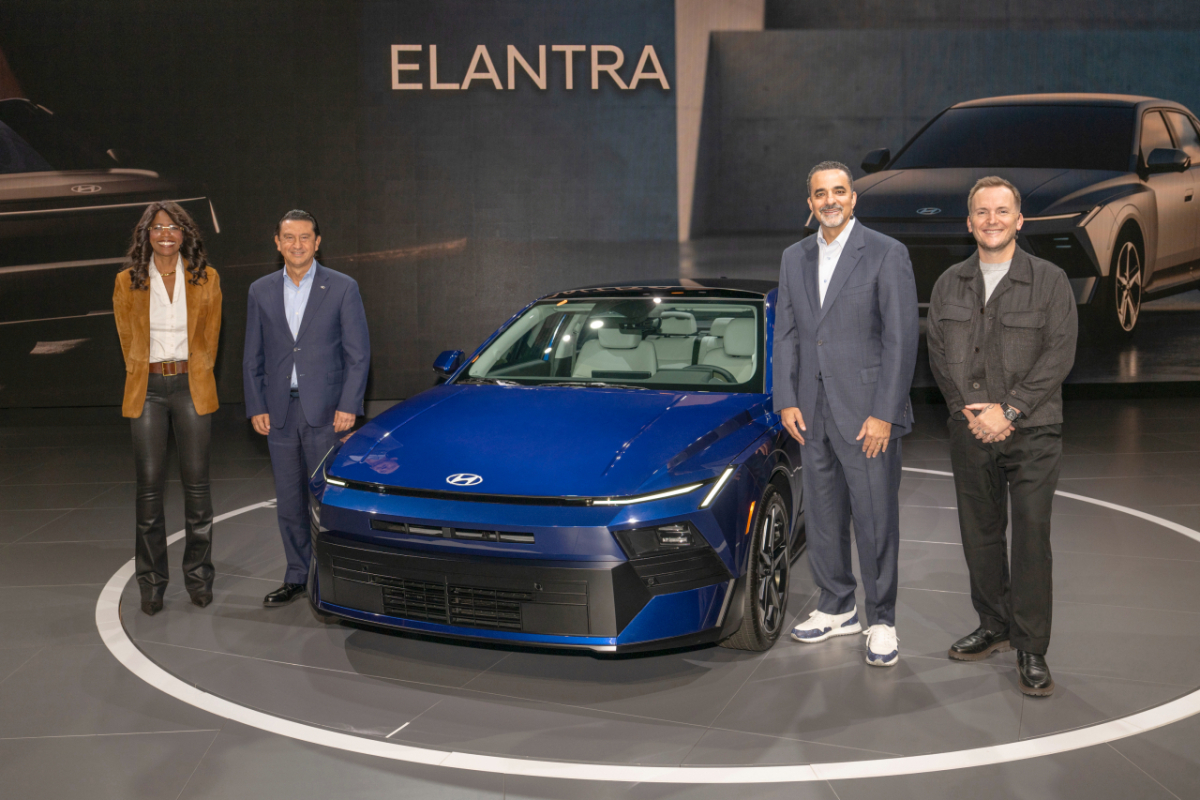
Hyundai Motor unveiled its new Avante and Tucson side by side in the United States. The two models account for 44.1% of Hyundai-branded vehicles sold in the U.S. this year, making them key pillars of the brand's lineup. With production disrupted by strikes at home and sales declining despite market growth in Europe, Hyundai Motor has found its U.S. sales more critical than ever. The company aims to boost its growth trajectory in the U.S. through a generational shift in the best-selling sedan and SUV (multi-purpose sports vehicle) segments locally.
According to automotive industry sources on the 22nd, Hyundai Motor revealed the new Avante (local name: Elantra) at the '2026 LA Auto Show,' currently being held at the Los Angeles Convention Center in the United States. The North American model is 85 mm longer than its predecessor and features a wheelbase extended by 30 mm, offering interior space comparable to that of a midsize sedan. It will be offered with 2.0-liter gasoline and 1.6-liter hybrid powertrains, with the hybrid targeting a fuel efficiency of 22.5 km/L based on pre-certification standards from the U.S. Environmental Protection Agency (EPA). The company also displayed the new Tucson, which is set for launch in North America next year.
Behind Hyundai Motor's strategy to lead with these two models in the U.S. lies sluggish performance in other key markets. Domestically, day and night production lines halted for a total of 120 hours during this year's wage negotiations. The industry estimates that the resulting production disruption amounted to 55,200 vehicles. In Europe, while the overall market grew by 3.7% year-on-year from January to September this year, Hyundai Motor's sales fell by 9.2% to 415,000 units. Essentially, the company failed to produce vehicles on schedule at home and was unable to convert increased demand into sales in Europe.
Consequently, global sales for the third quarter dropped by 11.3% year-on-year to 920,710 units, prompting Hyundai Motor to lower its annual sales target from 4,158,300 units to 4 million units. In October as well, global sales decreased by 6.3% year-on-year to 329,773 units.
In contrast, the Hyundai brand sold 73,452 vehicles in the U.S. in the same month, marking a 5% increase. The Tucson was the top seller, followed by the Avante. From January to October this year, 199,495 Tucsons and 140,614 Avantés were sold, representing year-on-year increases of 6% and 11%, respectively. Combined, the two models account for 339,109 units. Rather than attempting to revive demand for declining models, the company is introducing new vehicles into two lines that have maintained growth, suggesting that the impact of the new models could be maximized.
With nearly 200,000 units sold in the U.S. over ten months, the Tucson can maintain its sales base simply by capturing replacement demand from existing customers. The Avante also plays a role in acquiring new customers. Jose Munoz, Chairman of Hyundai Motor, stated, "The Avante is an incredibly important model, as many customers experience the Hyundai brand for the first time through it."
Genesis, which has faced sluggish sales in the U.S. market, is also counterattacking by adding hybrid powertrains to its key models. Genesis's U.S. sales last month fell by 5.6% year-on-year to 6,623 units. The brand is investing heavily in the U.S. market by unveiling the world's first hybrid version of the G80 sedan at this LA Auto Show and making the GV80 hybrid available to North American audiences for the first time. Additionally, the flagship SUV GV90 was displayed ahead of its launch next year. If Hyundai Motor continues its U.S. sales growth through the generational shift of the Avante and Tucson, Genesis will leverage fuel-efficient hybrids as an opportunity for a turnaround.

 in INDUSTRY
