

Backlash from the private power generation industry is growing over the LMP (regional electricity wholesale pricing system) that the government is pushing forward. This is because private power plants, which are struggling financially due to delays in transmission network construction, forecast that the introduction of this system will result in losses of approximately 650 billion won. Critics point out that the system forces sacrifices from power generators to secure funding for discounted industrial electricity rates in non-metropolitan areas.
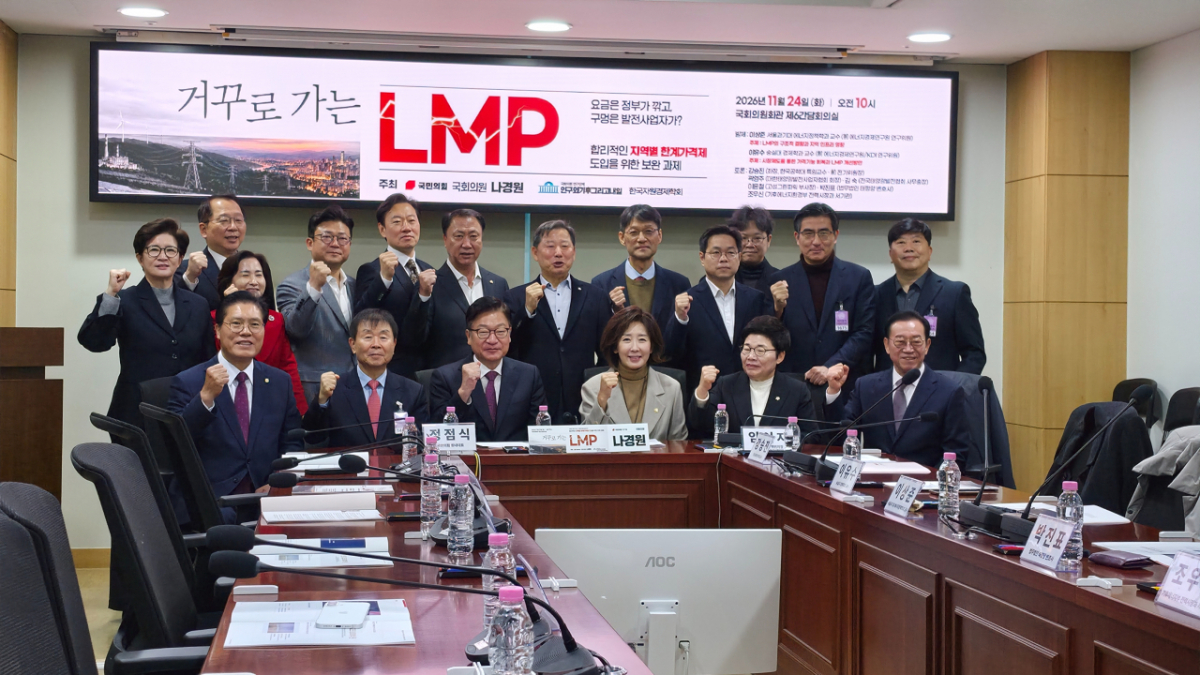
Lee Yu-soo, a professor in the Department of Economics at Soongsil University, stated at the "LMP Going Backwards" symposium, co-hosted on the 24th by People Power Party lawmaker Na Kyung-won and the National Assembly research group "Population, Climate, and Tomorrow" at the National Assembly Member Hall, that "if LMP causes a drop of 20 won per kWh (kilowatt-hour), losses of approximately 652.6 billion won will occur." He added, "Private power plants have already made investments based on government plans and a single price, but changing the rules after the fact is causing significant losses."
He further noted, "LMP, which keeps metropolitan prices fixed while lowering only non-metropolitan prices, is a unilateral reduction of settlement unit prices." He questioned, "The first problem to be solved is electricity rates. How long can this policy of unconditionally shifting responsibility to operators and refusing to raise electricity rates be considered sustainable?"
LMP is a system that calculates regional electricity wholesale prices differently by area, reflecting transmission network congestion and power losses, rather than applying the existing uniform national wholesale price. The issue is that the government is pushing for the introduction of the system by maintaining metropolitan electricity wholesale prices while lowering only non-metropolitan prices. In fact, plans are under discussion to lower the settlement unit prices for non-metropolitan power plants to reduce KEPCO's electricity procurement costs and use these savings as a source for discounted industrial electricity rates in non-metropolitan areas.
The power generation industry views the introduction of this system as a threat to the existence of power plants. Lee Yoon-cheol, Vice President of Goseong Green Power, explained, "Some private coal-fired power plants are purchasing coal on credit because they lack funds to buy it." He added, "If the current LMP system is implemented, each power plant will experience a revenue decrease of at least 100 billion won to 200 billion won." He continued, "Regardless of the power plant, within two to three years, they will run out of money to buy coal, making it impossible to operate the plants. Therefore, LMP is a system that cannot maintain a sustainable ecosystem."
The power generation industry takes the position that existing generation facilities should be excluded from LMP application. While new power plants can determine their locations considering regional electricity prices, it is practically impossible for existing plants to change their locations. In particular, applying LMP to existing generation facilities is expected to place a heavier burden on private power plants than on public ones. This is because public power plants can receive compensation for losses through mechanisms such as the settlement adjustment coefficient and government-approved difference contracts, whereas private power plants are directly exposed to losses from falling wholesale prices.
Experts have unanimously called for improvements to the LMP system. Kang Seung-jin, a special professor at Korea University of Technology and Education (former chair of the Electricity Commission under the Ministry of Climate, Energy and Environment), who served as the moderator for the symposium that day, stated, "The decision to cut industrial electricity rates before introducing LMP is the beginning of all problems." He emphasized, "While there are cases of LMP in other countries, the problem in Korea is that procedures were not followed." Park Jin-pyo, a lawyer at Lee & Ko, also said, "Why are public entities given means to avoid everything while only private entities have to bear it all?" He added, "Even if LMP is introduced, doing so solely through amendments to the Electricity Market Operation Rules without legal basis carries the risk of being unlawful."

 in INDUSTRY
