


Eight out of 10 adults reported feeling that 'mukbang' (eating broadcasts) and food advertisements have influenced their eating habits and health. In particular, the frequency of watching mukbang was positively correlated with the proportion of individuals consuming snacks high in sugar.
Seoul National University Health Culture Project Team said Wednesday that this was revealed through a survey conducted by Korea Research Institute targeting 1,022 adults aged 20 and older nationwide regarding media exposure and perceptions of health policies.
The project team selected four types of media content that could influence health habits—food advertisements, mukbang, alcohol advertisements, and smoking scenes—and asked respondents to what extent each type of content affected their health habits.
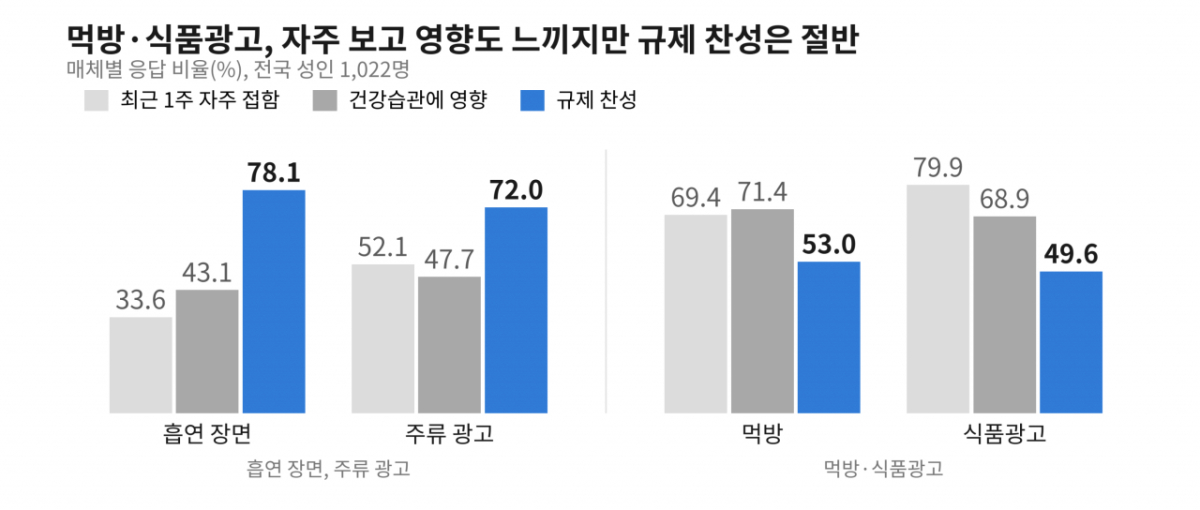
As a result, the most frequently encountered content over the past week was food advertisements (79.9%) and mukbang (69.4%). Alcohol advertisements (52.1%) and smoking scenes (33.6%) followed.
Among the content cited as having an impact on their health habits, mukbang (71.4%) was the most common, followed by food advertisements (68.9%), alcohol advertisements (47.7%), and smoking scenes (43.1%). 78.3% of respondents answered that at least one of mukbang or food advertisements had an impact.
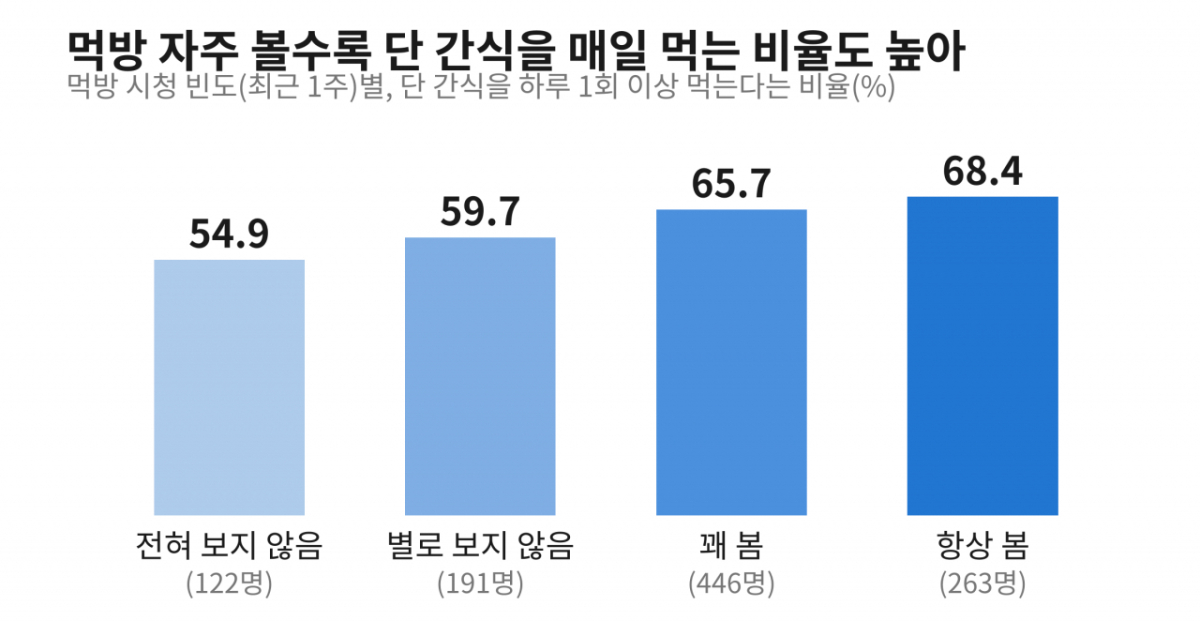
The frequency of consuming sweet snacks also varied depending on how often mukbang was watched. Among respondents who did not watch mukbang 'at all' over the past week, 54.9% consumed sweet snacks once a day or more.
The figures were 59.7% for those who watched 'not much,' 65.7% for those who watched 'quite often,' and 68.4% for those who watched 'always.' The proportion of individuals consuming sweet snacks continued to rise with increased frequency of watching mukbang.
Opinions were divided regarding regulations on different media types. Support for regulating smoking scenes (78.1%) and alcohol advertisements (72.0%) exceeded 70%.
In contrast, support rates for regulating food and restaurant programs such as mukbang and food advertisements were 53% and 49.6%, respectively. Support for mukbang regulation was 30.4% among those in their 20s, 33.5% among those in their 30s, and 62% among those aged 40 and older, indicating that younger demographics were more negative toward media regulations overall.
Support rates for regulation were not significantly different from eight years ago. According to a survey conducted in 2018 by Yoon Young-ho, head of the Seoul National University Health Culture Project Team (Professor at Seoul National University College of Medicine), support for mukbang regulation was 51.9%, and support for food advertisement regulation was 44.1%.
In this survey, support for mukbang regulation was 53%, nearly identical to the previous figure, while support for food advertisement regulation rose slightly to 49.6%. However, support rates for regulation remained around half.
No significant differences by income level were found in attitudes toward solving problems through regulation.
When monthly average household income was categorized as less than 3 million won, 3 million to less than 6 million won, and 6 million won or more, the differences in support rates for regulating all four types of media content across income brackets were minimal.
In the previous 2018 survey, there were no income-based differences in support for mukbang and food advertisement regulation, but support for regulating smoking scenes was higher among those with higher incomes. This gap has disappeared in the current survey.
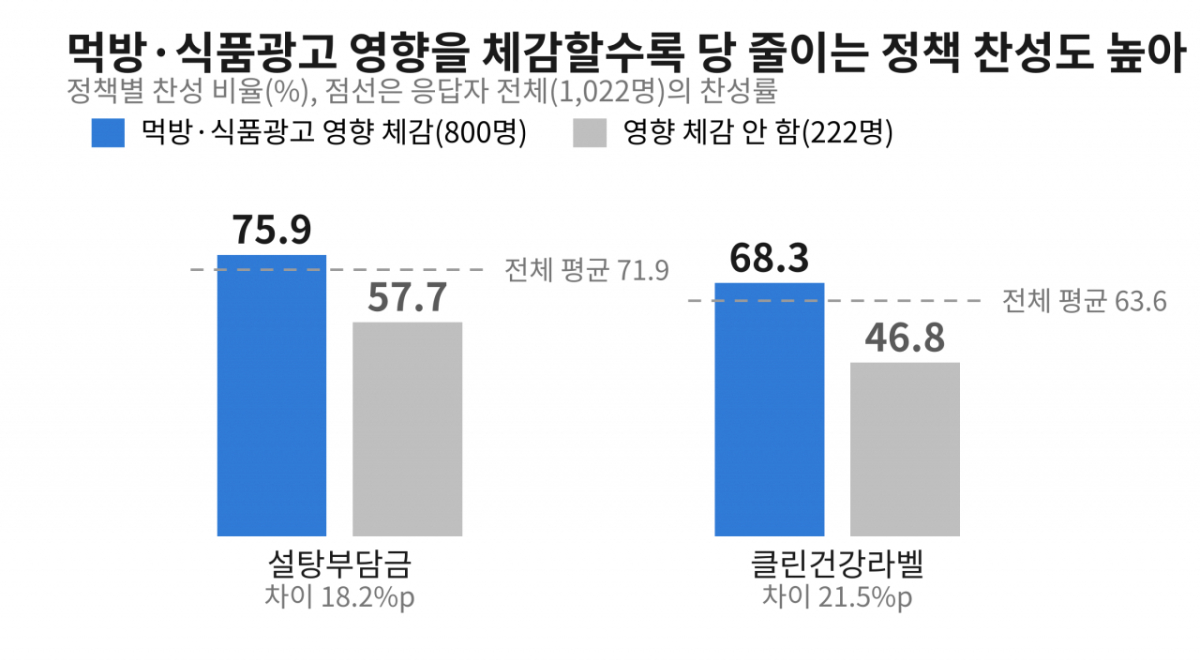
Respondents showed a tendency to support health-friendly policies more strongly as they perceived a greater impact of media on their eating habits. 71.9% of all respondents supported the introduction of a 'sugar tax' that imposes a levy on beverages high in sugar.
Among those who answered that mukbang and food advertisements influenced their health habits, 75.9% expressed support, which was 18.2 percentage points higher than the group that did not feel such influence (57.7%).
The project team also proposed the introduction of a 'Clean Health Label' in this survey.
The Clean Health Label is a system that grants certification marks to restaurants, cafes, convenience stores, and confectionery shops that serve menus with reduced sugar and sodium content. 63.6% of respondents supported the proposal, with the group that felt media influence (68.3%) showing support 21.5 percentage points higher than the group that did not (46.8%).
Project Team Head Yoon Young-ho proposed the introduction of a Clean Health Label certification system, saying, "It is necessary to consider introducing warning statements or labels so that consumers can easily and quickly recognize the harmful aspects of mukbang and food advertisements."

 in THEBIO


