

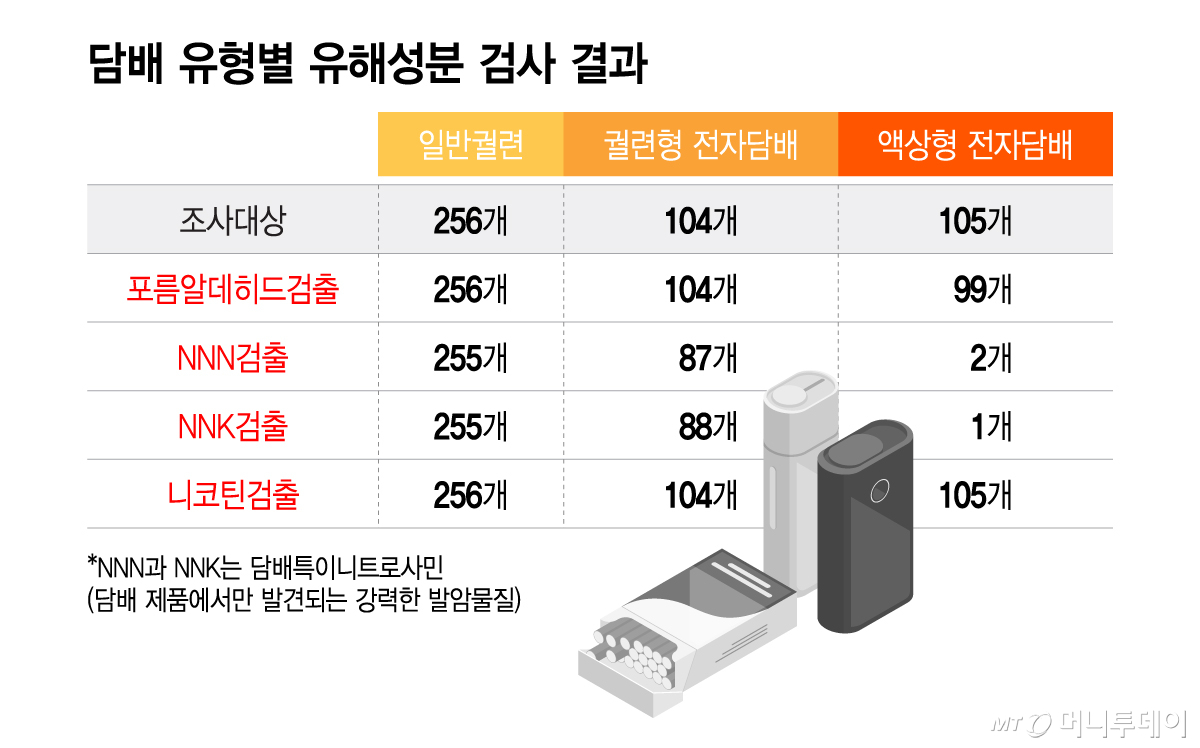
As heated tobacco products have spread on the grounds that they contain fewer harmful substances than conventional cigarettes, the overall tobacco product usage rate has actually risen slightly over the past seven years. While the smoking rate of conventional cigarettes is declining, e-cigarette use is increasing, resulting in a trend where users are switching tobacco types or using multiple products simultaneously rather than quitting smoking.
According to tobacco harmful component test results released on the 29th by the Ministry of Health and Welfare and the Ministry of Food and Drug Safety, formaldehyde was detected at 39.5 to 181 micrograms per stick in conventional cigarettes, while it was measured at 5.4 to 12.1 micrograms in heated tobacco products.
Group 1 carcinogens were confirmed in all products, regardless of whether they were conventional or e-cigarettes, but formaldehyde was detected at lower levels in e-cigarettes compared to conventional cigarettes. The government cautioned that the lower detection levels should not be interpreted as meaning e-cigarettes are less harmful based solely on simple numerical values.
In fact, the tar detection ranges for conventional cigarettes and heated tobacco products were 11.7 to 40.4 mg per stick and 10.3 to 32.0 mg per stick, respectively, showing similar categories. Tar is the total amount of various particulate matter and includes multiple harmful substances and carcinogens. Nicotine, which causes addiction, was also detected at considerable levels, with conventional cigarettes ranging from 0.8 to 2.6 mg per stick and heated tobacco products from 0.1 to 1.2 mg per stick.
When evaluating the logic of reduced harm from e-cigarettes, it is necessary to examine not only the ingredients of individual products but also actual tobacco use behaviors. This is because it is a critical issue whether e-cigarettes lead to smoking cessation beyond merely replacing conventional cigarettes, and whether existing smokers are using both products simultaneously. In fact, domestic statistics show an increase in e-cigarette use occurring simultaneously with a decrease in conventional cigarette smoking.
According to the KDCA Community Health Survey, the adult conventional cigarette smoking rate last year was 17.9%, down by 1.0 percentage points (P) from the previous year. In contrast, the usage rate of heated tobacco products rose by 0.3%P to 6.3%, and the usage rate of liquid e-cigarettes rose by 0.5%P to 4.5%.
The changes become even more distinct when looking at a longer period. Compared to 2019, the conventional cigarette smoking rate decreased by approximately 12% last year, but the usage rate of heated tobacco products increased by 90.9%, and the usage rate of liquid e-cigarettes increased by 73.1%. During the same period, the overall tobacco product usage rate actually rose by 0.5%P. This means that the spread of e-cigarettes has not led to a decrease in the total population using tobacco products.
The smoking cessation attempt rate also declined. The smoking cessation attempt rate among tobacco product users last year was 40.6%, down by 2.0%P from the previous year. The KDCA explained that for multiple tobacco users, nicotine dependence is higher, reducing the likelihood of successful quitting, and the possibility of simultaneous exposure to various harmful chemicals increases, which can lead to greater health hazards.
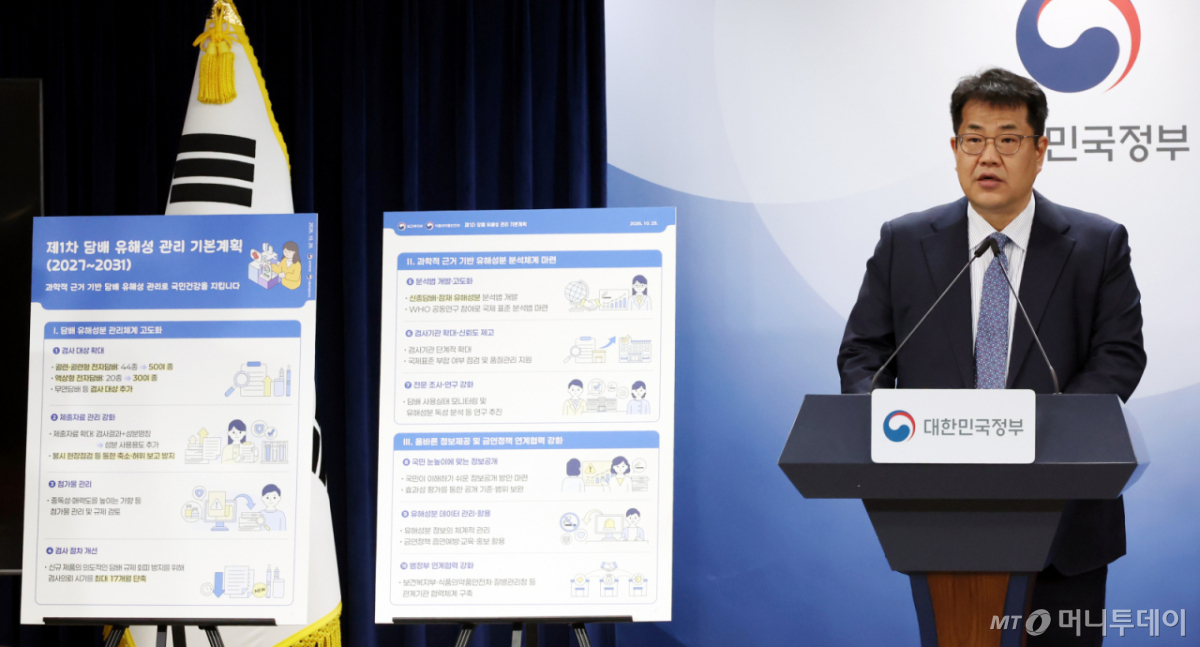
Based on such gaps, the government is expected to diversify the types of tobacco subject to management further. It plans to expand testing targets to include smokeless tobacco and leaf cigarettes, which were not included in this test, starting from 2029. The government is also reviewing the need to apply the current testing system's scope and establish separate testing methods for similar nicotine products, and plans to announce research results in December.
There are still limitations in testing liquid e-cigarettes as well. The government plans to develop standard e-cigarette devices and testing methods so that it can test actual exhaled emissions in the future. It also plans to monitor actions by tobacco companies that excerpt only some harmful component test results to promote specific products as if they are less harmful.
Lee Seong-gyu, director of the Korea Tobacco Regulation Research and Education Center, said, "There are more than 7,000 unknown harmful substances in tobacco, and this disclosure of harm information is just the tip of the iceberg in determining harmfulness," adding, "Thinking that what I am using is less dangerous is a great mistake, so we must discover and increase the number of tested components and systematize the methods."

 in LIVING

