

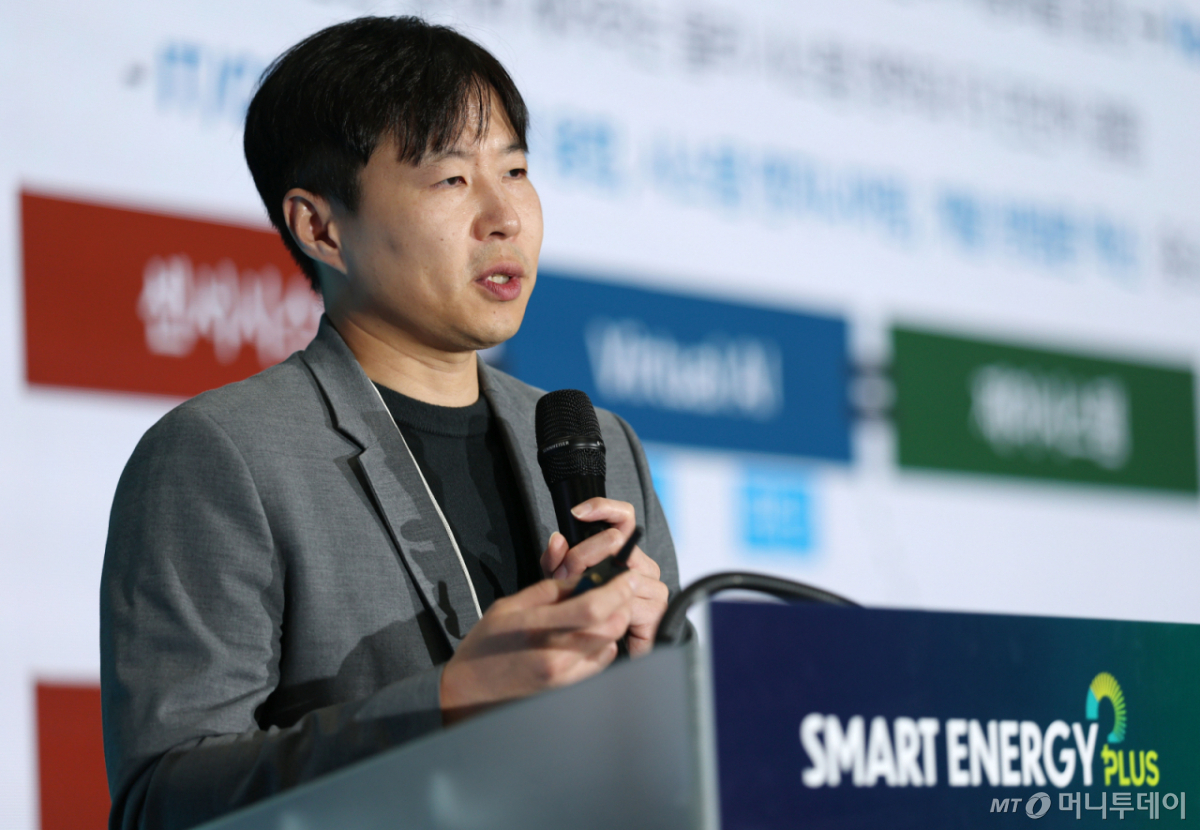
"Currently, there are many very old legacy pieces of equipment in the manufacturing ecosystem. We believe that converting this manufacturing system into an autonomous physical system offers far greater and more immediate practical benefits, making it a far more urgent priority."
Yoon Il-yong, head at POSCO Holdings' Future Technology Research Institute, made the remarks while delivering a presentation on "The AI Vision and Energy of the POSCO Group" at "Smart Energy Plus 2026," at COEX in Seoul Samsung-dong, Wednesday.
He said that humanoid robots are in a state where there is realistically time available, so robotization is showing results in the field first. Robotization is a technology that combines existing manufacturing equipment with artificial intelligence (AI) to enable it to operate autonomously like a robot.
The POSCO Group is focusing on the AI automation of its existing manufacturing equipment. Yoon said, "We define physical AI somewhat more broadly," explaining, "We define physical AI as the ability for AI to manipulate the real world by recognizing the real environment, making autonomous judgments, and controlling physical systems."
As an actual application case, he presented the automation technology for coil unloading cranes at steel plants. This is a task where the crane must independently recognize the position of steel coils because the truck's stopping position and angle vary each time. The POSCO Group utilizes a method of pre-developing AI models and control systems in a virtual space.
Yoon said, "In one case, we completed about 80 percent of the development before sensors were directly installed on site," adding, "We can analyze where to place how many LiDAR units and how to install them in the virtual space, and pre-create AI models."
The group is also promoting the unmanned operation of large equipment used for unloading raw coal from ships. This involves recognizing the structure of the ship's cargo hold and pre-developing the movement of the bucket that scoops up the raw coal in a virtual space; it is currently in the trial run stage.
The "Sim2Real" technology, which reduces the gap between the virtual space and the real environment, is also being advanced. To this end, kinematic modeling is being performed to implement equipment movements in a virtual space, and simulation technologies are being developed that reproduce actions such as workers walking, falling, or running.
"Energy GPT," which optimizes energy usage across the entire production process, is also a key development project. The goal is to improve the overall energy efficiency of the steel plant by comprehensively analyzing production volume and operating conditions for each process.
Yoon said, "The best decision to reduce energy the most is not to produce at all," explaining, "In the case of energy, there is a complete conflict with production." He added, "Given that 'how to make the optimal decision' is important in such contradictory situations, data must be connected, and the tacit knowledge and expertise within it must be accumulated."
Efforts are also underway to convert the know-how of highly skilled workers into knowledge that AI can utilize.
Yoon said, "Many highly skilled workers are approaching mandatory retirement age, and the working-age population is steadily decreasing," adding, "We aim to formalize tacit knowledge so that the know-how of highly skilled workers can be transferred, and to develop factory operations into autonomous systems based on this formalized knowledge."
Above all, the POSCO Group is pursuing humanoid robot development in parallel with the automation of existing equipment. It is focusing on force control technology and securing tactile data so that robots can handle equipment and tools precisely at steel plants and secondary battery material production sites. Yoon emphasized, "Collecting data on force and touch and training models with it is the most important priority."

 in INDUSTRY
