



Coupang has strongly protested the Korea Fair Trade Commission (hereinafter KFTC)'s imposition of a massive fine in the 300 billion won range, far exceeding expectations, over allegations that its delivery app Coupang Eats demanded "Most Favored Nation" treatment. In particular, Coupang's internal assessment is that the intent behind the case was to inflict economic damage by deviating from the essence of the matter, as the relevant sales figure serving as the basis for the fine increased substantially from 710 billion won to 5 trillion 14.9 billion won.
On the 9th, Coupang issued an official statement regarding the KFTC's imposition of a 300.8 billion won fine on Coupang Eats' "Most Favored Nation" demand behavior, stating that it is "an amount more than 600 times larger compared to past cases sanctioned for similar charges" and that it "violates the principle of equity."
In a review report sent to Coupang in June, the KFTC estimated sales related to "Most Favored Nation" demands at approximately 710 billion won. The expected fine based on this was in the range of 25 billion to 42 billion won, yet the commission decided on a fine exceeding ten times that amount.
The June review report had only extracted sales (transaction values) from franchisees and business locations that received "Most Favored Nation" request contacts, based on documents submitted by Coupang Eats. However, during the plenary session deliberation process, it subsequently aggregated sales from all Coupang Eats registered stores that did not separately receive such contacts. The KFTC determined that Coupang Eats had made direct or indirect "Most Favored Nation" demands to virtually all franchisees during the alleged violation period (July 2023 to January 2026). In addition, the KFTC explained that it aggravated the fine by 20% because Coupang had a history of past legal violations. This effectively emphasized the nature of the measure as a "punitive sanction."
Coupang takes the position that it cannot accept this decision by the KFTC. Coupang countered, stating, "The essence of this case is that efforts to provide better service were instead judged illegal," and added, "Since implementing free delivery for Wow members as a late entrant in the delivery app market, sales of merchants registered on Coupang Eats have increased by an average of 98% over one year, and the store burden per order has decreased by 5%."
Coupang also viewed the KFTC's fine calculation criteria as opaque. It argued that it is unfair to apply the "up to 6% of sales" fine rule, identical to that for the market leader, to Coupang Eats, which had a market share of less than 10% in 2023 when the incident occurred, and that it is difficult to accept the substantial increase in relevant sales from 710 billion won to the 5th trillion won range within five months.
Coupang claimed, "They expanded the scope to 'total delivery sales,' which are unrelated to the charges stated in the review report, increasing the fine by up to more than ten times," and argued, "If you change the fine calculation criteria entirely and stretch the fine like a rubber band, corporate defense rights will inevitably be severely infringed."
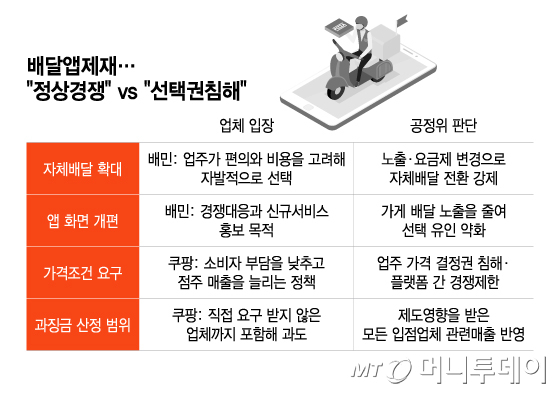
Along with Coupang, the KFTC imposed a 331.1 billion won fine on Baemin, which includes a 160.2 billion won fine for "Most Favored Nation" demands, as well as sanctions for forced conversion to in-house delivery and deceptive advertising that were excluded from the Coupang Eats case.
For these reasons, concerns are emerging in the platform industry about "high-intensity regulation without the Online Platform Act." This is because it has been confirmed that fines in the hundreds of billions of won can be imposed under current laws without legislation, and even demands for fee structure reform can be made. There are indications that this ruling could set a precedent spreading to other platforms such as shopping and reservations.
The platform competition promotion legislation, known as the "Online Platform Act," is a concept designed to promptly regulate dominant businesses by designating them in advance, addressing △self-preferencing △tying △multi-homing restrictions that prevent use of multiple platforms △and "Most Favored Nation" demands. Bills related to the Online Platform Act remain at the review stage of the Political Affairs Committee, the relevant standing committee of the National Assembly. Processing has been delayed due to overlapping concerns over trade friction stemming from backlash against discriminatory regulations on U.S. companies and disagreements between ruling and opposition parties. On September 16, the bill also failed to be placed on the agenda of the legislative subcommittee due to a lack of agreement between the ruling and opposition parties.

 in LIVING


