

[For more diverse corporate information on startups, please visit 'Data Lab' on the Unicorn Factory big data platform .]
While space may appear infinite, the area available for industrial use is limited. Low Earth Orbit (LEO), which is close to Earth and offers short communication delays and advantages for repeated observation, has already become a congested zone filled with numerous satellites and space debris.
Nations and companies are engaged in fierce competition to secure orbits for satellite operations and frequencies required for ground communications. Given that the structure favors countries that apply first and actually deploy satellites, the options available to latecomers inevitably shrink as their response is delayed.
The center of gravity in this competition has also shifted. In the past, developing a single high-performance satellite was crucial; now, the ability to repeatedly launch dozens or hundreds of satellites and operate them as constellations determines industrial competitiveness.
The capability to connect data generated by satellites to actual decision-making has also become important. To generate revenue, it is necessary to integrate different types of data—such as optical, Synthetic Aperture Radar (SAR), hyperspectral, and Radio Frequency (RF)—analyze them using AI (Artificial Intelligence), and apply them to fields such as communications, defense, disaster management, agriculture, and logistics.
The uses of Low Earth Orbit extend beyond communications and Earth observation. New markets are emerging, ranging from pharmaceutical and semiconductor manufacturing utilizing microgravity environments to space data centers, repair and refueling of malfunctioning satellites, and the removal of end-of-life satellites.
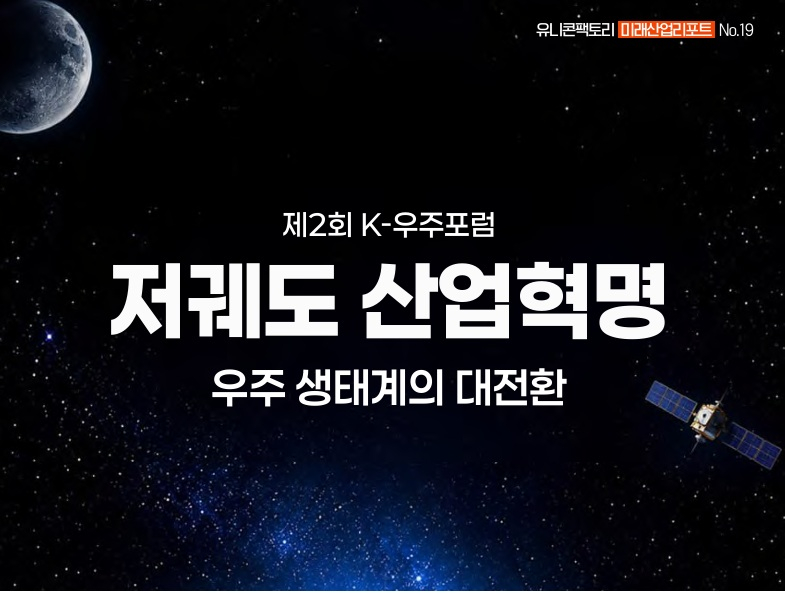
Issue No. 19 of Unicorn Factory's "Future Industry Report" covers key discussions from the "2nd K-Space Forum," held on October 28 at Seoul COEX. Under the theme "Low Earth Orbit Industrial Revolution: A Paradigm Shift in the Space Ecosystem," it provides an overview of survival strategies for the K-space industry presented by the government, major corporations, research institutions, startups, and VCs (Venture Capital).
The report examines the policies and corporate strategies necessary for Korea to build an independent Low Earth Orbit industrial ecosystem. It outlines the government's medium- to long-term roadmap, including the national strategic assetization of orbits and frequencies, the construction of a domestic Low Earth Orbit satellite communication network, strengthening Space Situational Awareness (SSA) capabilities, and the development of space data centers and on-orbit services.
It also covers private sector movements. This includes Hanwha Group's concept of "Integrated Space Infrastructure," which connects launch vehicles, ultra-low orbit observation networks, space AI data centers, and satellite communication networks, as well as an in-depth look at non-space companies such as Samsung Electronics, SK hynix, and Borin expanding their business areas into Low Earth Orbit.
In particular, it addresses the conditions required for Korea's space industry to transition from a government R&D (Research and Development)-centric model to a private service market. It also includes voices from the field stating that the government must not remain merely in the role of commissioning technology development but should become the "first customer" by purchasing private services such as observation imagery, communications, and space situational awareness.
It also introduces stories of K-Newspace startups, including Walkerinspace, which is challenging satellite repair and life extension; CSO, which developed ultra-small space cameras; and Space Lab, which is securing satellite refueling and orbital transport technologies. It examines what technologies these companies are leveraging as weapons to prepare for global expansion.
Possessing space technology alone is not enough to secure space sovereignty. One must be able to launch satellites when needed, collect and analyze data, and utilize it as desired services. This report captures why launch vehicles, satellites, data, services, policies, and investments must be connected into a single industrial ecosystem.
Detailed content can be found in the full version of the Future Industry Report. On mobile devices, scan the QR code below; on PC, click [☞Future Industry Report ⑲ 'Low Earth Orbit Industrial Revolution: A Paradigm Shift in the Space Ecosystem' Download].

[MoneyToday startup media platform 'Unicorn Factory']

 in FUTURE

