

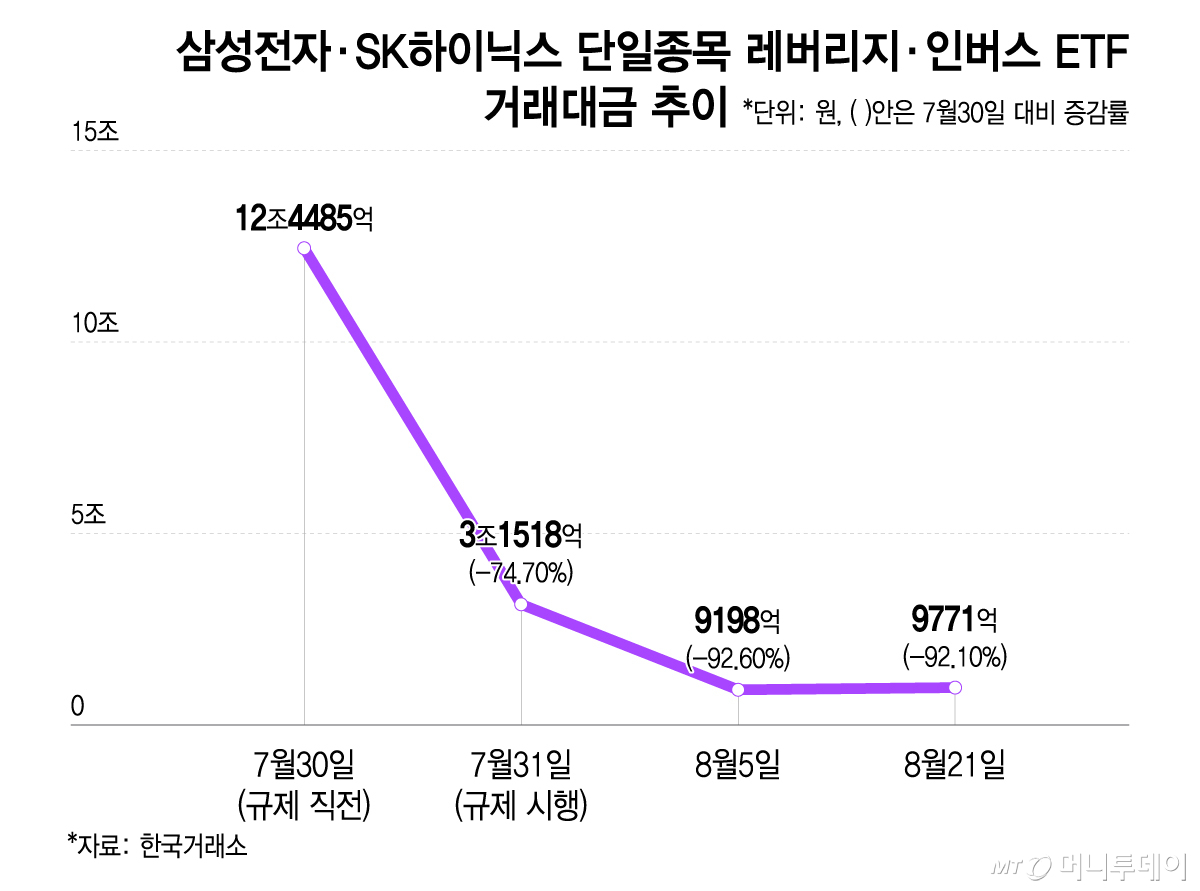
Global markets are seeing a sharp divergence between high-risk leverage betting and the cooling of overheated conditions in Korea. Recently, low-price buying of sharply fallen leverage products is heating up global markets. In contrast, the frenzy over single-stock leverage products in Korea is quickly subsiding. Large-scale funds have flowed net into overseas-listed SK Hynix single-stock leverage products, but trading volume for domestic Samsung Electronics and SK Hynix-related products has dropped by more than 90% since stricter regulations were implemented.
According to the financial investment industry on the 24th, the Financial Times (FT) reported on the 23rd that global investors are heavily buying leverage products at low prices despite a sharp drop in semiconductor stocks. FT compared this investment behavior—buying while expecting a rebound despite accepting additional downside risk during falling prices—to "catching a falling knife."
FT cited SK Hynix as a representative example. The Hong Kong-listed "CSOP SK Hynix Daily (2x) Leveraged Product," managed by CSOP Asset Management, is a single-stock leverage product that tracks twice the daily return of SK Hynix stock alone. Although this product has fallen 86% from its peak, more than $1 billion in net inflows have been recorded over the past six weeks. A single-stock leverage product based on U.S. memory company SanDisk also fell 85% from its peak, yet saw $350 million in net inflows.
The media highlighted the Korean market, noting that although financial authorities have strengthened regulations on single-stock leverage products, market assessments suggest investors' high-risk behavior has not changed sufficiently. Fabiana Fedeli, Chief Investment Officer (CIO) of M&G, stated, "While a significant portion of the market bubble may have burst, I do not believe investment behavior itself has changed," and added, "The measures taken by regulatory authorities also do not appear to be fully effective."
However, the actual trading flow in Korea's single-stock leverage market has changed significantly. Financial authorities raised the entry barrier for investors by increasing the basic collateral requirement for domestically and overseas-listed single-stock leverage products from 1 trillion won to 0.3 billion won in cash starting on the 31st of last month.
Trading volume plummeted immediately after the regulatory tightening. The daily trading volume of 16 domestically listed Samsung Electronics and SK Hynix leverage and inverse ETFs reached 12.4485 trillion won on the 30th of last month, but dropped sharply to 3.1518 trillion won on the 31st when regulations took effect. By August 5, it fell below 1 trillion won for the first time at 919.8 billion won. Even three weeks after the regulations were implemented, trading volume had not returned to previous levels. On the 21st, trading volume stood at 977.1 billion won, a 92% drop compared to just before the regulations took effect.
Financial authorities also consider the domestic single-stock leverage market to be stabilizing. A financial authority official said, "Trading has decreased compared to before, and we view the current market as being on a stable trend," adding, "We continue to monitor the situation and are proceeding without delay with the supplementary measures previously announced." Although FT conveyed market doubts about the effectiveness of Korea's regulations, at least based on trading volume data, the domestic single-stock leverage market appears to have entered a stable phase.

 in STOCK
