

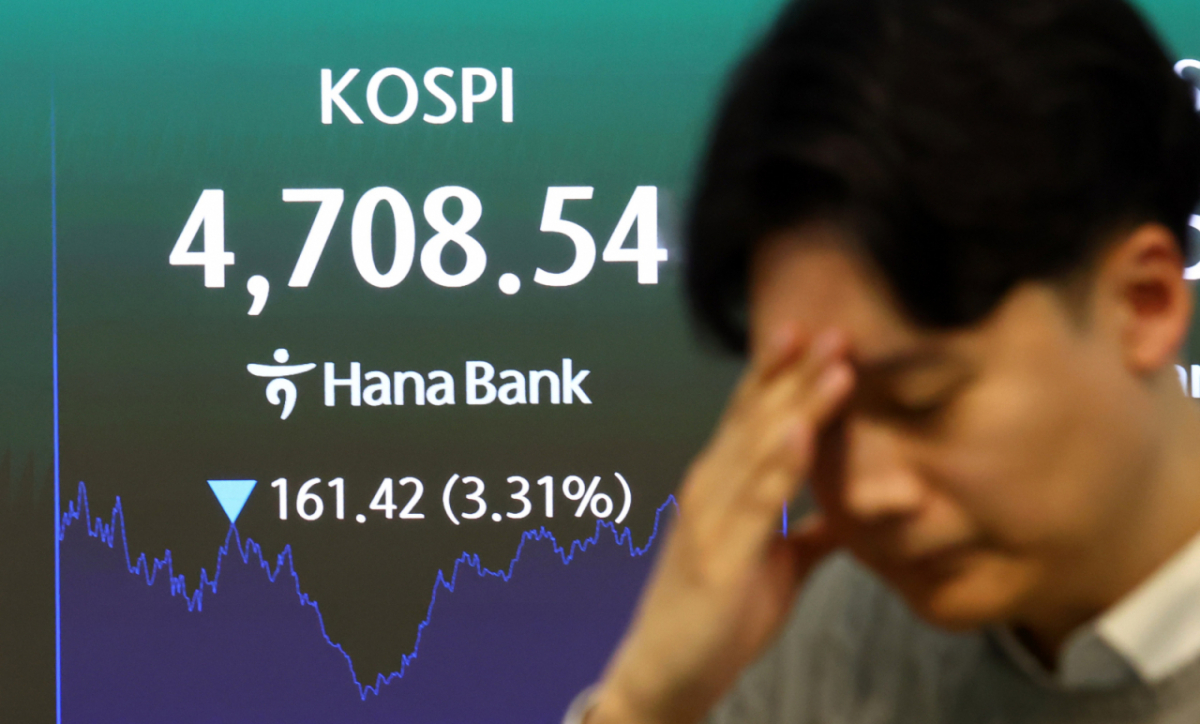
KOSPI barely held the 4,700 line. Following the impact of AI (artificial intelligence) technology stocks wobbling in the United States on the 20th (local time), with the Philadelphia Semiconductor Index plunging by more than 10%, KOSPI also fell to the 4,500 line during trading hours but narrowed its decline as bargain-hunting buying came in.
Although there had been expectations that investor sentiment would recover after the government announced preparations to activate the Securities Market Stabilization Fund (Market Stabilization Fund) on the previous day, opinions are prevalent in the securities industry that such an effect will be limited.
On the 23rd, KOSPI closed at 4,708.54, down 161.42 points (3.31%) from the previous trading session. On this day, KOSPI opened at the 4,734 line and failed to hold the 4,800 line. It plunged by more than 5% during trading hours, triggering the 60th sidecar (futures market circuit breaker) of this year. This is the 32nd sell-side sidecar. KOSPI fell as low as 4,586.80 before narrowing its decline. In the KOSPI market, 824 stocks declined, while only 71 stocks closed higher.
The simultaneous drop in major U.S. stock indices on the 20th (local time) acted as downward pressure on the domestic stock market. On the New York Stock Exchange, the NASDAQ Composite Index fell by 5.28%, the S&P 500 Index dropped by 3.70%, and the Dow Jones 30 Industrial Average declined by 1.93%. The Dow Jones Industrial Average and the S&P 500 Index fell by more than 10% from their previous highs, entering a correction phase. The NASDAQ Index gave back all of its gains for this year. The Philadelphia Semiconductor Index plunged by 10.7%.
Yang Hyeon-gyeong, a research analyst at iM Securities, said, "Suspicions of export control violations surrounding AMD's transactions with sanctioned Chinese companies, concerns over Broadcom's demand slowdown due to Google's outlook for reducing shipments of its TPU (Tensor Processing Unit) 8i next year, and reports of an accounting treatment investigation by the U.S. Securities and Exchange Commission (SEC) into NVIDIA influenced the sharp drop in U.S. semiconductor stocks."
There is also an assessment that KOSPI fell relatively less compared to the Philadelphia Semiconductor Index's plunge of more than 10%. This is because KOSPI had already pre-emptively reflected the shock by falling more than 5% on the previous trading day, the 20th. It opened lower as supply and demand skewed due to Anthropic's NASDAQ listing and risks related to AMD's China exports emerged, and sell-side sidecar was triggered in both the KOSPI and KOSDAQ markets for the first time in two weeks.
Opinions are emerging that market stabilization policies, such as the government's announcement of preparations to activate the Market Stabilization Fund on the previous day, are insufficient to turn around investor sentiment.
A research analyst at a securities firm who requested anonymity analyzed, "KOSPI market capitalization is 400 trillion to 500 trillion won, but the Market Stabilization Fund is only about 1 trillion won in scale, which is too small to change the trend," adding, "The policy plays a role in supporting the lower bound of the index, and ultimately, a rebound will be possible only if global macro conditions or AI skepticism improve."
On this day, in the KOSPI market (based on Korea Exchange standards), retail investors and foreign investors made net sales of 367 billion won and 237.2 billion won, respectively. Institutional investors made net purchases of 187.1 billion won.
Among institutional investors, financial investment entities, which include retail investors' ETF (Exchange-Traded Fund) volumes, made net purchases of 480.8 billion won. Other corporate entities, reflecting SK hynix's share buyback volume, bought 426.8 billion won worth of stocks. Foreign investors continued net sales for seven consecutive trading days since the 13th.
All KOSPI sectors closed lower. IT (Information Technology) services plunged by more than 8%. Construction fell by more than 6%, while general services and insurance ended weak, down by more than 5%. Pharmaceuticals, telecommunications, entertainment and culture, transportation and warehousing, distribution, and others fell by more than 4%.
Finance, transportation equipment and parts, paper and wood, electricity and gas, real estate, metals, machinery and equipment, textiles and apparel, and others dropped by more than 3%. Electronics, chemicals, manufacturing, securities, food and tobacco fell by more than 2%. Medical and precision instruments closed slightly lower.
Among top KOSPI market capitalization stocks, KB Financial Group, Celltrion, and Hyundai Motor fell by more than 5%. Samsung Biologics Logistics dropped by more than 4%. Samsung Electronics declined by more than 3%. SK hynix, LG Energy Solution, and Hyundai Motor all slipped by more than 2%. SK Square and Samsung Electro-Mechanics closed slightly higher.
KOSDAQ closed at 635.45, down 10.23 points (1.58%) from the previous trading session. On this day, KOSDAQ fell as low as 618.74 during trading hours, setting a new year-to-date low.
In the KOSDAQ market, retail investors and foreign investors made net sales of 174.3 billion won and 34.1 billion won, respectively. Institutional investors made net purchases of 197.9 billion won.
All KOSDAQ sectors also fell. Publishing and media reproduction dropped by more than 4%, while finance fell by more than 3%. Distribution, general services, transportation and warehousing, paper and wood, textiles and apparel, food and tobacco, non-metals, IT services, and others fell by more than 2%. Medical and precision instruments, telecommunications, pharmaceuticals, electronics, chemicals, metals, manufacturing, and other manufacturing dropped by more than 1%. Transportation equipment and parts, construction, and machinery and equipment remained slightly lower.
Among top KOSDAQ market capitalization stocks, Alteogen, Ecopro, and Ecopro BM fell by more than 3%. Jusung Engineering declined by more than 2%. Rainbow Robotics, HLB, and Rino Industrial dropped by more than 1%. Iotech closed slightly higher. Simmtech and Robotis rose by more than 2% and 5%, respectively.
On this day, in the Seoul foreign exchange market, the won/dollar exchange rate ended daily trading at 1,345.9 won, up 9.7 won from the previous session's closing price.

 in STOCK
