

As margin investing (investing with debt) (borrowing to invest) surged amid a bull market in the stock market during the first half of this year, securities firms' receivables risk amounts were confirmed to be at their highest level since 2024. Receivables, which had declined due to KOSPI corrections, jumped 27% within just three trading days, signaling that margin investing (investing with debt) is rising again. Unlike credit financing, receivables are not subject to a statutory cap on securities firms' own capital, prompting calls for integrated management.
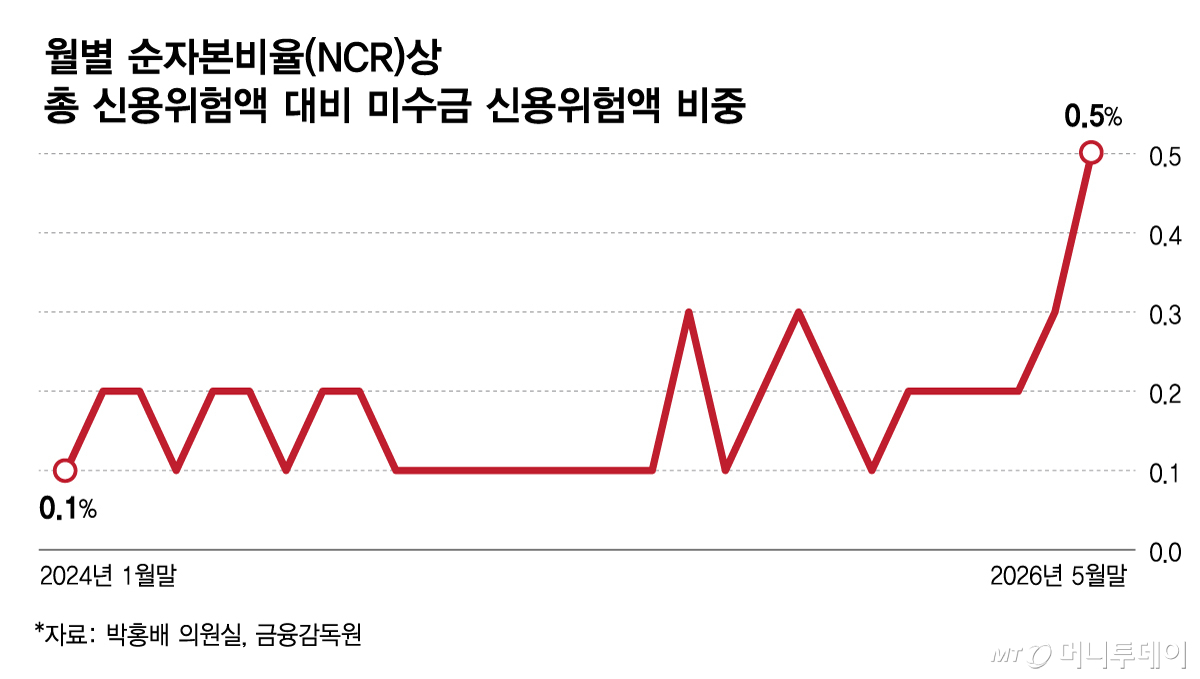
According to data submitted by the Financial Supervisory Service to the office of Park Hong-bae, a member of the Democratic Party of Korea's National Assembly Political Affairs Committee on the 24th, the share of receivables within domestic securities firms' credit risk amounts reached 0.5% as of the end of May. This marks a fivefold surge in just six months from 0.1% at the end of last November, reaching the highest level since January 2024. Receivables refer to loans provided by securities firms to investors for the shortfall when purchasing stocks until the actual settlement date (order date + two days), commonly known as ultra-short-term margin investing (investing with debt).
Especially as receivables held by individual investors increased in the second quarter of this year, the share of receivables within securities firms' credit risk expanded significantly. The average was 0.15% in 2024 and rose slightly to 0.158% last year. While the risk amount share remained at 0.2% during the first quarter of this year, it surged vertically to 0.3% by the end of April and 0.5% by the end of May.
This indicates a sharp increase in the proportion of receivables within securities firms' risk amounts. Securities firms reflect credit risk amounts when calculating the Net Capital Ratio (NCR), a financial soundness regulation. The fact that customer receivables accounted for 0.5% is the highest since January 2024.
Looking at the trend of monthly average receivables increases, the peak was reached in May-June this year. Monthly average receivables stood at 1.0195 trillion won in January, rising to 1.3849 trillion won in May—an increase of 365.4 billion won (35.84%). In June, it surged further to 1.4321 trillion won, a jump of 412.6 billion won (40.47%) compared to January.
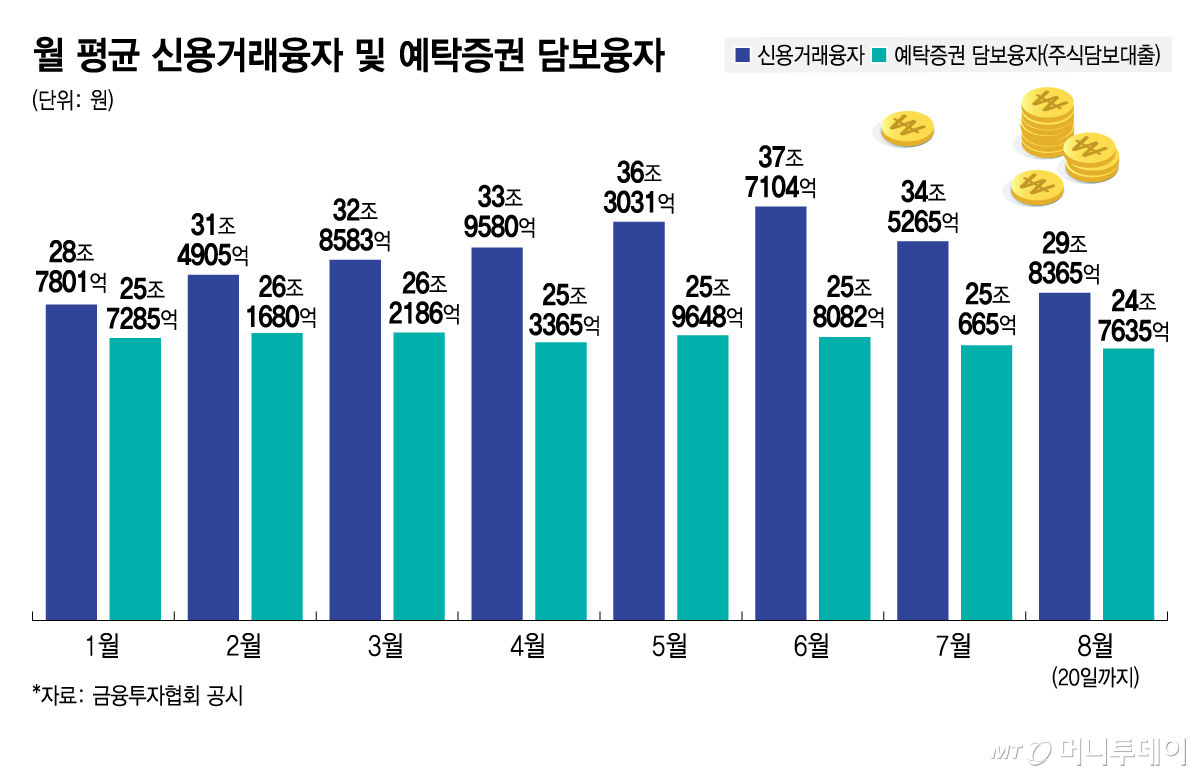
Credit financing transactions, which have slightly longer loan periods than receivables, follow a similar trend. Credit financing involves borrowing funds from securities firms when purchasing stocks and can typically be extended for 1-3 months, up to a maximum of 1-2 years. Monthly average credit financing transactions stood at 28.7801 trillion won in January, grew by over 5 trillion won to 33.9580 trillion won in April, and increased further to 36.3031 trillion won in May. The monthly average for credit financing in June reached 37.7104 trillion won, an increase of 8.9303 trillion won (31.03%) compared to January.
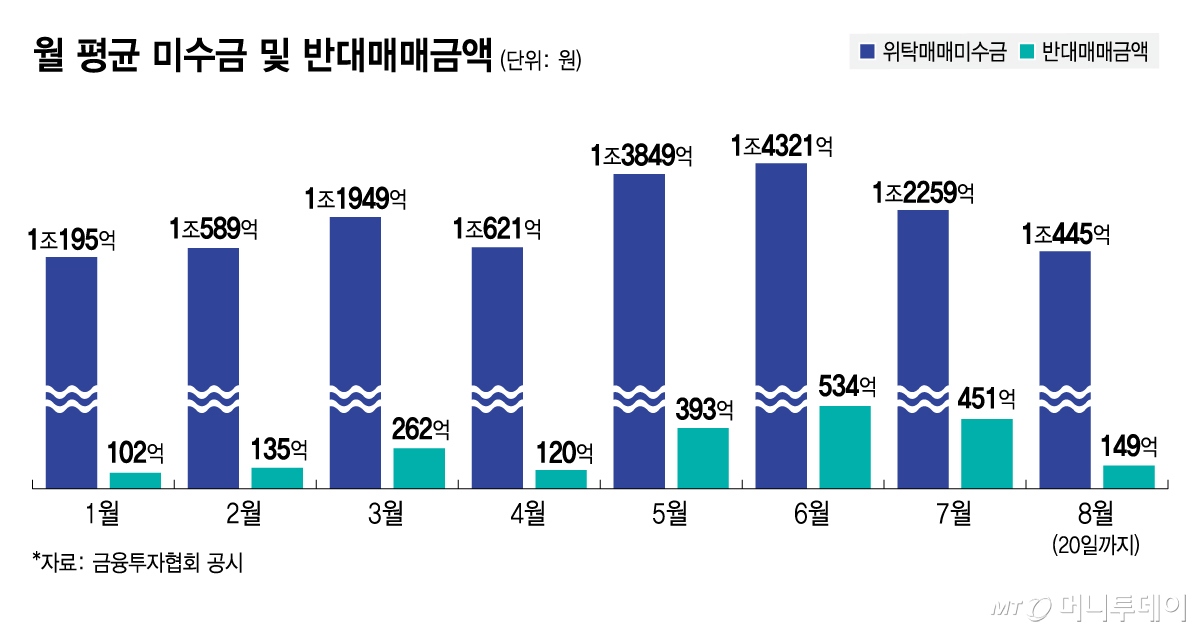
The problem is that forced liquidations due to non-repayment of margin investing (investing with debt) are increasing, leading to correspondingly larger losses for investors. In fact, looking at the status of forced liquidations occurring because receivables were not repaid by the stock settlement date, monthly averages rose from 10.2 billion won in January to 39.3 billion won in May and 53.4 billion won in June. In June, investors failed to deposit receivables on time, resulting in an average daily forced liquidation of 53.4 billion won.
Last week, as the KOSPI recovered to 7,000 points intraday, both receivables and forced liquidations increased. Receivables, which stood at 867 billion won on the 14th, surged by 230.4 billion won (26.57%) to 1.0974 trillion won just three trading days later on the 20th. Over the same period, forced liquidations ballooned from 3.8 billion won to 9.4 billion won, approximately 2.5 times higher.
Amid this, financial authorities raised the annual growth rate limit for household loans at banks from 1.5% to 3%, while stock collateral loans (deposit securities financing) are also increasing, causing margin investing (investing with debt) to rise again. There are concerns that banks, which have gained some leeway in total volume controls, could channel negative account loans into funds for buying stocks at low prices if they implement such lending.
Deposit securities financing, where investors borrow living expenses using already settled securities as collateral, has also recently recovered to the 25th trillion won range. Securities collateral loans, which stood at 24.1379 trillion won on the 4th, increased to 25.3785 trillion won as of the 20th. Since investors typically use securities collateral loans obtained from one securities firm (e.g., Firm A) to purchase other stocks at another firm (e.g., Firm B), concerns have been raised that this could lead to circular margin investing (investing with debt).
Initially, financial authorities considered an integrated management plan that would consolidate all de facto loans, including receivables, credit financing transactions, and stock collateral loans, but are now focusing on self-management by securities firms.
However, unlike credit financing transactions, receivable transactions face no statutory cap on own capital per securities firm, and complaints related to forced liquidations have surged recently, prompting calls for integrated management. Park Hong-bae (Rep.) stated, "As stock market trading becomes more active, individual investors' margin investing (investing with debt) is also increasing; therefore, an effective integrated management plan by financial authorities must be established to manage both credit financing and receivable transactions together." He further emphasized, "Securities firms must also strengthen their own risk management to prevent investor losses from escalating due to forced liquidations resulting from receivables."

 in STOCK


