

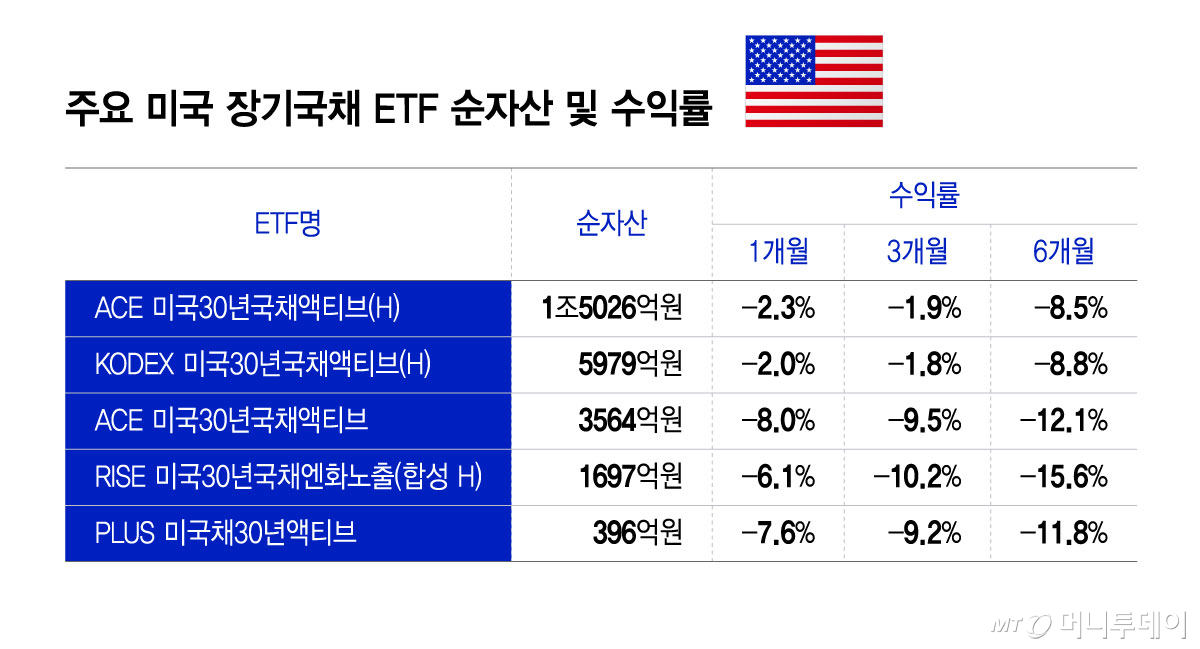
As the yield on the U.S. 30-year Treasury bond has reached its highest level in 19 years, showing signs of instability that are affecting global financial markets, investors in bonds are also facing growing losses. The one-month return of U.S. 30-year Treasury ETFs has recently been sluggish, hovering around minus 2 percent. In particular, exchange-rate-exposed products have recorded losses of approximately minus 8 percent amid a decline in the KRW/USD exchange rate. Experts advise that even though current interest rates are high, uncertainty remains elevated for the foreseeable future, suggesting cautious investment rather than buying at the bottom.
According to the domestic financial investment industry and others on the 24th, the net asset value of domestically listed long-term government bond ETFs (including U.S. and Korean bonds) totaled 6.7338 trillion won, down by 362.8 billion won over the past month. This decline was driven by a sharp rise in yields on recent U.S. long-term Treasury bonds (which caused bond prices to fall), leading to lower returns for long-term bond ETFs and a subsequent drop in net assets.
On this day, the yield on the U.S. 30-year Treasury bond stood at 5.239 percent, down 3.7 basis points (1 bp = 0.01 percentage point) from the previous day. While this is 9.8 basis points lower than the recent high of 5.337 percent recorded on the 18th, it remains at a high level. Compared to the end of June, yields have risen by as much as 33.6 basis points, reaching levels seen just before the global financial crisis. This reflects concerns over the growing size of the U.S. fiscal deficit. Although the U.S. government has attempted to stabilize rates by increasing its buyback volume, yields have rebounded once again.
Yields on domestic treasury bonds are also rising, with long-term bond yields seeing particularly sharp increases. On this morning, the 30th-year treasury bond yield stood at 4.694 percent, down 0.9 basis points from the previous day. However, compared to the end of last month, it has risen by 18.7 basis points.
As bond prices plummeted, returns on long-term bond ETFs have also declined. ACE U.S. 30-Year Treasury Active (H) posted a one-month return of -2.3 percent, showing sluggish performance. Its three-month and six-month returns were -1.9 percent and -8.5 percent, respectively. KODEX U.S. 30-Year Treasury Active (H) also recorded a one-month return of -2 percent. With the exchange rate falling, products exposed to currency fluctuations have performed even more poorly. The one-month returns for ACE U.S. 30-Year Treasury Active and PLUS U.S. 30-Year Active were only -8 percent and -7.6 percent, respectively.
Advice to approach long-term bond investments cautiously continues to emerge. While short-term interest rate shocks have driven yields sharply higher, lowering price levels, and weak employment and inflation indicators have reduced the likelihood of a Federal Reserve rate hike in September, concerns about volatility remain. Im Jae-kyun, a researcher at KB Securities, stated, "Regardless of the Fed's rate hike outlook, concerns over the U.S. fiscal deficit remain a key worry for long-term yields." He added, "The burden from Iran tensions and the possibility of the Democratic Party gaining control of the House of Representatives after the midterm elections are also risk factors." He further noted, "Apart from the fact that interest rates are high, there is little incentive to buy."

 in STOCK
