

“Homeplus Flyer Pole Incident Becomes a Precedent”... While victim compensation has accelerated, determining responsibility remains a long-term battle.
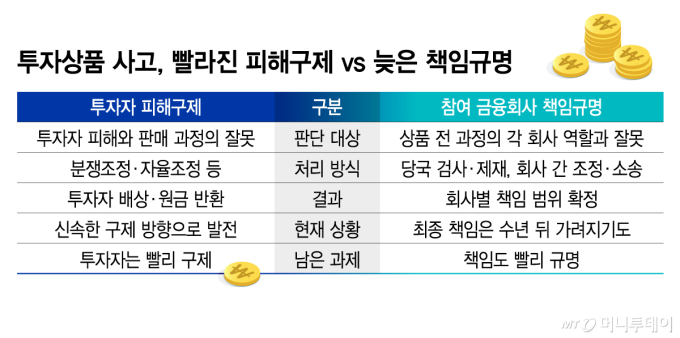
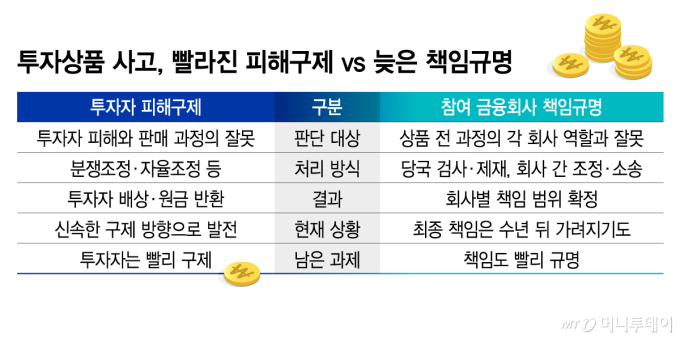
Financial authorities are reviewing a "compensation first, settlement later" plan for investors confirmed to have been sold incomplete electronic short-term bonds (short-term bonds) by Homeplus, under which the seller would provide compensation upfront and settle amounts once actual losses are finalized. However, after the seller provides compensation, the liability of other financial institutions such as asset management companies will be determined in court years later. Critics argue that beyond victim relief, the respective responsibilities of financial institutions involved in the incident, regulatory authorities, and investors must be properly clarified.
According to the financial investment industry on the 31st, the Financial Supervisory Service is considering a plan to compensate investors who were confirmed to have been sold incomplete securities in inspection and sanction results regarding Homeplus, even though the company is undergoing reorganization proceedings and the final loss amount has not yet been determined.
In the past, the market experienced a large-scale incomplete sales incident, which accelerated the time for victim compensation. Financial authorities improved the financial dispute adjustment procedure in 2021 to establish a mechanism allowing financial institutions to first voluntarily adjust multiple similar disputes. However, compensating investors first does not absolve the final responsibility of the financial companies involved in the incident.
The Optimus incident highlights the time lag between investor compensation and the clarification of liability. NH Investment & Securities paid 278 billion won in principal to 831 retail investors in 2021. Instead of accepting the Financial Supervisory Service’s Dispute Mediation Committee’s recommendation for "cancellation of contracts due to error," it opted for a private settlement: paying investors their principal and then taking over the investment certificates and related rights. Subsequently, it initiated separate legal proceedings to seek liability from Hana Bank and Korea Securities Depository, among others. In effect, the timelines for investor compensation and the final clarification of responsibility between financial institutions have been moving independently.
Critics point out that it is necessary to distinguish between the seller's responsibility and the ultimate liability of all financial institutions involved in an incident. If a product involves multiple financial institutions such as asset managers and trustees, each company's actual role and faults must be examined from product discovery and design through information creation, verification, management, and sales.
The responsibility of financial authorities is also raised. The Financial Supervisory Service inspects and sanctions relevant financial firms and takes measures to compensate investors after an incident occurs. However, the factual findings confirmed in this process do not immediately lead to a procedure that comprehensively summarizes the responsibilities of participating companies at an early stage. It is pointed out that even if the court determines the final civil liability ratio, it is necessary to more clearly identify each company's actual role and faults during the authorities' inspection phase.
A financial investment industry official said, "If the sales company violated the suitability principle or its duty to explain, it must naturally bear the corresponding responsibility," while adding, "The structure that requires years of litigation with other participating companies over liability even after investors are prioritized and compensated needs improvement."
Investors cannot be exempt from discussions on responsibility. Lee Sung-rok, a senior researcher at the Capital Market Research Institute, pointed out in his report titled "Issues and Directions for Improving the Investor Damage Compensation System" that even if investor damage compensation is expanded, investors' self-responsibility must also be given significant consideration.
Calls are being raised for institutional improvements that allow the timelines for investor compensation and the clarification of responsibilities among financial firms to be advanced together, rather than kept separate. It is pointed out that a structure is needed where investors receive swift relief while sales companies, asset management firms, and other participating financial institutions bear responsibility according to their actual roles and faults, and investors themselves accept responsibility for risks they voluntarily chose. As the clock for compensation speeds up, so too must the clock for clarifying responsibilities.
"Not solely the developer's fault": The true responsibility revealed by the Heritage and Lime rulings
When an investment product fails, the sales company directly in contact with investors is immediately held accountable. However, in court proceedings that determine liability among financial firms after investor damages have been remedied, final responsibility is not decided solely by who sold the product. The key criterion for assigning liability lies in what each financial firm actually did—from discovering and designing the product to writing, verifying, managing, and selling it.
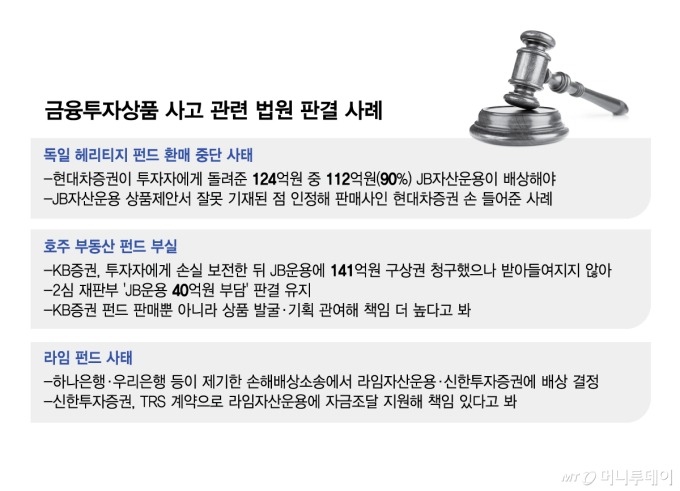
◇ Hyundai Motor Securities Returns 12.4 Billion Won… First Instance Assigns 90% Responsibility to JB Asset Management
According to the financial investment industry on the 31st, in a damages lawsuit between sales firm Hyundai Motor Securities and asset manager JB Asset Management regarding the suspension of redemptions by Germany's Heritage Fund, the first-instance court ruled last year that JB Asset Management must pay 1.12 billion won in compensation. As JB Asset Management filed an appeal, the dispute over liability between financial institutions has moved to the second instance.
The first-instance court ruled that JB Asset Management's product proposal contained incorrect information regarding the capabilities, financial stability, and creditworthiness of the local German implementing company, the fund fee structure, and safety mechanisms for recovering invested funds, thereby holding JB Asset Management liable under the entrusted sales contract. However, considering various circumstances, the court limited JB Asset Management's liability to 90%.
It demonstrates that the financial company selling products to investors and returning money first does not necessarily have to be the same entity bearing final responsibility for the incident. Conversely, if the sales company was involved in product discovery or structural design, both the sales process and the actual acts of involvement can become subjects of liability assessment.
In the Lime scandal as well, the court recognized the liability of the asset management company and securities firms involved with the product, in addition to the sales agent. The Seoul Southern District Court, in February this year, ruled on a lawsuit filed by Hana Bank against LIME Asset Management and Shinhan Investment Corp., among others, confirming Hana Bank's bankruptcy claim against LIME Asset Management at approximately 38.9 billion won. The court also recognized joint liability for damages against former LIME Asset Management Executive Vice President Lee Jong-pil, Shinhan Investment Corp., and Im Il-woo, former head of the PBS Business Division at Shinhan Investment Corp.
Hana Bank filed a lawsuit against Limm Asset Management and Shinhan Investment Corp, among others, citing losses incurred from the sale of Limm funds. Shinhan Investment Corp was involved in the product by providing total return swap (TRS) funds for the Limm Trade Finance Fund. The court ruled that, in a lawsuit filed after Hana Bank had compensated investor damages, both Limm Asset Management and Shinhan Investment Corp were held liable.
The Heritage and Lime cases demonstrate that liability for investment product failures is not determined solely by the formal status of sales firms or asset managers. What matters most in determining final responsibility is what each company actually did during the processes of product discovery, design, information creation, verification, management, and sales.

◇ Financial Supervitory Service conducted an inspection... but final responsibility returns to the court
The issue is that the responsibility of each financial institution is often determined after a long period of civil litigation following investor compensation. The lawsuit against LIME at Hana Bank was filed in 2022, and the first-instance judgment was issued in February this year.
The Financial Supervisory Service inspects relevant financial institutions, including asset managers as well as sales firms, when investment product incidents occur to investigate and sanction illegal or improper conduct. It also steps in to provide relief for investors through dispute resolution. However, critics point out that the authorities' inspections and sanctions are limited to determining whether individual financial institutions violated regulations, without extending to a comprehensive early clarification of the actual roles and faults of the companies involved in the incidents within a unified accountability framework.
This is why, despite authorities confirming a significant portion of the misconduct and wrongdoing by various participating companies during the inspection process, financial institutions repeatedly find themselves in situations where they must prove the other party's liability through civil litigation after providing compensation to investors. This explains why it takes years for courts to recognize substantial liability on the part of financial institutions other than sales firms, as seen in the cases of Heritage and Lime.
Of course, it is not the authority of financial regulators to determine civil liability for damages and compensation ratios among financial companies. However, there are calls for the Financial Supervisory Service (FSS) to go beyond merely inspecting relevant companies involved in sales, management, and custody after an incident occurs. Instead, the FSS should examine the entire process—from product discovery, design, due diligence, information creation, verification, management, custody, to sales—as a single case to more comprehensively identify what roles each company actually played and where errors occurred.
A financial investment industry official said, "If a financial firm that sold to investors made a mistake during the sales process, it is only natural for them to bear responsibility." However, they added, "If multiple financial firms were involved in the product, each company's actual role and where the problem occurred must be identified together to properly assign liability."
It is not that the Financial Supervisory Service intends to determine civil liability ratios; rather, there are concerns that a mechanism is needed to more swiftly link the factual findings confirmed during inspections by prosecutors to the identification of responsibilities among financial institutions. If the actual liabilities of each financial institution can be clarified early on between the period of official inspection by authorities and the final judgment by the courts, it would reduce the time and costs involved in obscuring liability through lawsuits lasting several years after investor compensation has been provided.
South Korea faces years of blame game after accident... UK and EU: "Manage roles and responsibilities from product design stage"
Critics argue that to reduce years-long disputes over liability following the purchase of investment products, financial authorities should more actively utilize inspection results for early accountability determination. The Financial Supervisory Service (FSS) currently inspects sales companies and asset management firms to identify illegal or improper conduct; however, it is proposed that the entire process—from product discovery and design to verification, operation, and sales—be treated as a single case to facilitate liability coordination among financial institutions. Established systems in advanced overseas markets such as the United Kingdom, the European Union (EU), and Australia, which predefine the responsibilities of participating companies from the product design stage, are cited as models worthy of reference.
◇Overseas advanced markets: Manage everything from investment product design to sales as a single process
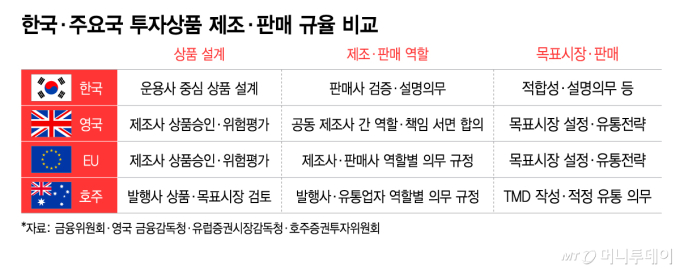
According to the financial investment industry on the 31st, the UK Financial Conduct Authority (FCA) operates a "product governance" system that requires financial firms designing and developing financial products to have product approval procedures in place and to establish target markets. In particular, when multiple companies jointly create a single financial product, the system mandates that their respective roles and responsibilities be explicitly defined through written agreements.
The European Union's Markets in Financial Instruments Directive II (MiFID II) also distinguishes the roles of companies that design and develop financial products from those that sell and distribute them. Companies responsible for designing and developing products must define the target market and distribution strategy, and provide relevant information to ensure selling firms understand the products. Selling firms, in turn, must use this information to grasp the product's characteristics and target market. The European Securities and Markets Authority (ESMA) requires that the rationale behind decisions made during the product governance process—including those regarding target markets and distribution strategies—be documented.
Australia has also been implementing the Design and Distribution Obligations (DDO) since 2021. Product issuers must create a Target Market Determination (TMD) that specifies which consumers are suitable for their products, ensuring that products are distributed accordingly. Sales and distribution operators also manage the product design and sales process by linking it to the issuance of relevant sales information, such as transmitting related sales data to issuers.
These regulations do not determine the proportion of civil liability for financial companies after an accident occurs. However, they are evaluated as a reference for supplementing South Korea's system for clarifying responsibility, given that they manage the roles and obligations of participating companies from product design and development through to post-sales as a single process.
◇Clarify pre-responsibility and link the Financial Supervisory Service inspection to accountability determination
It is pointed out that to expedite the clarification of responsibilities after purchasing investment products, there is a need to more clearly define the roles and responsibilities of each company in advance, focusing on products involving multiple financial institutions and complex structures where disputes are highly likely. This approach involves recording what reviews were conducted through internal committees prior to product sales and explicitly specifying the roles and responsibilities of companies involved in product design and operation, as well as sales agencies.
Jung Yu-shin, a professor at the Graduate School of Business Administration at Sogang University, stated that "it is best to clarify the responsibilities of companies involved in product design and operation, as well as trustees and entrustors, through internal mechanisms." Professor Jung explained that for products with a certain level of complexity, they should be reviewed in advance, with records kept of the procedures followed by an internal committee. He also emphasized the need to clearly define the responsibilities of the companies involved in product design and operation, as well as sales companies, beforehand. By establishing responsibility relationships in advance, these can be taken into account during supervision and disciplinary processes.
It may be possible to review a plan to utilize the responsibility relationships clarified in advance for determining liability after an incident. Although the Financial Supervisory Service does not determine civil liability ratios between financial companies, if the investigation process reveals each company's actual role and illegal or improper conduct, this information could be used to adjust liability among financial companies.
While the right to a final judicial determination must be guaranteed, if participating companies can adjust their liabilities before litigation, it could reduce the time and costs involved in disputing responsibilities over several years following victim compensation. It has been pointed out that investors should first seek redress while establishing a system to clarify beforehand the responsibilities of companies involved with the product and to utilize facts confirmed after an incident for early identification of liability.

 in STOCK


