

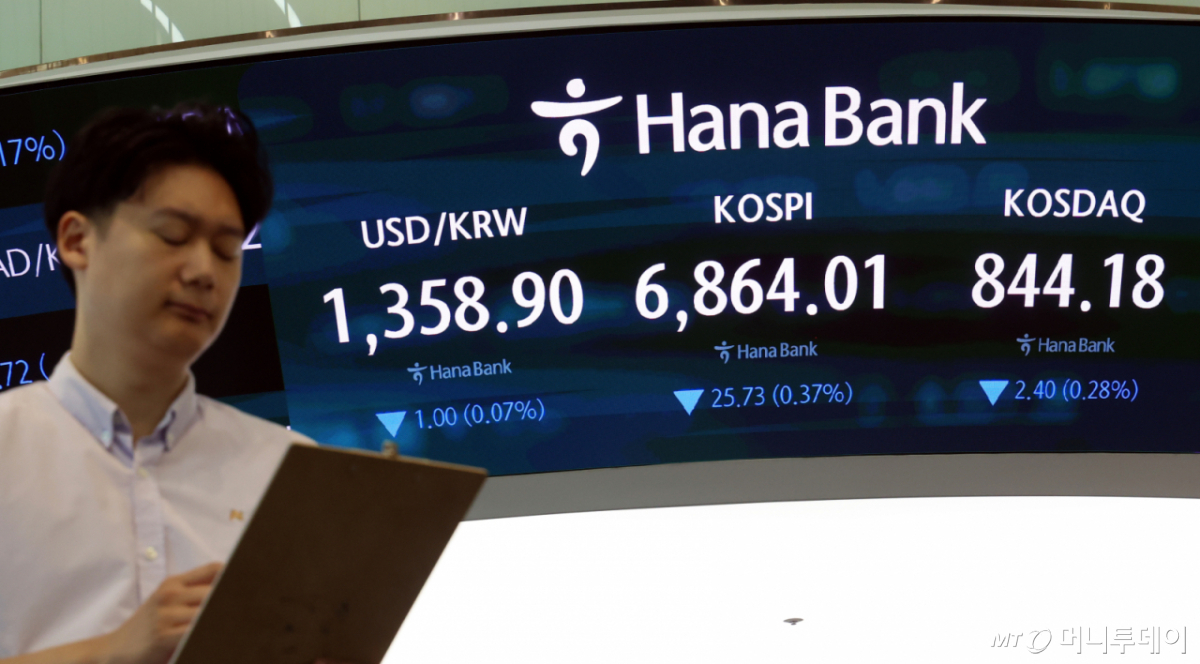
The KOSPI index fell during trading on the 29th, standing at a crossroads for defending the 6,800 level. Amid downward pressure from U.S.-driven oil price and interest rate burdens, semiconductor stocks, which plunged the previous day, have narrowed their volatility, cushioning the shock to the stock market.
As of 1:15 p.m. on the same day, the KOSPI was calculated at 6,816.26, down 73.48 points (1.07%) from the previous trading session. The index opened at 6,844.41, down 45.33 points (0.66%), repeatedly switching between gains and losses before widening its decline in the afternoon.
Based on cumulative data from Korea Exchange and NextTrade, retail investors made net purchases of 1.3081 trillion won, while other corporate entities bought a net 1.1616 trillion won. Foreign investors sold a net 1.8814 trillion won, and institutional investors sold a net 599.8 billion won.
Selling pressure on non-semiconductor stocks intensified. In the KOSPI market, while 139 stocks rose and 740 fell, among the top 10 by market capitalization, LG Energy Solution and Samsung Life Insurance showed weakness in the 3rd% range, Hyundai Motor in the 2nd% range, and Samsung Biologics in the 1st% range.
Samsung Electronics is trading near flat, while SK Hynix is slightly lower. Amid continued rebound buying following the previous day's sharp drop, intraday price movements have seen repeated reversals between gains and losses. Samsung SDI showed strength in the 4th% range early in trading on news of production facility expansion, but later gave back its gains to enter a slight uptrend.
Concerns over tightening due to rising U.S. market interest rates are weighing on the stock market. The yield on 10-year U.S. Treasury bonds rose at one point on the 28th (local time) by 6.1 basis points from the previous day (1bp = 0.01 percentage points) to 5.241%, marking its highest level since June 2007.
Oil prices also rose. Brent crude futures for November delivery closed at $105.28 per barrel, up 0.92% from the previous day, while WTI (West Texas Intermediate) futures closed at $92.60 per barrel, up 0.21%.
U.S.-Iran peace negotiations, which appeared to gain momentum after Iran presented a "7-day negotiation proposal," have again fallen into deadlock following U.S. President Donald Trump's rejection of the proposal on the 27th (local time), continuing an erratic course.
Han Ji-young, a researcher at Kiwoom Securities, stated, "A realistic approach is to keep open the possibility that rising market interest rates will be controlled through scheduled macroeconomic indicator events during the week and U.S.-Iran negotiations," adding, "It is worth noting that internal resilience remained relatively solid despite the sharp drop in the index."
The researcher further noted, "Given that U.S. Micron Technology earnings, U.S. September employment indicators, and South Korea's September exports are pending, which could drive a reversal in market sentiment, there is little practical benefit to a strategy of responding to future volatility with stock sales."
Jo Su-hong, head of the Research Center at NH Investment & Securities, revealed, "A notable feature is that retail investor supply levels in the 7,000 to mid-7,000 range have decreased significantly compared to late May," adding, "If oil prices and interest rates stabilize following a resolution to U.S.-Iran negotiations, there is a possibility of breaking through the upper limit."

 in STOCK
