

GC Biopharma is expanding its research scope into the fields of anticancer vaccines and cell and gene therapies by leveraging its in-house developed next-generation ribonucleic acid (RNA) and lipid nanoparticle (LNP) technologies.
The company plans to enhance the expression efficiency of circular RNA and self-amplifying mRNA, and secure technology for delivering RNA to target tissues, with the aim of applying these advancements to the development of various therapeutics.
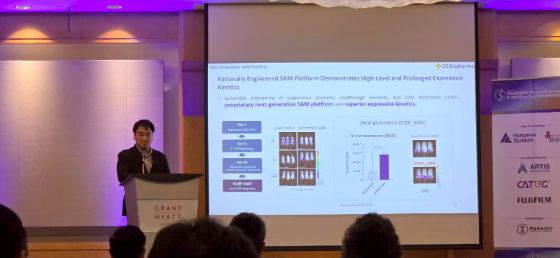
GC Biopharma said Friday that it presented research outcomes on its next-generation RNA design technology and in-house LNP platform at the "2nd World Summit on RNA-Based Therapeutics and Vaccines," held in Incheon from the 10th to the 12th.
The presentation revealed research results demonstrating improved expression efficiency and sustained expression of circular RNA and self-amplifying mRNA, going beyond existing linear mRNA.
It also introduced results evaluating the potential for developing in vivo CAR-T (in vivo CAR-T) and cancer vaccines by utilizing LNP technology to deliver RNA to desired cells and tissues.
Jung Jae-seong, Team Leader of the RNA Science team at GC Biopharma, who led the presentation on the RNA field, introduced the company’s in-house developed "Hetero-ribozyme" technology.
By placing inactive ribozymes at both ends of linear RNA and designing them to activate only when the two ends precisely interlock, the team confirmed a circularization efficiency of over 90%.
The sustained expression of circular RNA was also confirmed. When circular RNA loaded with the chimeric antigen receptor (CAR) gene was introduced into human T cells, approximately 50% CAR expression was maintained even after six days. In contrast, linear mRNA showed a sharp decline in expression over the same period.
The effect of eliminating target B cells was also improved by approximately 10-fold in models applying circular RNA.
In research on self-amplifying mRNA, key regulatory regions of the RNA structure were optimized to enhance expression efficiency and stability.
Animal experiments revealed that the company’s in-house self-amplifying mRNA recorded protein expression levels approximately three times higher than global benchmark technologies.
The company explained that this confirmed the potential for developing vaccines and therapeutics based on low-dose administration.
In the LNP field, Son Ji-yeon, Unit Leader of the Genetic Medicine Platform at GC Biopharma, presented research results applied to in vivo CAR-T and cancer vaccines. LNPs serve as carriers that deliver RNA to target cells within the body and are utilized to enhance the delivery efficiency of RNA therapeutics.
GC Biopharma applied a targeted LNP (tLNP) designed to reduce the proportion delivered to the liver and enhance delivery to the spleen in its in vivo CAR-T research.
In animal models, T cell delivery efficiency and B cell elimination effects were confirmed. Additionally, in humanized mouse models, it demonstrated statistically significantly higher performance compared to benchmark technology for human CD8-positive T cells in blood and spleen.
Research results on cancer vaccines utilizing the in-house developed LNP "GC01" were also disclosed. In melanoma animal models, GC01 more effectively suppressed tumor growth compared to Moderna’s LNP.
Changes in the tumor microenvironment were also observed, including increased T cell infiltration and cancer cell killing activity within tumors, as well as a decrease in dysfunctional exhausted T cells.
GC Biopharma explained that GC01 is currently being applied in clinical trials for a COVID-19 mRNA vaccine and that it has secured a manufacturing and quality control (CMC) foundation.
The company plans to expand cancer vaccine development using these technologies in the future.
However, the efficacy of the in vivo CAR-T and cancer vaccines disclosed this time are research results confirmed through animal models, etc., and therapeutic effects in actual patients must be verified through subsequent clinical development.
Jung Jae-wook, head of the R&D Division at GC Biopharma, said, "Since we have secured all technologies from RNA design to LNP delivery in-house, we will expand our pipeline into various therapeutic areas."

 in THEBIO
