

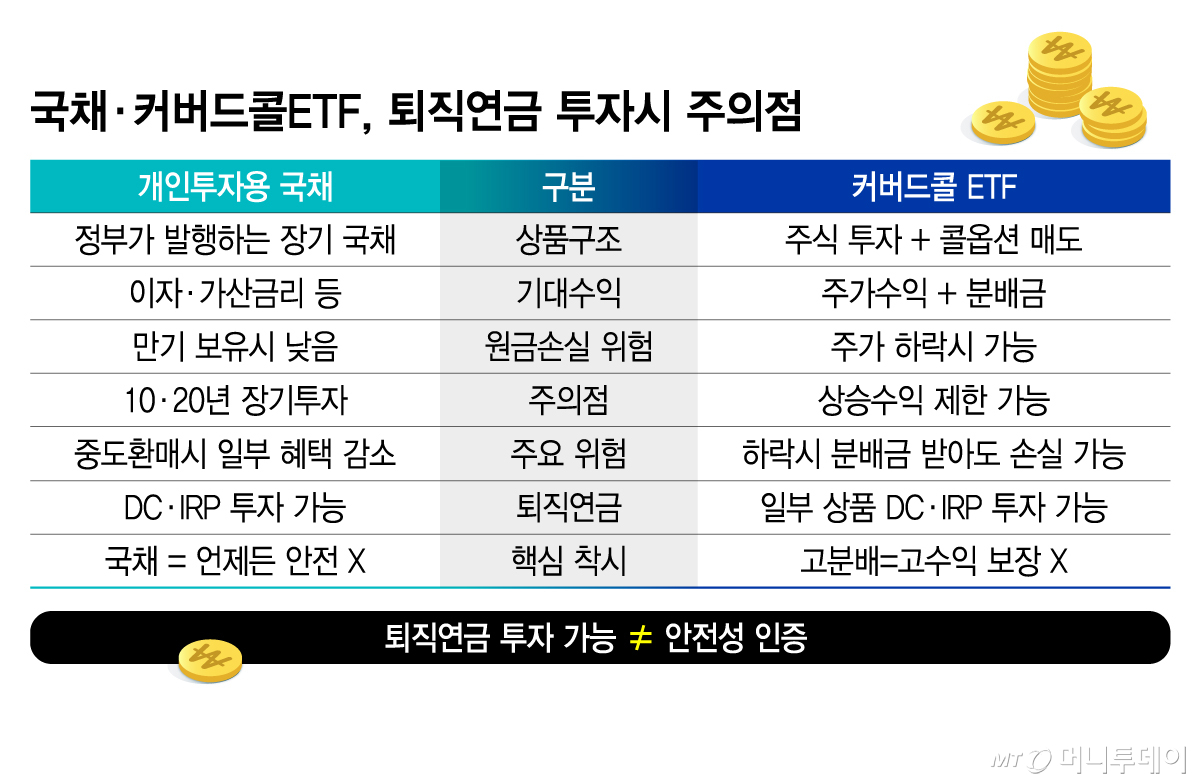
Retirement pensions are rapidly shifting from "retirement savings" centered on principal and interest guarantees to "retirement investments" where subscribers directly select products. This month, 10-year and 20-year government bonds for individual investors were included in retirement pensions for the first time, followed by covered call ETFs (exchange-traded funds), which carry a risk of principal loss; some products allow investment up to 70% of accumulated assets. Since being available for purchase in a retirement pension does not necessarily mean the product is safe, there are calls to strengthen mechanisms that ensure subscribers properly understand the distinct risks associated with each product as choice options expand.
According to the financial investment industry on the 29th, retirement pension accumulated assets reached 501.4 trillion won at the end of last year. While the proportion of DB-type (defined benefit) plans is decreasing, DC-type (defined contribution) plans and IRPs (individual retirement pensions), which are managed directly by subscribers, are growing rapidly. Investments in performance-linked products such as TDFs (target date funds) and ETFs are also increasing.
The range of investment products has also expanded. Starting this month, 10-year and 20-year government bonds for individual investors can be purchased through DC-type plans and IRPs. Because they are issued by the government, holding them until maturity guarantees the return of principal and interest; however, these are products premised on long-term holding. If redeemed early, investors cannot receive benefits associated with long-term holding, such as additional interest rates and compound interest. It is necessary to sufficiently inform retirement pension subscribers about product characteristics, including the burden of long-term holding and the reduction in benefits upon early redemption.
Covered call ETFs are different in nature. These products pursue distributions by using premiums received from selling call options, in exchange for giving up a portion of returns from stock price increases. Monthly distribution types pay out distributions every month. If stock prices fall, there is a risk of principal loss; in rapidly rising markets, upside gains may be limited. KB Asset Management's "RISE 200Weeekly Covered Call" is classified as a "high risk" product with an investment risk rating of Level 2. The prospectus explicitly states that the full amount of principal is not guaranteed and that investors bear the risk of loss. This product can be invested in up to 70% of accumulated assets within retirement pensions. This does not mean the product's safety has been recognized, but rather that it can be purchased within the risk asset investment limits of DC-type plans and IRPs. If subscribers interpret the fact that a product is "available for purchase in a retirement pension" as a signal that it is a "safe product for retirement funds," there is a concern that actual investment risks may be underestimated.
The Financial Supervisory Service also classified covered calls as a fund type with "potential to mislead consumers." This is because target rates of return could be mistaken for guaranteed rates of return. Accordingly, starting on the 30th, a "Standard Template for Core Fund Risks" will apply to 10 types of public funds, including newly launched covered call funds. This requires informing investors about the possibility of principal loss and product-specific special risks using easy-to-understand language, graphs, and charts.
Properly communicating the risks associated with each retirement pension product has become important because subscribers' responsibilities have increased. Unlike DB-type plans, DC-type plans and IRPs require subscribers to directly select investment products, and the results are reflected in their own retirement assets. Hong Won-gu, a research fellow at the Korea Capital Market Institute, emphasized, "As retirement pension investment products become more diverse, information provision must also become more sophisticated so that subscribers can fully understand and choose based on product-specific characteristics, including not only returns but also the possibility of principal loss, the burden of long-term holding, and return structures."

 in STOCK
