

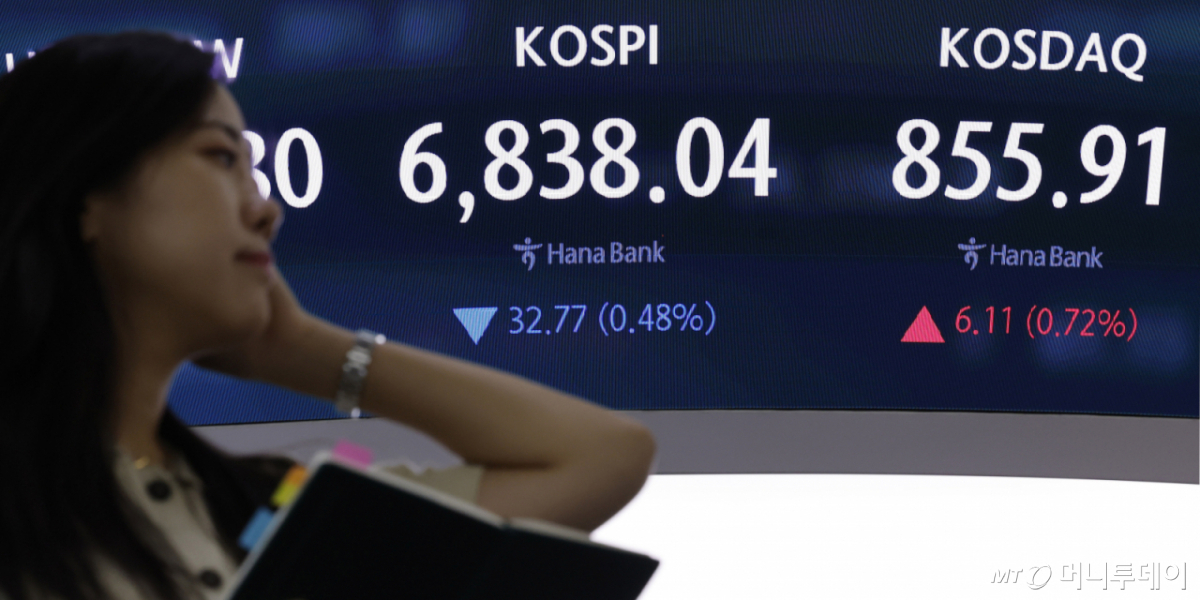
The KOSPI ended in a decline. It appears that the impact of the overnight correction in U.S. stock markets, driven by rising Treasury yields, has spilled over into domestic markets. The securities industry expects volatility to revive through demand generated by Anthropic's listing and Meta's AI agent, "Muse."
On the 30th, the KOSPI index closed at 6838.04, down 32.77 points (0.48%) from the previous day. The KOSPI opened at 6943.47, up 72.66 points (1.06%), attempting a rebound for the first time in three days, but ultimately ended the session lower.
The KOSPI's movement appears to reflect conditions in the New York stock market. On the 29th (local time), the Dow Jones Industrial Average on the New York Stock Exchange closed at 51,349.92, down 131.59 points (0.26%) from the previous trading day. The S&P 500 index fell 12.85 points (0.17%) to 7670.84, while the NASDAQ Composite Index dropped 22.84 points (0.09%) to 26,797.54.
Despite this situation, the Philadelphia Semiconductor Index recorded 12,629.16, up 1.32% from the previous close. On the same day, SK Hynix ADR, a local memory semiconductor stock, closed at $186.68, up 2.62%, while Micron, a U.S. memory semiconductor company, ended trading at $1,065.08, up 1.05%.
The securities industry is focusing on additional positive factors, such as the delayed listing of Anthropic and the AI agent unveiled by Meta, while anticipating a rise in the stock market.
Anthropic's listing has been gradually postponed from September to November. The fact that the scheduled date has been pushed back suggests that it may resolve supply bottlenecks in semiconductors. Anthropic's listing is also an element that could attract domestic investor demand. Given that investment funds had previously poured into SpaceX, investor sentiment is expected to be stimulated by this listing as well. In addition, Meta's Muse could increase demand for CPUs and memory.
Kim Min-gyu, a researcher at KB Securities, stated, "In a situation where a new AI narrative was needed beyond the positive factor that everyone knows—good earnings—the news from Anthropic and Meta can act as a positive element for semiconductors." He added, "If long-term interest rates calm down, even temporarily, due to an interest rate hike, it could be not bad for the stock market. It is now time to pay attention to semiconductors again."
Han Ji-young, a researcher at Kiwoom Securities, said, "Micron's earnings, ahead of its announcement, serve as a test case showing whether the entire AI and memory sector can withstand high interest rate burdens, going beyond a single semiconductor stock." She added, "While foreign selling could put pressure on domestic semiconductors first, it is necessary to consider the possibility that the intensity will be weaker than in June."

 in STOCK
