

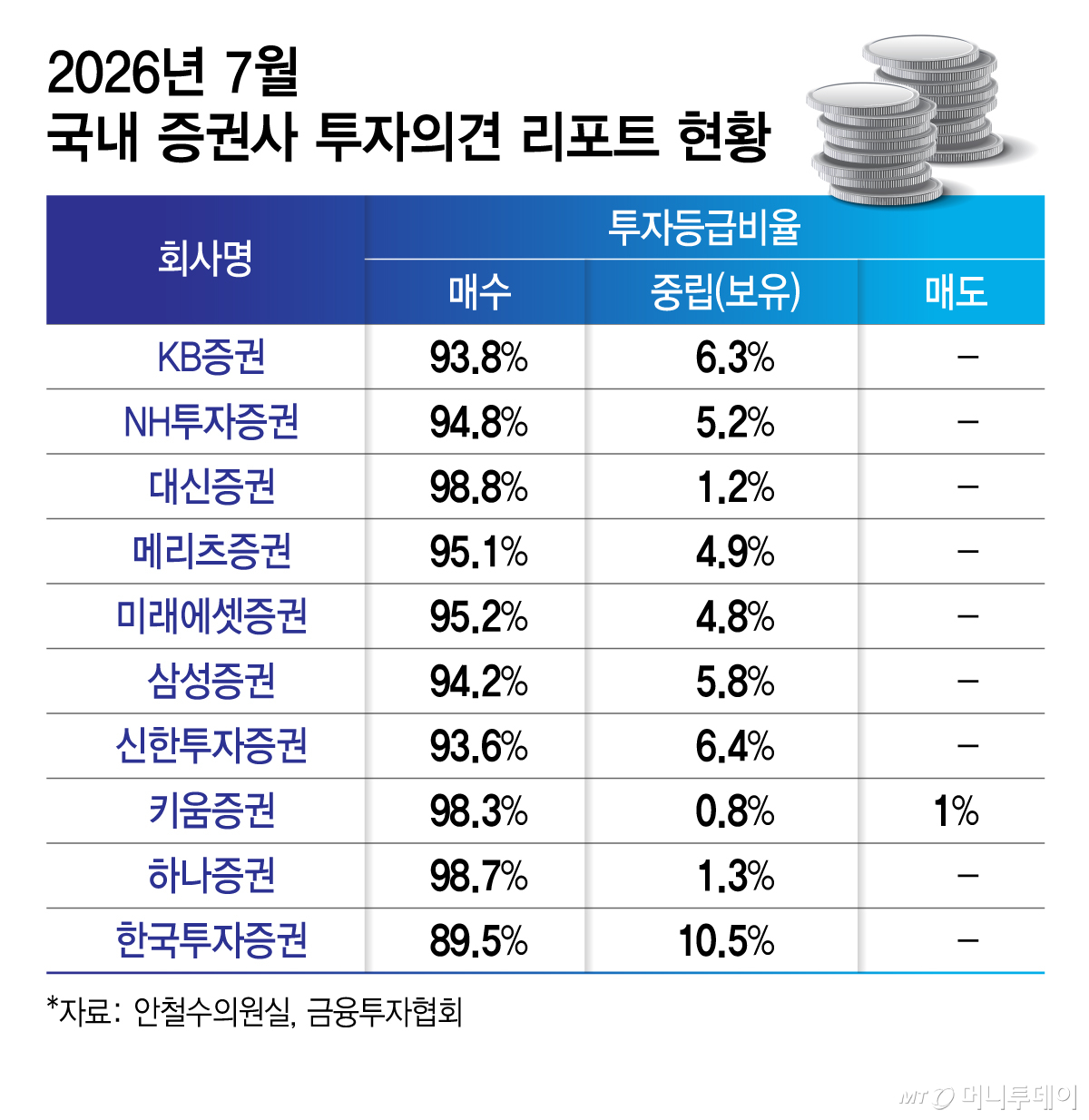
It was revealed that even in July, when the KOSPI plunged by more than 22% and circuit breakers were triggered four times, investment opinions from domestic securities firms remained extremely skewed toward "buy." Nine out of 10 major securities firms had no sell recommendations at all, and the average proportion of buy recommendations across the 10th firms reached 95.2%.
While it is impossible to judge the accuracy of investment opinions based solely on short-term stock price fluctuations, controversy is growing over whether domestic securities firms' investment opinions, which are uniformly "buy" regardless of rising or plunging markets, provide sufficient discernment for investors.
According to the "Status of Investment Opinion Reports from 10 Domestic Securities Firms in July 2026," submitted by the Korea Financial Investment Association to the office of Rep. Ahn Cheol-soo of the People Power Party on the 1st, the proportion of buy recommendation reports for individual stocks approached 100%, with Daishin Securities at 98.8%, Hana Securities at 98.7%, and Kiwoom Securities at 98.3%. Even Korea Investment & Securities, which had the lowest proportion of buy recommendations, reached 89.5%.
In contrast, sell recommendations were virtually "zero." Among the 10th firms, only Kiwoom Securities issued any sell recommendations, and even then, the proportion was a mere 1.0%. The remaining nine firms had not a single sell recommendation. The proportion of neutral/hold opinions was also highest at Korea Investment & Securities with 10.5%, while the other nine firms remained in the single digits.
This concentration of buy recommendations occurred amid extreme stock market volatility. The KOSPI plunged by 22.19% in July alone. Unprecedented volatility was observed, with the KOSPI circuit breaker triggered four times and sidecars (futures market circuit breakers) triggered 15 times within a single month.
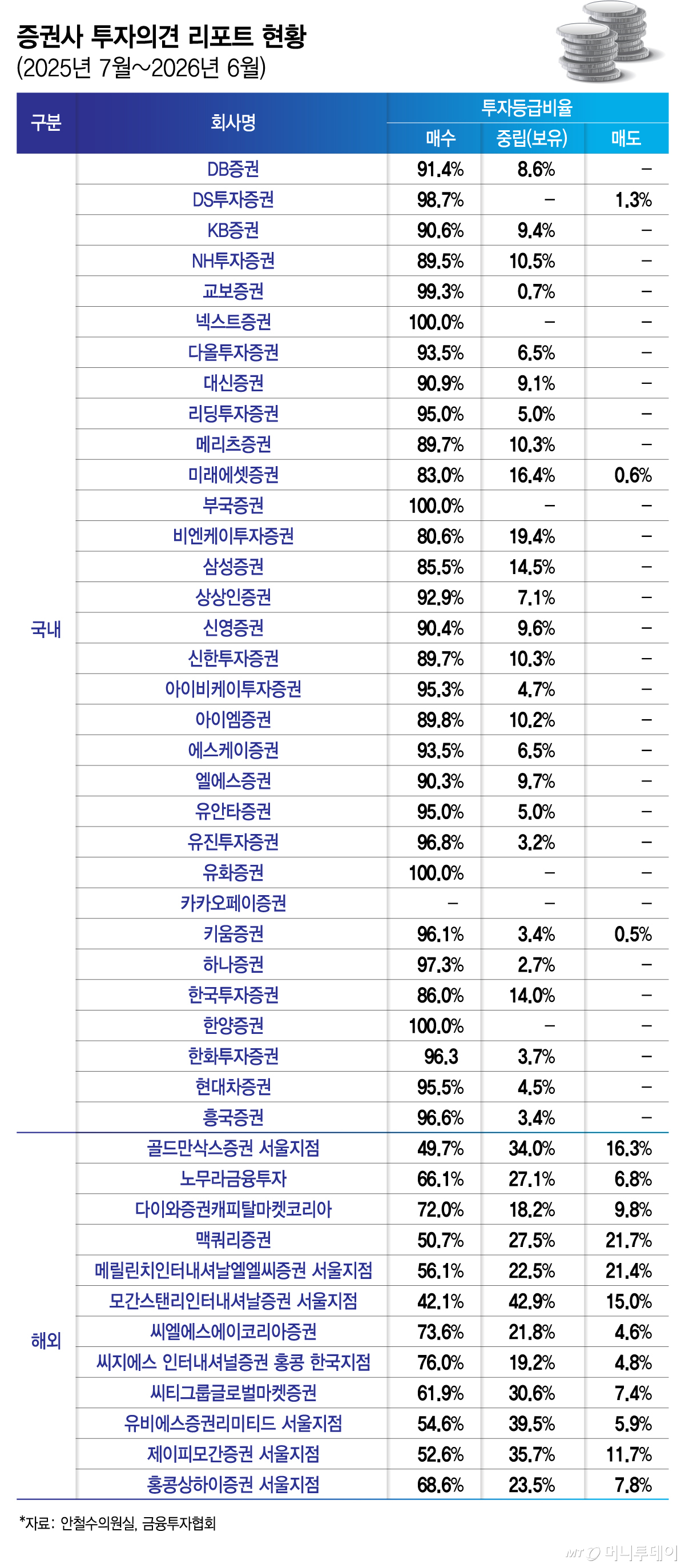
Expanding the timeframe, the proportion of buy recommendations from domestic securities firms ranged from 80% to 100% from July last year to June this year. In contrast, the distribution of investment opinions from foreign-affiliated securities firms over the same period was markedly different. Macquarie Securities had a breakdown of 50.7% buy, 27.5% neutral, and 21.7% sell, while Merrill Lynch's Seoul branch recorded 56.1%, 22.5%, and 21.4%, respectively. Unlike domestic firms, foreign-affiliated firms showed a relatively even distribution of buy, neutral, and sell opinions.
The buy bias among domestic securities firms has deepened over a long period. According to an analysis by Senior Research Fellow Kim Jun-seok at the Capital Markets Institute, who examined approximately 740,000 domestic analyst reports from 2000 to 2024, the proportion of buy/strong buy opinions rose from 67.3% in the 2000s to 89.6% in the 2010s, and further increased to 93.1% between 2020 and 2024. Fellow Kim analyzed that Korea's buy bias has become extremely extreme since the 2010s and shows signs of becoming entrenched in the long term.
Critics point out that if sell recommendations disappear even during severe plunges and volatile markets, and if there is a significant gap compared to foreign-affiliated securities firms, how much differentiated signal can investment opinions such as buy, neutral, and sell actually provide to investors? An (Rep.) stated, "The fact that domestic securities firms' investment opinions are uniformly 'buy at any cost,' with little difference whether stock prices are trending upward or experiencing extreme volatility, shows a loss of discernment," adding, "It proves the futility of securities experts in forecasting stock prices."
Financial authorities also view the concentration of buy recommendations in securities firm reports as an issue that undermines credibility. The Financial Services Commission and the Financial Supervisory Service issued a press release on the same day announcing plans to promote comprehensive improvements to the research system, including strengthening the independence of research departments, excluding excessive influence from sales divisions when evaluating analysts, and allowing the option to disclose the names of authors who write sell recommendations.

 in STOCK

