

As the volatility of the Korea Exchange (KRX) after-hours market has come under scrutiny, it was revealed that only two securities firms are providing liquidity to the market as market makers. Analysts note that participation is inevitably low because market makers must hedge the price fluctuation risk they assume by quoting prices on both the buy and sell sides using instruments such as futures or exchange-traded funds (ETFs), but there are no appropriate hedging means available in the after-hours market.
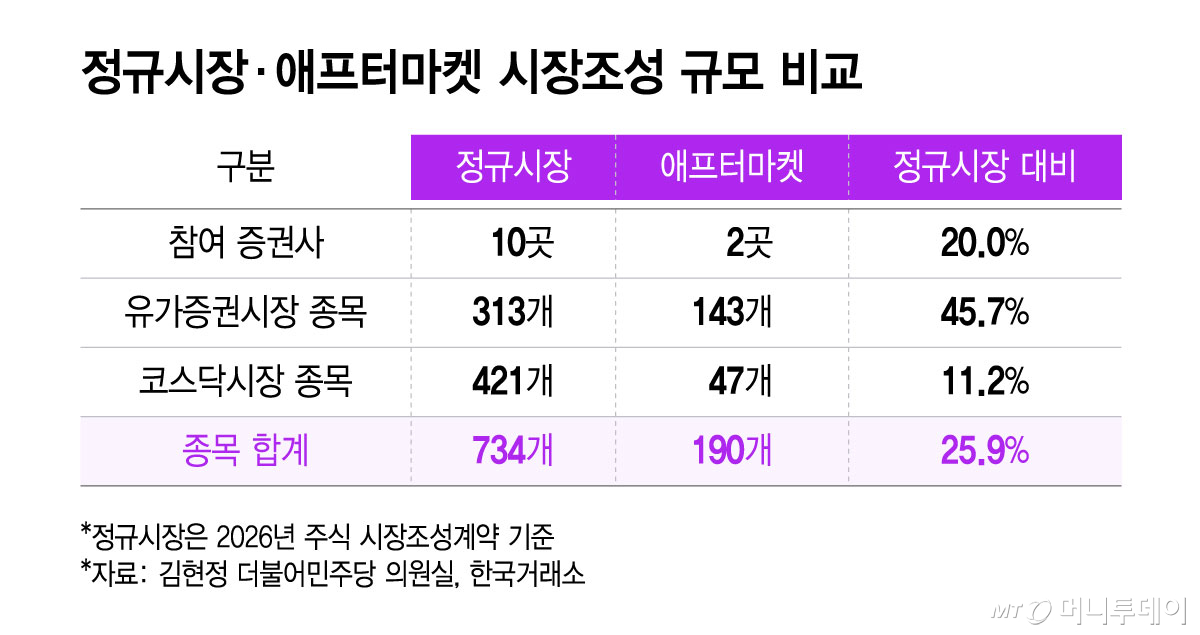
According to documents submitted by the Korea Exchange to Kim Hyeon-jung, a Democratic Party of Korea lawmaker on the Political Affairs Committee, on the 7th, only two securities firms, Meritz Securities and Daol Investment Securities, participated in after-hours market making. Meritz Securities and Daol Investment Securities are responsible for KOSPI, while Meritz Securities handles KOSDAQ. The number of stocks under market-making contracts is 143 for KOSPI and 47 for KOSDAQ, totaling 190.
This contrasts with the regular trading session, where 10 securities firms are responsible for market making. The number of stocks in the after-hours market is also about one-quarter of that in the regular session. In the regular session, 10 securities firms handle market making for a total of 734 stocks, including 313 on KOSPI and 421 on KOSDAQ.
The low participation of securities firms in after-hours market making is due to the lack of appropriate hedging means. Market makers hedge the price fluctuation risk arising from supplying quotes on both the sell and buy sides using futures or ETFs, but the methods available during the after-hours session are limited.
First, ETFs and exchange-traded notes (ETNs) are excluded from trading in the after-hours market. The regular derivatives market closes at 3:45 p.m., and the night derivatives market opens at 6:00 p.m. As a result, even index futures cannot be traded during the first two hours of the after-hours session. The 10 products covered by the night market do not include individual stock futures. Additionally, the uptick rule (requiring sell quotes to be at or above the previous transaction price when short selling) applies equally to market-making quotes as it does to general quotes.
In a situation where methods to offset risk are limited, securities firms find it difficult to readily step forward when asked to provide liquidity by placing quotes. It is also pointed out that if the structure lacking hedging means remains unchanged, the number of participating securities firms and stocks cannot increase.
Kim (Rep.) stated, “The exchange explained that trading volume was low because it did not evaluate market-making obligations for more than two weeks during the initial period of the after-hours market launch, which is the most unstable phase,” adding, “In effect, it welcomed investors while essentially turning off liquidity supply mechanisms.”
He continued, “It was foreseeable that securities firm participation would be low during hours when even hedging means are unavailable, yet the exchange, driven by competition with alternative trading systems, was only in a rush to meet the launch date,” and added, “In addition to implementing the fourth-quarter market-making obligation evaluation without any issues, it must introduce liquidity measures that include expanding hedging tools and incentives for participation.”

 in STOCK
