

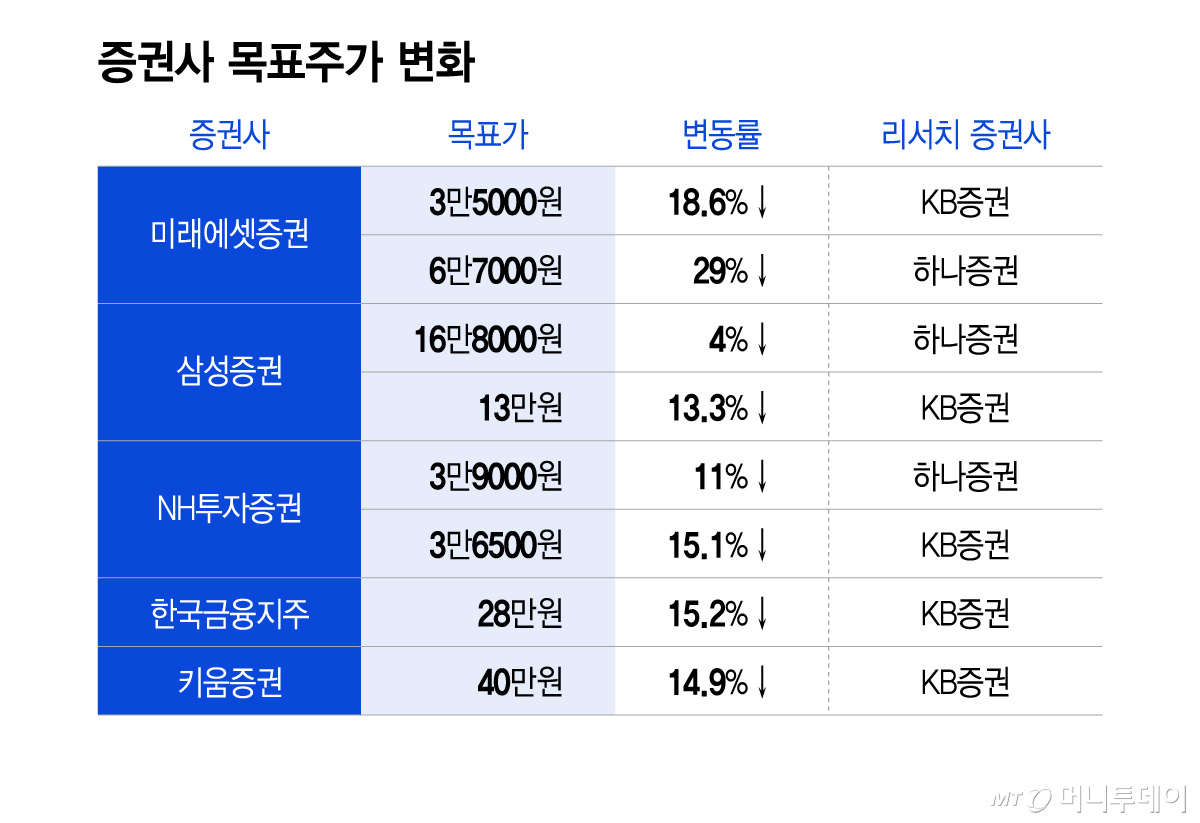
As third-quarter results for securities firms that posted record-breaking performance in the first half are projected to fall short of expectations, the securities industry has been lowering target prices across the board. This is due to the full-scale decline in trading volume that began in the third quarter. In particular, Mirae Asset Securities, which rose to the position of "leading securities firm" with the highest net profit in the first half this year, is expected to turn to a loss with a net loss in the 400 billion won range for the third quarter.
According to financial investment industry sources on the 10th, the securities industry has lowered target prices for securities firms by 4-29% from previous levels since the start of this month. The target price for Mirae Asset Securities was cut by 18-29%, Samsung Securities by 4-13%, NH Investment & Securities by 11-15%, while Korea Investment & Holdings (Korea Investment & Securities) and Kiwoom Securities were each lowered by approximately 15%.
This is because the decline in stock market trading volume since the second half is expected to hit brokerage profits, a major revenue source for securities firms. According to Meritz Securities, the average daily domestic trading volume in the third quarter was 52 trillion won, a sharp 41% decrease from the previous quarter. The outstanding balance of credit lending decreased by 10% from the previous quarter to 34 trillion won. Overseas trading volume also fell by 30% to $124.9 billion.
Accordingly, third-quarter results for major securities firms are projected to be weaker than in the first half. Meritz Securities predicted that the combined net profit of five firms—Korea Investment & Holdings, Mirae Asset Securities, Samsung Securities, NH Investment & Securities, and Kiwoom Securities—would be 1.27 trillion won in the third quarter, a 72% decrease from the previous quarter. This level is 35% below market expectations.
KB Securities also forecast that the combined net profit of the five securities firms would be 1.1 trillion won, a 45% decrease year-on-year. This is 46% lower than market expectations.
In particular, Mirae Asset Securities is expected to post a net loss in the third quarter. Hana Securities estimated that Mirae Asset Securities' consolidated net loss attributable to owners of the parent would be 408.8 billion won in the third quarter, marking a swing to a deficit. This level significantly falls below the market consensus estimate (average of securities firm estimates) of 98.6 billion won in net profit. KB Securities also projected a net loss of 383.7 billion won.
A major cause is valuation losses on SpaceX. The stock price of SpaceX fell from $170 at the end-of-second-quarter valuation to around $150 by the end of the third quarter. Factoring in the decline in the won/dollar exchange rate (1,549 won → 1,353 won), related valuation losses are estimated to reach 1 trillion won.
Go Yeon-su, a researcher at Hana Securities, stated, "The investment amount in SpaceX as of the end of the second quarter was approximately 5 trillion won, of which about 4.6 trillion won is classified as FVPL (Fair Value through Profit or Loss), making the expanded earnings volatility due to changes in SpaceX's stock price and exchange rate a burden." He added, "However, as of the 5th, SpaceX's stock price has recovered to around $170, and if the stock price is maintained at or above this level, there is a possibility that related valuation gains will be reflected again in the fourth quarter."
Korea Investment & Holdings is also expected to miss expectations for its third-quarter results. KB Securities projected that Korea Investment & Holdings' consolidated net profit attributable to owners of the parent would be 401.4 billion won in the third quarter, falling 35% below the consensus estimate. This represents a 59% decrease from the previous quarter and a 40% decrease year-on-year. Kang Seung-geon and Lee Gwang-jun, researchers at KB Securities, explained, "The base effect of large valuation gains on equity-related investment assets, which drove strong results in the third quarter, and the reflection of some valuation losses due to the stock market decline are burden factors."
However, analysis also suggests that there is still room for profit growth and high dividend appeal. Jo Ah-hae, a researcher at Meritz Securities, said, "Given that the absolute level of customer deposits remains high, securing stable revenue sources in the WM (Wealth Management) sector is possible, and there is additional room for profit growth based on issued notes and Integrated Investment Accounts (IMA), among others." He added, "Since strong results have already been generated in the first half, the appeal of high dividends remains valid." The average dividend yield for the five securities firms this year is estimated at 6%.

 in STOCK
