

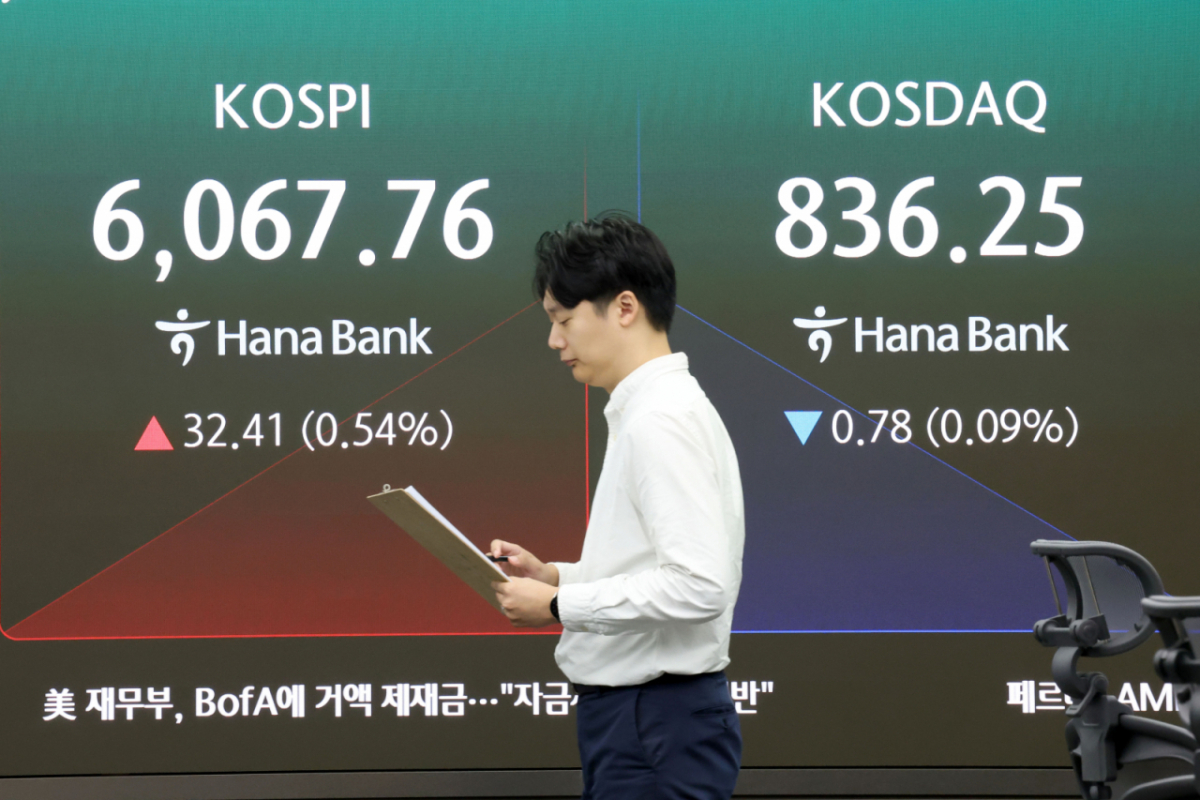
The KOSPI, which had plunged by more than 5%, rebounded by over 150 points in early trading on the 14th but gave back about half of its gains. The rebound lacks momentum as external uncertainties and foreign selling pressure persist. Securities firms expect it will be difficult to find clear upward drivers for the time being.
According to the Korea Exchange, as of 11:30 a.m. on the 14th, the KOSPI was trading at 6,123.30, up 87.95 points (1.46%) from the previous trading day. The index rose to 6,190.65 in early trading, rebounding by more than 2%, but the gains have narrowed as time has passed.
On the KOSPI market on the 14th (based on Korea Exchange and NextTrade data), retail investors and foreign investors both made net sales. Foreign investors sold a net 333.8 billion won, while retail investors sold a net 253.1 billion won. After selling over 5 trillion won the previous day, foreign investors started the session with net buying but quickly switched to net selling. In contrast, institutional investors recorded net purchases of 284.3 billion won, supporting the index's rise. Among institutional investors, other corporations are making net purchases of 298.6 billion won. Samsung Electronics' share buyback has been fully completed, while SK Hynix's is currently in progress.
Experts in the financial investment industry diagnose the KOSPI's rise on the 14th as a technical rebound reversing the previous day's sharp drop. However, they analyze that the weak strength of the rebound and the pattern of gains widening and then narrowing indicate that the causes of the plunge have not been fully resolved.
The previous day, the KOSPI plunged by more than 5%, triggering a sidecar (futures market circuit breaker) on the stock market. Factors acting as negative news included: △ concerns over technological catch-up due to the launch of new products within the year by Chinese memory maker CXMT; △ uncertainty over artificial intelligence (AI) policy following the U.S. midterm elections; and △ the possibility of further domestic interest rate hikes.
Lee Sang-jun, a researcher at NH Investment & Securities, said, "The rise on the 14th is less about negative factors being resolved in the short term and more about the nature of rebound buying following the previous day's sharp drop." He added, "Financial markets have become sensitive due to the Middle East war and high oil prices, and foreign selling pressure continues, so supply and demand conditions are also weak."
Opinions also suggest that the narrowing of gains during the rebound is a result of investors' lack of confidence in market stability. Heo Jae-hwan, an executive at Eugene Investment & Securities, explained, "Because the market is unstable, some investors are trying to reduce their stock allocation by taking advantage of the rebound." He added, "The shock from concerns over memory semiconductors was surprisingly not large in the Japanese and Taiwanese stock markets."
It is also expected to be difficult for the market to shift to a trend-based upward trajectory in the short term. Executive Heo said, "Large semiconductor stocks have been damaged in both investor sentiment and supply and demand after attempting to rebound since July-August only to plunge again." He predicted, "If events that boost confidence in the semiconductor industry cycle do not emerge, such as Anthropic's additional data center investment plans through its initial public offering (IPO), a wait-and-see attitude or lull is highly likely to continue for the time being."
However, considering stock price trends after past sharp drops, assessments also point out that medium-term rebound possibilities remain. According to Kiwoom Securities, excluding this instance (the 6th to the 13th), there have been only two cases in the last 20 years where a five-consecutive-trading-day decline and a cumulative rate of change of -13% were recorded simultaneously. Also, after the top 10 instances of five-consecutive-trading-day sharp drops in the past, average returns improved over time: -0.8% after five trading days, 3.2% after 20 trading days, and 8.2% after 60 trading days.
Han Ji-young, a researcher at Kiwoom Securities, advised maintaining existing stock allocations or expanding them through split purchases, emphasizing the possibility of medium-term index recovery. She explained, "Consecutive sharp drops of more than 10% have historically been followed by relatively strong medium-term rebounds." She added, "To ensure the continuity of the rebound, it is necessary to restore confidence in medium- and long-term earnings. While this year's operating profit consensus estimate for the KOSPI after October is being revised downward, consensus estimates for 2027-2028 are actually being revised upward."

 in STOCK
