

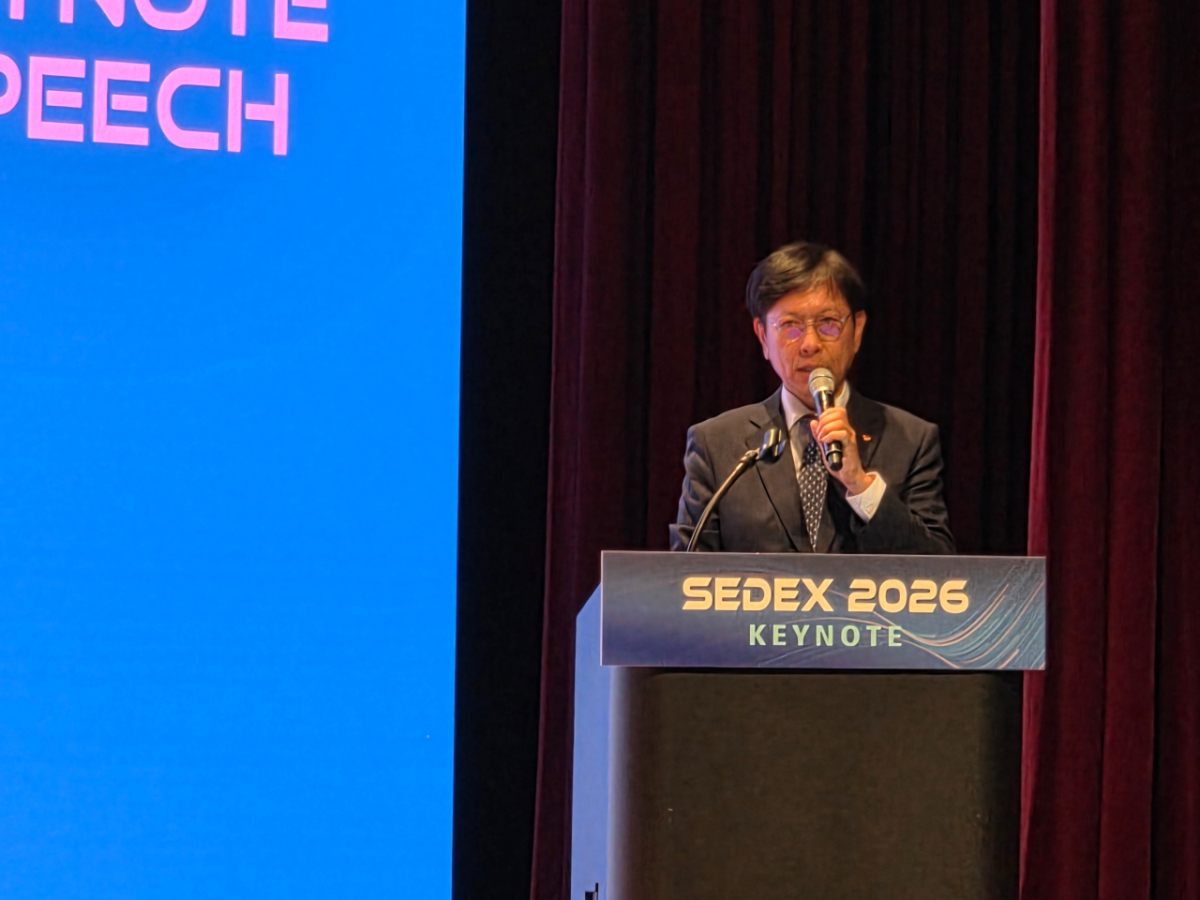
Ahn Hyun, president in charge of development at SK hynix, said, "We no longer view memory merely as a component itself." As AI (artificial intelligence) inference expands and limitations emerge in the performance and capacity of existing memory, the company is pursuing a strategy to build new memory layers beyond High Bandwidth Memory (HBM), such as 3D-stacked DRAM and High Bandwidth Flash (HBF).
Ahn made these remarks during his keynote speech at the 28th Semiconductor Daejeon (SEDEX 2026) held on Wednesday at COEX in Gangnam-gu, Seoul. He said, "The development, standardization, and securing of production capacity for memory must be prepared in advance before demand is formed."
He diagnosed that with the rapid spread of AI technology and a surge in data throughput, existing memory structures alone are difficult to meet demand.
Accordingly, Ahn revealed that the approach to memory development must change to match the growth rate of the AI industry. He explained that as tasks performed by AI agents become more complex and the amount of data to be processed increases, memory demand is rising rapidly.
In particular, he pointed out that data movement between memory layers is a major factor limiting the performance of AI systems. Ahn said, "Since existing memory has a structure where increasing processing speed reduces capacity and increasing capacity lowers speed, data movement ultimately becomes the biggest bottleneck," adding, "A new memory technology is needed between existing HBM, DRAM, and SSDs."
Ahn presented "3D-stacked DRAM" as the next-generation memory technology. Unlike existing HBM, which is placed beside the processor, this method stacks DRAM directly on top of the processor to reduce data movement distance. It can increase bandwidth by approximately 10 times compared to HBM and reduce power consumption to half the level.
He also introduced High Bandwidth Flash (HBF) as another technology. HBF is a technology that increases storage capacity by stacking NAND flash (hereinafter referred to as NAND) vertically, similar to how DRAM is stacked. While its bandwidth is about half that of HBM, it can secure more than 10 times the storage capacity.
Regarding concerns about NAND's low write performance and durability, Ahn said, "Since this workload is read-centric, it is fully viable." SK hynix released a draft specification with related companies in July this year and is pushing to finalize the specification by January next year.
He also forecast that existing HBM will evolve centered on customer-tailored products. Ahn said, "HBM is evolving into standard and custom versions," adding, "In the long term, the (customer-tailored) custom trend will expand further." SK hynix is preparing custom HBM that adds various functions to the base die according to customer requirements.
Along with this, the company is also developing CXL (Compute Express Link)-based pooled memory, which allows multiple servers to share memory resources, and next-generation SSDs (Solid State Drives) that improve input/output processing performance by 4 to 8 times compared to existing levels. These are technologies aimed at improving memory utilization efficiency in data centers and reducing the performance gap between storage devices.
Furthermore, he emphasized the need for cooperation among domestic semiconductor companies. He said, "In the technological and industrial changes triggered by AI, we hope that many domestic companies and SK Hynix will develop and collaborate on the required technologies in their respective positions to create a completely new AI ecosystem in South Korea."

 in INDUSTRY
