

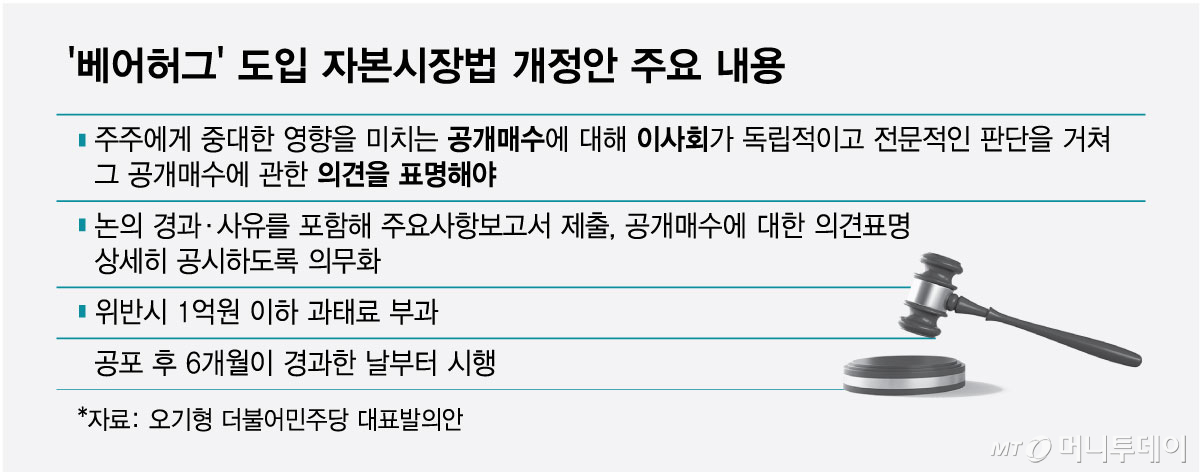
If the Bear Hug system is introduced as a measure to boost share prices, listed companies will no longer be able to conceal the fact that they have received an acquisition proposal, its terms, or the board of directors' opinion. For minority shareholders, an acquisition proposal becomes positive news for the stock price and provides the information necessary to make a selling decision. However, if the proposal falls through, the stock price could experience wild swings, so it is essential to carefully scrutinize the board's decision and the tender offer conditions.
According to the financial investment industry on the 14th, the core of the Korean-style Bear Hug is that when a listed company receives an acquisition proposal such as a tender offer, the board of directors must not hide it but must disclose it publicly. The company must also inform the public of the proposal's terms, its review plan, expression of opinion, and, in the case of rejection, the reasons for doing so. Failure to express an opinion may result in a fine of up to 100 million won. If the content is inadequate or the proposal is rejected without reason, it could escalate into litigation for breach of directors' duty of loyalty to shareholders.
A Bear Hug is a merger and acquisition (M&A) strategy that presents attractive terms difficult to refuse, much like a bear tightly hugging its prey with its front paws so it cannot move. If an acquirer proposes a tender offer to buy shares at a price significantly higher than the current stock price, it can not only pressure management and the board of directors but also leverage pressure from shareholders and the market.
The reason the Bear Hug is mentioned as a share price boosting measure is that the risk of undervalued companies becoming targets for M&A increases. Typically, stocks with a price-to-book ratio (PBR) below 1 are classified as undervalued shares. This means that the value assessed in the stock market is lower than the company's asset value. Companies with substantial assets and stagnant growth are often in a state of perennially low PBR. To avoid hostile M&A, such companies must prove on their own that their value exceeds the price offered by the acquirer. This is why they need to take action on shareholder return policies, management changes, and fundamental improvements.
As such, if the Bear Hug is introduced, a tender offer proposal itself could act as positive news for the stock price. This is because the market expects companies to voluntarily embark on improving corporate valuation to prevent their control from being seized. Starting next month, lists of low-PBR companies will also be published. Combined with the introduction of the Bear Hug, it appears that companies' efforts to boost share prices will gain further momentum.
Kim Su-hyun, a researcher at DS Investment & Securities, said, "Low-PBR companies neglected for various reasons can find that an acquisition proposal itself serves as a catalyst for re-rating, regardless of whether the acquisition is completed."
Minority shareholders may also have the opportunity to sell their shares at attractive prices. Under current law, listed companies are not obligated to disclose M&A proposals, so in most cases they make opaque disclosures such as "nothing has been specifically confirmed." Minority shareholders find it difficult to know the specific terms or even the fact that a proposal was made. However, if the Bear Hug is introduced, minority shareholders will be able to determine whether to sell their shares based on relevant information.
However, there is clearly a possibility of wild stock price swings due to failed acquisition proposals or probing offers from acquirers lacking funding capacity. Additionally, the mandatory tender offer ratio is currently under discussion as "50% + 1 share," meaning that if this remains unchanged, minority shareholders will not be able to sell all their shares at a premium price. This is why it is necessary to carefully consider the effectiveness of acquisition proposals, the pro-rata allocation ratio for tender offers, and the risk of M&A failure.

 in STOCK
