

The Financial Supervisory Service is stepping in to curb the practice of securities firms charging up to 10 times higher trading fees for online transactions even when accounts are opened at branch offices. Going forward, investors will be informed about fee differences and can choose whether to designate a managed account when opening an account at a branch office.
The Financial Supervisory Service announced on the 14th that it will improve the practice of some securities firms charging higher trading fees for accounts opened at branch offices compared to online channels.
Securities firms receive trading fees as compensation for intermediating investors' trades in stocks, ETFs (Exchange-Traded Funds), and other instruments. According to a survey by the Financial Supervisory Service, 10 domestic securities firms have been applying differential trading fees based on how accounts are opened. When investors visited branch offices to open accounts, they were charged higher trading fees than if they had created them online.
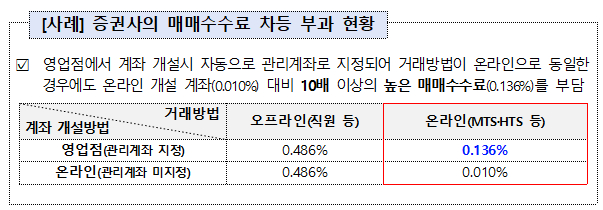
This is because accounts opened at branch offices are automatically designated as "managed accounts," meaning service costs for consultations and asset management are included in the fees. The problem is that even when investors trade online via mobile trading systems (MTS) or other channels without consulting with branch staff, the trading fees remain unchanged.
In fact, one securities firm charged a 0.136% trading fee for accounts opened at branch offices and traded via MTS or other online platforms. This is 13.6 times the 0.01% trading fee applied when both account opening and trading are done online. Trading fees vary depending on where the account was created, even though the trading method is identical.
However, it has been pointed out that securities firms' guidance has been insufficient. Proper information regarding the fact of differential trading fees and the services available based on managed account designation was not provided. Furthermore, investors' right to know and right to choose were restricted, as accounts opened at branch offices were automatically designated as managed accounts, leaving no option to select non-managed accounts.
In response, the Financial Supervisory Service has required securities firms to establish procedures for comparing and informing investors about trading fee differences and available services during the account opening stage. Differences in trading fees will be explicitly stated in terms of service or transaction explanations provided at the time of account opening, allowing investors to verify them.
Improvements will also be made so that investors can choose whether to designate a managed account when opening an account at a branch office. For existing investors, securities firms will enable confirmation of managed account status via text messages, MTS, etc., and guide them on how to open new non-managed accounts if necessary.
The Financial Supervisory Service plans to complete institutional improvements by the first quarter of next year. A Financial Supervisory Service official stated, "We will proceed with follow-up measures, such as revising related terms of service and monitoring securities firms' compliance status, without any issues," adding, "We expect that through these improvement measures, investors' choice of account type will be expanded and unnecessary trading fee burdens will be reduced."
The official further stated, "We will continue to make efforts to establish fair and reasonable business practices among securities firms going forward."

 in STOCK
